viernes, 13 de marzo de 2009

MachinedFD - Réplicas de todo tipo

Enlace:

http://www.machinedfx.blogspot.com/

¡Este chico sí que sabe lo que se hace!

Starkiller Redemption Lightsaber

Lightsaber Used for the Jedi Ceremonial Robe Costume in Unleashed.
Photobucket

Starkiller Unleashed Lightsaber Replica Deluxe Final Production Model.

Capable of Housing soundboards uses a 1" Blade Socket.
All Handcrafted using aircraft grade aluminum and brass.
The only plastic piece in the whole hilt is the acrylic crystal.
Weights almost a pound and is 12.25" long.
NO CNC MACHINES ARE USED,THIS IS ALL DONE ON HAND TURNED MACHINES, NO DROID ASSISTANCE IS USED!

Photobucket
Photobucket
Photobucket

Photobucket

He Takes His Job Very Seriously!

In game screen shot of Starkiller Lightsaber From Unleashed

Photobucket
Photobucket Image Hosting

Deluxe Weathered DL-44 Han Solo Blaster

Photobucket
Photobucket
All Metal Replica.

Working Star Trek Ressikan Flute Replica

As Seen On Star Trek The Next Generation Episode "Inner Light"
Presentation box coming soon!
Photobucket

Hellraiser - Wikipedia

Fuente:

http://es.wikipedia.org/wiki/Hellraiser

Información:

Hellraiser

De Wikipedia, la enciclopedia libre

Hellraiser
Título Hellraiser

Ficha técnica
Dirección Clive Barker

Producción Christopher Figg

Guión Clive Barker

Música Christopher Young

Fotografía -

Reparto Andrew Robinson
Clare Higgins
Ashley Laurence

Datos y cifras
País(es) Reino Unido
Año 1987
Género Terror
Duración 94 minutos

Hellraiser es una película británica de terror lanzada al mercado en el año 1987, explora temas tales como el sadomasoquismo, la relación entre el dolor y el placer, y la moralidad de personajes sometidos al temor y a la tentación. Basada en la aclamada novela escrita por Clive Barker llamada The Hellbound Heart quien escribió y dirigió esta película. Es también la primera película de una saga que llega hasta el año 2006. Originalmente fue llamada Sadomasochists From Beyond the Grave (cfr. artículo sobre la película en International Movie Database).

Contenido

[ocultar]

Argumento [editar]

"Hellraiser", basada en el cuento corto "The Hellbound Heart" de Clive Barker, empieza con una escena donde un hombre llamado Frank adquiere una extraña caja negra, adornada por filigranas doradas. Luego, en un cuarto vacío, el hombre manipula la caja, que resulta ser un acertijo que, una vez resuelto, permite la entrada de extrañas criaturas a nuestro mundo quienes le ofrecen todos los placeres y todo el dolor de ambos mundos. Finalmente Frank muere despedazado por cadenas, anzuelos y garfios que se clavan en su piel y terminan por desmembrarlo en un espasmo sublime.

Un tiempo después, la familia Cotton se muda a la casa donde tuvo lugar aquel evento. La casa pertenece a Larry (Andrew Robinson), y el hombre que en ella desapareció resulta ser su hermano Frank. Junto con Larry llega su esposa Julia (Clare Higgins) y su hija Kirsty (Ashley Laurence).

Lo que Larry no sabe, es que su esposa Julia tuvo un breve pero intenso romance con Frank, por lo que ella se ha vuelto distante y fría con su legítimo esposo. Durante la mudanza, Larry sufre una herida en la mano, y parte de su sangre cae al piso del cuarto, ahora vacío, donde Frank realizó su extraño ritual. La sangre se filtra bajo las tablas del suelo e inicia la resurrección de Frank. Pero solo es un esqueleto humano con un esbozo de músculos y órganos; la sangre de Larry no fue suficiente para restituir a Frank a una forma totalmente humana, y para lograrlo necesitará más sangre.

Afortunadamente para él, Julia descubre al monstruo, y a pesar de su horror inicial, accede a llevar víctimas para que Frank complete su resurrección. Mientras tanto, Kirsty sospecha que algo raro ocurre en la casa, y cuando descubre la caja negra, sin darse cuenta atrae a las criaturas que se llevaron a su tío.

Para evitar sufrir el mismo destino que Frank, Kirsty debe hacer un trato con ellos y entregar a su propio tío a estas criaturas.

Elenco [editar]

Actor/Actriz Personaje
Andrew Robinson Larry Cotton
Clare Higgins Julia Cotton
Ashley Laurence Kirsty Cotton
Sean Chapman Frank Cotton
Oliver Smith Frank (sin piel)
Robert Hines Steve Doug
Doug Bradley Cenobita líder (Pinhead)
Nicholas Vince Chatterer
Simon Bamford Butterball
Grace Kirby Cenobita mujer

Véase también [editar]

Enlaces externos [editar]

Event Horizon (Ciencia) - Wikipedia

Fuente:

http://en.wikipedia.org/wiki/Event_horizon

Información:

Event horizon

From Wikipedia, the free encyclopedia

Jump to: navigation, search
General relativity
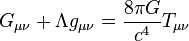
G_{\mu \nu} + \Lambda g_{\mu \nu}= {8\pi G\over c^4} T_{\mu \nu}\,
Einstein field equations
Introduction to...
Mathematical formulation of...
Resources
[hide]Phenomena
Kepler problem · Lenses · Waves
Frame-dragging · Geodetic effect
Event horizon · Singularity
Black hole

In general relativity, an event horizon is a boundary in spacetime, most often an area surrounding a black hole, beyond which events cannot affect an outside observer. Light emitted from beyond the horizon can never reach the observer, and anything that passes through the horizon from the observer's side appears to freeze in place, with its image becoming more redshifted as time proceeds.

More specific types of horizon include the related but distinct absolute and apparent horizons found around a black hole. Still other distinct notions include the Cauchy and Killing horizon; the photon spheres and ergospheres of the Reissner-Nordström solution; particle and cosmological horizons relevant to cosmology; and isolated and dynamical horizons important in current black hole research.

Contents

[hide]

[edit] Event horizon of a black hole

The most commonly known example of an event horizon is defined around general relativity's description of a black hole, a celestial object so dense that no matter or radiation can escape its gravitational field. This is sometimes described as the boundary within which the black hole's escape velocity is greater than the speed of light. An alternate description is that within this horizon, all lightlike paths (paths that light could take), and hence all paths in the forward light cones of particles within the horizon, are warped so as to fall further into the hole. Once a particle is inside the horizon, moving into the hole is as inevitable as moving forward in time (and can actually be thought of as equivalent to doing so, depending on the spacetime coordinate system used).

The surface at the Schwarzschild radius acts as an event horizon in a non-rotating body that fits inside this radius. (A rotating black hole operates slightly differently.) The Schwarzschild radius of an object is proportional to the mass. For the mass of the Sun it is approximately 3 km, and for that of the Earth about 9 mm. For a black hole created by the collapse of a star (which has a mass above the Chandrasekhar limit) the lower limit is about 4 km.

Black hole event horizons are especially noteworthy for three reasons. First, there are many examples near enough to study. Second, black holes tend to pull in matter from their environment, which provides examples where matter about to pass through an event horizon is expected to be observable. Third, the description of black holes given by general relativity is known to be an approximation, and it is expected that quantum gravity effects become significant near the vicinity of the event horizon. This allows observations of matter in the vicinity of a black hole's event horizon to be used to indirectly study general relativity and proposed extensions to it.

The definition of "event horizon" given by Hawking & Ellis,[1] Misner, Thorne & Wheeler,[2] and Wald[3] differs from the one presented here. Their definition rules out the cosmological and particle horizons presented below (as well as the apparent horizon). However, modern usage has brought those ideas under the umbrella of the term "event horizon". (See, e.g.,[4].) To make the distinction clearer, some authors refer to their more specific notion of a horizon as an "absolute horizon". In the context of black holes, event horizon almost always refers to the absolute horizon, as distinct from the apparent horizon.

[edit] Event horizon of the observable universe

The particle horizon of the observable universe is the boundary that represents the maximum distance at which events can currently be observed. For events beyond that distance, light hasn't had time to reach our location, even if it were emitted at the time the universe began. How the particle horizon changes with time depends on the nature of the expansion of the universe. If the expansion has certain characteristics, there are parts of the universe that will never be observable, no matter how long the observer waits for light from those regions to arrive. The boundary past which events can't ever be observed is an event horizon, and it represents the maximum extent of the particle horizon.

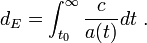
The criterion for determining whether an event horizon for the universe exists is as follows. Define a comoving distance dE by

d_E=\int_{t_0}^\infty \frac{c}{a(t)}dt\ .

In this equation, a is the scale factor, c is the speed of light, and t0 is the age of the universe. If d_E \rightarrow \infty, (i.e. points arbitrarily as far away as can be observed), then no event horizon exists. If d_E \neq \infty, a horizon is present.

Examples of cosmological models without an event horizon are universes dominated by matter or by radiation. An example of a cosmological model with an event horizon is a universe dominated by the cosmological constant (a de Sitter universe).

[edit] Event horizon of an accelerated particle

Spacetime diagram showing a uniformly accelerated particle, P, and an event E that is outside the particle's event horizon. The event's forward light cone never intersects the particle's world line.

If a particle is moving at a constant velocity in a non-expanding universe free of gravitational fields, any event that occurs in that universe will eventually be observable by the particle, because the forward light cones from these events intersect the particle's world line. On the other hand, if the particle is accelerating, in some situations light cones from some events never intersect the particle's world line. Under these conditions, an event horizon is present in the particle's (accelerating) reference frame, representing a boundary beyond which events are unobservable.

For example, this occurs with a uniformly accelerated particle. A spacetime diagram of this situation is shown in the figure to the right. As the particle accelerates, it approaches, but never reaches, the speed of light with respect to its original reference frame. On the spacetime diagram, its path is a hyperbola, which asymptotically approaches a 45 degree line (the path of a light ray). An event whose light cone's edge is this asymptote or is farther away than this asymptote can never be observed by the accelerating particle. In the particle's reference frame, there appears to be a boundary behind it from which no signals can escape (an event horizon).

While approximations of this type of situation can occur in the real world[citation needed] (in particle accelerators, for example), a true event horizon is never present, as the particle must be accelerated indefinitely (requiring arbitrarily large amounts of energy and an arbitrarily large apparatus).

[edit] Interacting with an event horizon

A misconception concerning event horizons, especially black hole event horizons, is that they represent an immutable surface that destroys objects that approach them. In practice, all event horizons appear to be some distance away from any observer, and objects sent towards an event horizon never appear to cross it from the sending observer's point of view (as the horizon-crossing event's light cone never intersects the observer's world line). Attempting to make an object approaching the horizon remain stationary with respect to an observer requires applying a force whose magnitude becomes unbounded (becoming infinite) the closer it gets.

For the case of a horizon perceived by a uniformly accelerating observer in empty space, the horizon seems to remain a fixed distance from the observer no matter how its surroundings move. Varying the observer's acceleration may cause the horizon to appear to move over time, or may prevent an event horizon from existing, depending on the acceleration function chosen. The observer never touches the horizon, and never passes a location where it appeared to be.

For the case of a horizon perceived by an occupant of a De Sitter Universe, the horizon always appears to be a fixed distance away for a non-accelerating observer. It is never contacted, even by an accelerating observer.

For the case of the horizon around a black hole, observers stationary with respect to a distant object will all agree on where the horizon is. While this seems to allow an observer lowered towards the hole on a rope to contact the horizon, in practice this cannot be done. If the observer is lowered very slowly, then, in the observer's frame of reference, the horizon appears to be very far away, and ever more rope needs to be paid out to reach the horizon. If the observer is quickly lowered by another observer, then indeed the first observer, and some of the rope can touch and even cross the (second observer's) event horizon. If the rope is pulled taut to fish the first observer back out, then the forces along the rope increase without bound as they approach the event horizon, and at some point the rope must break. Furthermore, the break must occur not at the event horizon, but at a point where the second observer can observe it.

Attempting to stick a rigid rod through the hole's horizon cannot be done: if the rod is lowered extremely slowly, then it is always too short to touch the event horizon, as the coordinate frames near the tip of the rod are extremely compressed. From the point of view of an observer at the end of the rod, the event horizon remains hopelessly out of reach. If the rod is lowered quickly, then the same problems as with the rope are encountered: the rod must break and the broken-off pieces inevitably fall in.

These peculiarities only occur because of the supposition that the observers be stationary with respect to some other distant observer. Observers who fall into the hole are moving with respect to the distant observer, and so perceive the horizon as being in a different location, seeming to recede in front of them so that they never contact it. Increasing tidal forces (and eventual impact with the hole's gravitational singularity) are the only locally noticeable effects. While this seems to allow an infalling observer to relay information from objects outside their perceived horizon but inside the distant observer's perceived horizon, in practice the horizon recedes by an amount small enough that by the time the infalling observer receives any signal from farther into the hole, they've already crossed what the distant observer perceived to be the horizon, and this reception event (and any retransmission) can't be seen by the distant observer.

[edit] Beyond general relativity

The description of event horizons given by general relativity is thought to be incomplete. When the conditions under which event horizons occur are modelled using a more complete picture of the way the universe works, that includes both relativity and quantum mechanics, event horizons are expected to have properties that are different from those predicted using general relativity alone.

At present, it is expected that the primary impact of quantum effects is for event horizons to possess a temperature and so emit radiation. For black holes, this manifests as Hawking radiation, and the larger question of how the black hole possesses a temperature is part of the topic of black hole thermodynamics. For accelerating particles, this manifests as the Unruh effect, which causes space around the particle to appear to be filled with matter and radiation.

A complete description of event horizons is expected to at minimum require a theory of quantum gravity. One such candidate theory is M-theory.

[edit] See also

[edit] References

[edit] More technical references

  1. ^ S. W. Hawking and G. F. R. Ellis (1975). The large scale structure of space-time. Cambridge University Press.
  2. ^ Thorne, Kip S.; Misner, Charles; Wheeler, John (1973). Gravitation. W. H. Freeman and Company.
  3. ^ Wald, Robert M. (1984). General Relativity. Chicago: University of Chicago Press.
  4. ^ J. A. Peacock (1999). Cosmological Physics. Cambridge University Press.

Event Horizon (film) - Wikipedia

Fuente:

http://en.wikipedia.org/wiki/Event_Horizon_(film)

Información:

Event Horizon (film)

From Wikipedia, the free encyclopedia

Jump to: navigation, search
Event Horizon

Theatrical release poster
Directed by Paul W. S. Anderson
Produced by Jeremy Bolt
Lawrence Gordon
Lloyd Levin
Written by Philip Eisner
Uncredited:
Andrew Kevin Walker
Starring Laurence Fishburne
Sam Neill
Kathleen Quinlan
Joely Richardson
Richard T. Jones
Jack Noseworthy
Music by Michael Kamen
Orbital
Cinematography Adrian Biddle
Editing by Martin Hunter
Distributed by Paramount Pictures
Release date(s) August 15, 1997 (USA)
August 22, 1997 (UK)
Running time 97 min. (about 127 min., original film)
Country UK/USA
Language English
Budget US$60-70 million[1][2]
Gross revenue US$26.6million[2]

Event Horizon is a 1997 science fiction horror film. The screenplay was written by Philip Eisner (with an uncredited rewrite by Andrew Kevin Walker) and directed by Paul W. S. Anderson. The film stars Laurence Fishburne as one of the main protagonists and Sam Neill as the main protagonist-turned-antagonist. Although considered a box office failure, the film developed a cult following which resulted in the 2006 release of a two-disc special edition DVD.

Contents

[hide]

[edit] Plot

In the year 2047, a signal from the starship Event Horizon is picked up on Earth. The ship had disappeared without trace beyond Neptune in 2040; her loss was considered the worst space disaster on record. The ship has reappeared in a decaying orbit around the planet Neptune, and the rescue ship Lewis and Clark is dispatched to investigate. The ship's crew is commanded by Capt. Miller (Laurence Fishburne) and carries the Event Horizon's designer, Dr. William Weir (Sam Neill).

When the Lewis and Clark arrives, the crew are informed by Dr. Weir that the Event Horizon had actually been built to test a secret, experimental gravity drive. The drive would create an artificial black hole to bridge two points in space to significantly reduce journey time. The ship had been on its initial test flight, intended to reach Proxima Centauri; it subsequently vanished without a trace. Weir plays to the crew the only signal received since the ship's reappearance, spoken by ship's captain, Cpt. Kilpack, which is a series of confusing screams and shouts, embedded in which is the Latin phrase liberate me ("save me").

Upon approaching the drifting vessel, no definitive trace of human life is found; inconclusive sensor readings lead the Lewis and Clark's crew to enter the Event Horizon to search for survivors. Inside, the crew split up and Medical Tech Peters (Kathleen Quinlan) discovers a frozen human corpse floating on the bridge, with both eyes gouged out. Engineer Justin (Jack Noseworthy) enters the ship's core and sees a black, liquid-like mirror within its drive; it sucks him inside as he touches it and emits a large shock wave, damaging the Lewis and Clark. Rescue Tech Cooper (Richard T. Jones) manages to pull Justin out of the core by his tether, but he is catatonic.

With the Lewis and Clark heavily damaged, the remaining crew transfer to the Event Horizon, which only contains 20 hours of usable oxygen. A short time later, Justin emerges from his catatonia and attempts to commit suicide by ejecting himself from an airlock, to escape the memory of what he saw inside the ship's core. Although Justin is rescued by Miller, he is seriously injured.

Soon afterwards the rescuers begin to experience hallucinations of their personal fears and regrets. Miller sees the manifestation of a subordinate he was forced to abandon in a fire; Peters sees images of her son Denny (Barclay Wright), with his legs covered in bloody lesions, and widower Dr. Weir sees his wife Claire (Holley Chant), missing her eyes and urging him to join her.

The crew discover that although the ship's drive successfully opened a gateway in space-time, it actually led outside the known universe and into another dimension, described as "pure chaos, pure evil". The Event Horizon's reconstructed video log shows the original crew activating the gravity drive and, moments later, engaging in a frenzy of torture, self-mutilation, cannibalism and sodomy. The ship's captain, who has torn out his own eyes, leaves the previously-heard Latin message which has since been found to actually say liberate tutame ex inferis ("save yourself from Hell").

It appears that the Event Horizon has returned with a supernatural presence which is using its occupants' personal torments against them, with the aim of compelling them to return to the "chaos" dimension. The Lewis and Clark now repaired, Miller decides to destroy the Event Horizon despite the strong objections of Weir. While preparing to evacuate, Peters is led to her death by plummeting down a shaft as a result of being tricked by a manifestation of her son. Weir, having abandoned the crew and arriving at the core, discovers her body. He sees a vision of his wife's suicide, and is compelled by her reanimated form to tear out his eyes.

Weir then uses bombs fitted to the Event Horizon to destroy the Lewis and Clark, which kills its pilot Smith (Sean Pertwee) and causes Cooper, on the ship's hull, to be thrown into space. Weir goes on to kill D.J. (Jason Isaacs) by vivisection, leaving him suspended from the ceiling of the medical facility.

Seemingly possessed by the presence on board, Weir threatens Miller and X.O. Starck (Joely Richardson) with a nail gun, saying the ship is "alive" and will not allow anyone to leave. He activates the ship's gravity drive, beginning a ten-minute countdown, after which the Event Horizon will return to the chaos dimension. Cooper, having used his space suit's oxygen to propel him back to the ship, causes Weir to shoot the bridge window and be blown into space towards his apparent death. Miller attempts to detonate the explosives installed on the Event Horizon to split the ship in two; after arming all of the explosives and recovering the detonator for them, he is trapped by a burning manifestation of his former comrade and forced to escape to the ship's core.

Inside the core, Miller again sees the vision of his comrade, which then changes into a scarred Dr. Weir (eyes restored) who shows Miller scenes of the Lewis and Clark's remaining crew being tortured and mutilated. The two fight, but Miller is eventually able to reach the detonator, which he then triggers, sacrificing himself as the ship explodes. Weir screams, denied the surviving crew.

The ship explodes at the neck and splits in two. The gravity drive then activates, pulling the rear of the ship into a wormhole. Starck and Cooper, with a comatose Justin, survive in the remaining forward decks and place themselves into stasis. Starck has a nightmare of a mutilated Dr. Weir rescuing her, and is awakened in a distraught state by a second rescue team as the film ends.

[edit] Production

The first draft of Philip Eisner’s screenplay was written in 1992. The film borrows elements from others in the science fiction and horror genres, such as Stanisław Lem’s Solaris, 2001: A Space Odyssey, Alien, Aliens, The Haunting, Disney's The Black Hole, The Shining, Flatliners, and Hellraiser. For instance, the interior of Lewis and Clark was inspired by the starship Nostromo from Alien. The film is thematically similar to The Haunting and The Shining, complete with the added homage of a tidal wave of blood.

In keeping with the naturalistic science fiction setting of the film, costumes are based upon present day flight suits complete with shoulder patches and modified United States Coast Guard officer rank insignia. The sailing ship in the center of the Lewis and Clark’s mission patch is a United States Coast Guard Cutter in reference to the ship’s search and rescue role.

Crewmembers have modified flags on their uniforms to suggest political change prior to 2047. Characters played by American actors wear a modified flag of the United States with fifty-five stars, while characters played by British actors wear the European flag with an extra circle of stars within the original one.

After releasing the highly successful Mortal Kombat in 1995 Anderson was offered the movie. The release-date had already been set and Anderson agreed to do the film, despite that the deadline meant that the post-production period was severely reduced. On the commentary Anderson cited this as the main-cause for the many troubles faced during production and especially when Anderson was to make decisions on the final cut.

On the commentary Anderson mentioned his wish to direct an R rated picture after the PG-13 rated Mortal Kombat and mentioned he turned down the opportunity to direct X-Men in order to make Event Horizon.

Anderson claims that his initial cut of the film, before the visual effects had been completed, ran to about 130 minutes in length. The film was even more graphic in this incarnation, and both test audiences and the studio were unnerved by the gore. Paramount ordered Anderson to cut the film by 30 minutes and delete some of the violence, a decision that he regrets. Some of the lost scenes were offered as special features on the 2006 DVD but were taken from poor-quality video tape, the only format in which the scenes now exist; the studio had little interest in keeping unused footage and the film has since been lost.[3]

[edit] Cast

[edit] Soundtrack

The score of the film was written and performed by Orbital and Michael Kamen. The end credit theme was the song “Funky Shit” by The Prodigy. The movie has been extensively sampled by many bands, notably on Zao's 1999 album, Liberate Te Ex Inferis. Finnish black metal band Flauros has also used that dialog on their song "Monuments of Weakness." Several samples also appear in the song “The Technogoat” and other songs from The Codex Necro album by Anaal Nathrakh as well as on The Ichneumon Method album by The Axis of Perdition, the song “Fun with Knives” (from the album of the same name) and “The Dark Inside Me” by Velvet Acid Christ and on the song “Age of Suffering” by Norwegian death metal band Bloodthorn from the album Under the Reign of Terror. Popular trance producer John Graham under the alias Space Manoeuvres created the track “Stage One” which took samples from the theatrical trailer of the film. Industrial band Front Line Assembly also made liberal use of such samples on its Implode album, most notably on the track "Synthetic Forms," which samples Laurence Fishburne's character saying "This place is a tomb.", over and over again. Infected Mushroom has also taken samples from the movie and included them in their tracks.

[edit] In media

The Xbox video game Conker: Live and Reloaded features a multiplayer level named "T.M.S. Spamono" which was modeled after the Event Horizon's interior.[citation needed] The ship "Spamano" is a spoof of USS Palomino from Disney's The Black Hole.[citation needed] The level consists of the long hallway from the ship with a Gravity Drive engine on each end, which is the base for each team. The ship appears to be traveling through open space.

The film is also an influence for the 2008 sci-fi horror game Dead Space.[citation needed]

In Halloween Horror Nights 2008, a house loosely inspired by this film was called Interstellar Terror.

Trey Parker and Matt Stone cite this movie as an inspiration for their Satan-worshipping woodland critters who engage in gory acts and orgies in South Park episode 814, "Woodland Critter Christmas".[4]

In the Family Guy episode "Movin' Out (Brian's Song)", Chris Griffin gets a job at the local convenience store, and quickly develops a friendship with his manager wherein they interminably discuss films and film scenes. At one point, the manager is eager to share in his appreciation of how 'awesome' Event Horizon is, but Chris withholds his apparently legitimate shared enthusiasm in order to extract a commitment from him to rehire his sister Meg. When the manager agrees, Chris immediately responds with gushing praise for how "totally awesome" the film is.

[edit] References

  1. ^ Event Horizon - Box Office Data, Movie News, Cast Information. The Numbers. Retrieved on 19 August 2008.
  2. ^ a b Event Horizon - box office/business. Internet Movie Database. Last update on 10 May 1998.
  3. ^ Special Edition DVD Commentary
  4. ^ South Park Season 8 DVD Commentary

[edit] External links

Preceded by
Chasing Amy
Box office number-one films of 1997 (UK)
August 24, 1997 – August 31, 1997
Succeeded by
Austin Powers: International Man of Mystery