martes, 31 de marzo de 2009

PERSONAJES TODOPODEROSOS: ¿Y QUÉ MÁS DÁ?

Muchos Máster y Juegos de Rol se preocupan de los "personajes todopoderosos" o "superpoderosos" y llegan hasta tal punto en su obsesión que trabajan para coartar los "superpoderes" que las reglas pueden proporcionarles. Infelices. No saben que trabajan en contra de sus propios intereses.

Puedo contar una anécdota que me viene a la cabeza de "Vampiro: La Mascarada". Era yo el Máster y jugaba con mi grupo habitual de entonces. Me preguntaron: Antes de poder salir a la misión, ¿podemos conseguir armas? Yo respondí: Sí, claro. Ellos insistieron: ¿Cualquier arma? Yo repuse: Sí, claro. Mientras las podais pagar... Tenían dinero de sobra y un arsenal. Cogieron de todo. Pero uno de los jugadores se volvió hacia mí en un momento dado y, mirándome, dijo para el resto de jugadores: "Si Sergio nos deja coger tantas armas es porque no las vamos a necesitar". Yo no respondí, lo que en nuestro argot casi se podía considerar una afirmación tácita de que, en efecto, no iban a necesitar armas. ¿Eso les detuvo? No. ¿Les hizo coger armas de menor calibre? No. Pero se sintieron felices, se sintieron preparados, y sobre todo se sintieron FELICES.

Déjales si se sienten felices con sus superpersonajes. Si así son felices, sí así se sienten bien, ¿qué más dá? ¿Acaso el rol no es para disfrutar?

Si te preocupa el equilibrio del juego, o no ser ya un reto para tus jugadores, no te preocupes demasiado. Con el tiempo será la falta de sensatez y cerebro del jugador la que propicie su ruina. Si no su arrogancia (según el caso, si bien ambas proposiciones se dan en mayor o menor grado). Normalmente en poco tiempo. ¡Y sé muy bien lo que me digo!

Lo que me recuerda otra interesante anécdota de hace varios años: Un jugador metido a Máster estaba preocupado porque sus superjugadores habían asesinado al jefe de un gremio criminal en Aguas Profundas con mucha facilidad explotando sus conocimientos de las reglas, de los conjuros, y sobre todo su escasa cabeza (o eso proponía él) eligiendo a los rivales. Ahora se habían embarcado a una isla para conquistarla, y no se sentía motivado para plantear un reto a sus jugadores. Yo le propuse lo siguiente sin pensarlo apenas: Haz que les ataquen elfos de mar; mientras algunos combaten arriba en una maniobra de distracción que otros agujereen el barco abajo. ¿Es cruel? Bueno: Yo no impido a los jugadores pensar por qué enemigos tan flojos se enfrentan a ellos, y desde luego no les prohíbo asomarse al mar, o ser prudentes y bajar a la sentina si te atacan precisamente unos anfibios con aspecto de soldados organizados. Pero eso tiene que salir del jugador... ¿Será lo bastante prudente, o irá "de sobrao"? "El orgullo precede a la caída". Que cada cual haga lo que vea, pero en este caso sería la sensatez el superarma, y no dotes bien escogidas y un conocimiento preciso de las reglas.

MORALEJA: La inteligencia es el mejor arma. Sin ella, todo lo demás es inútil. Pero la sensación de felicidad jugando al rol es tan impagable como imprescindible. Los jugadores se blindan porque no saben hacer otra cosa para sentirse "plenos", pero en el fondo todo eso es secundario comparado con vivir una buena aventura que sea un reto; si se sienten "acosados" se olvidarán de todos sus superpoderes como si jamás los hubieran tenido. Será igual que si estuvieran desnudos. (WTF?!? Esto me ha quedado un poco a Sun Tzu. Pero, ¿qué queréis que os diga? Las lecturas se tienen que notar por algún lado, ¿no?).

Hugh Hefner pone a la venta su mansión Playboy

Fuente:

http://www.libertaddigital.com/economia/hugh-hefner-pone-a-la-venta-su-mansion-play-boy-1276355019/

Información:
RESIDENCIA PERSONAL

Hugh Hefner pone a la venta su mansión Playboy

El multimillonario magnate de la industria erótica Hugh Hefner, presidente de Playboy, ha puesto a la venta su residencia, el palacete adyacente a la famosa Mansión Playboy por 28 millones de dólares. La excusa: sus hijos irán pronto a la universidad.

Hugh Hefner, fundador de Plaboy (EFE)

(Libertad Digital) Situada en Hombly Hills (California) la mansión en venta fue construida en 1923 y adquirida por Hefner en 1998. Quienes la conocen la describen como la hermana pequeña o el "mini-yo" de la famosa Mansión Playboy.

Constituye la residencia personal de Hefner y su esposa Kimerbley y está emplazada justo al lado derecho de la Mansión Playboy donde las conejitas de la afamada revista hacen las delicias de los invitados a las fiestas de Hefner.

La mansión en venta, que tiene dos pisos, cuenta con 2.200 metros cuadrados. Tiene un diseño de estilo inglés. Con cinco dormitorios y siete cuartos de baño, esta mansión tiene paredes pintadas a mano, una cocina recién reformada con habitación para mayordomo, dos salas para el personal de la mansión además de biblioteca, varios salones, comedores y sala familiar. También cuenta con una piscina y una pista de tenis.

La mansión, diseñada por Arthur R. Kelly para la hija de Arthur Letts Jr., el propietario original de la mansión Playboy. Según cuenta el diario LA Times, los Hefners venden su hogar porque sus hijos tendrán que ir dentro de poco a la Universidad.

No explican si lo que pretenden es tener más facilidades para afrontar los gastos de los estudios de sus vástagos, o porque temen que las distracciones dentro de casa influyan en su rendimiento. Hug Hefner, de 82 años, es el fundador del emporio Playboy. Kimberley Hefner, fue la chica Playmate del mes de enero de 1988 y Playmate del año en 1989.

Para cualquier persona que esté interesado en adquirir esta mansión tendrá que disponer de 27,9 millones de dólares, según la información ofrecida por LA Times. En cambio, el portal inmobiliario Zillow, valora el terreno por 2,2 millones de dólares.

Claro que el algoritmo que utiliza este portal para calcular el precio de la parcela en cuestión, no tiene en cuenta el caché del antiguo inquilino o de las vecinas que se divierten en la mansión de al lado.

NO HAY SISTEMA DE DADOS Y REGLAS "REALISTA"

Después de leer con enorme interés sobre la polémica de los sistemas de dados y ponderarlo mucho, he concluído que no hay un sistema de dados "realista" porque es un contrasentido en los términos.

¿Qué quiere decir esto? Que la Realidad, la Vida Real, no es justa en momentos de crisis. En momentos de tensión a cualquiera le puede pasar cualquier cosa, mal que nos pese, con el matiz de que la experiencia es un grado para solventar un apuro.

Piénsalo así: ¿Quién estará más tranquilo si un ordenador se cuelga y hay que arreglarlo deprisa y corriendo porque te juegas el trabajo? ¿Un usuario ocasional que leyó un manual una vez o un antiguo técnico de una tienda que ha montado ordenadores durante dos años? ¿A quién es más probable que le salga bien lo que emprenda, teniendo en cuenta la sensatez y la lógica de la veteranía, que te templa a base de palos y malas experiencias?

Teniendo en cuenta que los dados representan la Suerte, el Azar, la Oportunidad, el Caos, enfrentada a la templanza de quien ha visto ese reto u otros parecidos anteriormente -¡y a su suerte!-, la anterior respuesta se divide en dos:

Primero, que la Suerte hace lo que quiere; favorece a quien le viene en gana.
Segundo, que la Suerte suele favorecer a los veteranos por encima de los novatos.

Esto no quiere decir que un sistema de dados no pueda ser "Justo". Ser ecuánime es algo distinto. Justicia es dar a cada uno lo suyo, y otorgar a cada uno las mismas oportunidades. Como en el deporte, más que como en una Sala de Justicia. ¿Por qué? Porque un sistema de dados está para crear "un espectáculo interesante" -y lo demás son patrañas. No basta con que sea "justo"; también debe dar juego y crear una buena diversión que mantenga a los jugadores -¡y al público!- expectantes y vivamente interesados.

En un juego de rol hay que añadir otro factor: Que sea rápido, directo, intuitivo y fácil de aprender; sensato, lógico y de sentido común; además de divertido de emplear y un constante reto para los jugadores. ¿Por qué? Primero porque los jugadores no se leen los libros que usan (lo siento pero es así) y segundo porque un juego, para que lo sigas jugando, te tiene que desafiar tanto como apasionar. Y tercero: Porque si te tiene que gustar no puede ser irracional ni atentar contra el sentido común.

¿Imposible? Bueno, "Impossible is nothing" según NIKE. Además, todo es cuestión de trabajárselo. Pensar, analizar (dividir el tema en pequeños problemas) y luego sintetizar (juntar todas las pequeñas soluciones en un reglamento). Puro "discurso del método" de Descartes; que los humanos somos muy aficionados a ponerle nombres pedantes y rimbombantes a todo, cuando esto es algo de lo más simple. Cualquiera lo puede hacer. Si quiere, claro. Si quiere y se lo trabaja.

Sí, ya sé que hablar y dar lecciones es fácil. Que trabajar es lo difícil. Pero explico los pensamientos que me guían. Nada más. Que no sea porque no digo y explico lo que hago.

HAY MUCHO AMOR EN UN JUEGO DE ROL

Recientemente he recibido una supercompra de juegos de rol en inglés, de eBay UK. Los precios se han vuelto competitivos y eso me ha venido bien para arrasar con las ventas de un amable vendedor.

Coger un libro de rol no es lo mismo que tener un PDF. Es una experiencia distinta. Es un libro distinto. Puedes olerlo, contemplarlo, escucharlo, acariciarlo y hasta te habla. Si eres sensible puedes sentir el alma del juego, y ver el amor, cariño, mimo y entusiasmo que se ha volcado en él como si fuera un hijo. Es más que un objeto inanimado; es un hijo que lanzas al mundo para que haga su vida y cumpla el propósito que le es propio. Su Destino. Puedes hablar con el libro a niveles empáticos, y él te corresponderá, con la diligencia que se espera del mejor amigo.

Siempre he pensado que un libro es el mejor amigo. Un rey español del medievo dijo que los libros eran sus mejores consejeros, pues no dejaban que el miedo les impidiera expresar lo que pensaban (o algo así).

En todo caso un libro siempre está ahí, siempre te espera, es paciente, es franco, claro, directo, puede repetir lo que no hayas entendido, no te reprocha que lo dejes arrumbado durante meses o años -ni tú a ti mismo-, y estar con él siempre es tan agradable como la primera vez -o mejor. Entre otras cosas. Por eso puedes confiar en él.

Los libros de rol no son una excepción. Salvo en una cosa: Tienen cosas diferentes que contar. Estimulan la imaginación. Dan consejos. Resuelven dudas. Son maestros y consejeros de rol. Ésa es su función y ése es su Destino. Todo lo demás son singularidades.

CODA:

"Los libros son, entre mis consejeros, los que más me agradan, porque ni el temor ni la esperanza les impiden decirme lo que debo hacer."

Alfonso V el Magnánimo (1394-1458) Rey de Aragón.

Fuente: Proverbia.net (Libros)

TRUCOS CREATIVOS: MEJORANDO LAS COSAS

A veces miro los juegos de rol que poseo, o rebusco en los recuerdos de mi experiencia, y digo "tal sistema de juego me vendría de perlas", "tal aspecto", "tal regla"...

Pero copiar está mal. Es más: Es inapropiado. Si uno va a hacer un juego de rol, ¡qué menos que ser original!

Sí, hay cosas que no se pueden tocar: Elfos, enanos, humanos, espadas, madera, gato, farola... Pero su planteamiento y encaje debería ser como mínimo sugestivo, interesante, desde el propio punto de vista, y eso ya es creación.

Pero no se crea de la nada. La imaginación altera lo que conoce. Así te lo explican en los libros del Taller de Escritura que poseo, y así lo señala mi experiencia.

La gente dice que soy imaginativo. ¿Lo soy? Lo único que hago es reenfocar las cosas y mezclar cosas como antes no se habían hecho... Y eso es exactamente lo que sigo haciendo.

Cuando encuentro una faceta que me gusta de otro juego -o película, serie, la vida misma...- digo "¿cómo podría hacerla mejor?" A veces no se puede; pero nunca se sabe hasta que no se intenta. Siempre vemos algo que no nos gusta, y que encantados cambiaríamos; bien, esta es mi oportunidad.

Si muchas veces no se consigue es por un error de aproximación. Porque la palabra "mejor" es ambigua. Sustituyámosla por "rápido", "directo", "interesante", "distinto", u otra, y la pregunta se responde sola. Muchas veces mejorar es cuestión de cambiar y probar el resultado, así, volando a ciegas. Ensayo y error.

En otras ocasiones el cambio para mejor resulta de adaptar las reglas y conceptos tomados de otros juegos a la realidad propia del juego que estoy creando. Si es apropiado entonces está bien. Si no, no.

Me sucede con frecuencia que un día no encuentro la respuesta o el trabajo resultante no me gusta. Pero al día siguiente lo miro, más tranquilo, y digo... vaya, no está tan mal. O digo: ¿Qué pasaría si metiera esto y quitara lo otro, y metiera esta palabra y esta otra allá...? Y el proceso se vuelve fluido y constructivo. La paciencia es fundamental.

Al final, todo es ponerse. Todo es trabajo. Jugar con las cosas, es decir. Jugar con los conceptos, con las ideas, con los principios....

¿Qué pasaría sí...? Es la eterna pregunta. Encontrar la respuesta puede ser tan sencillo como plantear la pregunta, o como seguir dando vueltas a la peonza, confiando en que se detendrá sola
cuando deba hacerlo.

Y la práctica es un grado. Cuanto más se intenta, mejor se hace. Os lo aseguro.

¿Qué sabe usted de Íngrid Betancourt?

Fuente:

http://exteriores.libertaddigital.com/que-sabe-usted-de-ingrid-betancourt-1276236428.html

Información:

COLOMBIA

¿Qué sabe usted de Íngrid Betancourt?

Por Inger Enkvist

Íngrid Betancourt.
La ex diputada colombiana Íngrid Betancourt, rehén de las FARC durante seis años y medio, es una estrella mediática en gran parte del mundo, especialmente en Francia. Pero ¿quién es, realmente, esta mujer?
Los periodistas extranjeros que la entrevistan suelen quedar cautivados por su carisma, su inteligencia y su preparación cultural: aparte del español, habla con soltura el francés y el inglés. Los lectores de su libro La rabia en el corazón (2002) la ven como una santa de nuestros días. Sin embargo, los responsables de las comisiones francesas de apoyo a su liberación han pasado del entusiasmo al desconcierto: no entienden su gusto por el lujo y el alto concepto que tiene de sí misma. Por otra parte, otros rehenes liberados han marcado distancias con ella.

¿Por qué hay tantas opiniones opuestas sobre su persona?

El padre de Íngrid, Gabriel Betancourt, fue dos veces ministro, así como representante diplomático de Colombia en Nueva York y en París. Se casó con una reina de belleza mucho más joven que él, Yolanda Pulecio, con la que tuvo dos hijas: Astrid y, en 1961, Íngrid. Ésta ha descrito a sus padres como conservadores y católicos.

La familia vivió entre Bogotá y París, siempre en los mejores barrios. Cuando los Betancourt se separaron, la madre se mudó definitivamente, con sus dos hijas, a la capital francesa, donde se movió en círculos cosmopolitas.

Íngrid estaba estudiando en la famosa Sciences-Po –donde tenía como profesor al futuro primer ministro francés Dominique de Villepin– cuando conoció a su primer esposo, el diplomático galo Fabrice Delloy. Tuvieron dos hijos, y se separaron cuando nació el más pequeño. Íngrid volvió entonces a Colombia, a probar fortuna en el mundo de la política.

Juan Carlos Lecompte.Por los contactos de su familia, pudo entrar a trabajar en un ministerio. Al poco tiempo decidió presentarse a las elecciones. Su segundo marido, Juan Carlos Lecompte, dejó su profesión de arquitecto para convertirse en un exitoso ayudante de relaciones públicas. En las elecciones de 1994, Íngrid se puso en las bocacalles de Bogotá a repartir preservativos para que los votantes no se dejaran "contaminar" por la corrupción. Así se dio a conocer, y consiguió ser elegida diputada (en representación del Partido Liberal). En las elecciones al Senado de 1998 distribuyó máscaras antipolución, alegando que el aire era ya irrespirable a causa de la corrupción. Su humor fue de nuevo apreciado por los votantes.

En 2002 trató de hacerse con la Presidencia del país. Para ello, fundó un nuevo partido. Otra vez, su marido se reveló un publicista genial: le propuso denominar Verde Oxígeno a la nueva formación, para abundar así en la idea de que Colombia necesitaba cambiar de aires. En esa campaña, Íngrid distribuyó píldoras de Viagra entre los votantes: y es que había que "enderezar" la política del país.

Como parte de la campaña, Íngrid entró en contacto con un editor parisiense de mucho éxito, Pixot. Según el periodista francés Thomet, Íngrid escribió su libro junto con el novelista Lionel Duroy, algo que no consta en la obra, en la que se da cuenta de la vida política colombiana desde la perspectiva de aquélla; de hecho, un lector que no conociera la situación podría llegar a pensar, leyéndolo, que su protagonista lo era también, absolutamente, de la política colombiana. En sus páginas, Íngrid se presentaba como una mujer joven, bella e intrépida que luchaba con ahínco y sin perder el humor contra la corrupción.

Pixot le montó una campaña publicitaria por todo lo alto, logrando que el libro fuera traducido a una veintena de idiomas. Sin embargo, en Colombia su autora no despertó tanto entusiasmo. Según una encuesta publicada en la revista Semana un mes antes de las elecciones, Íngrid tenía una intención de voto inferior al uno por ciento. No lució mejor en las respuestas a la pregunta de quién era el político mejor preparado para combatir la corrupción.

Álvaro Uribe resultó vencedor de esos comicios, con el 54,6% de las papeletas. Otros tres candidatos obtuvieron más votos que Íngrid, que hubo de conformarse con el 0,5%. Estos datos podrían ser fundamentales para entender el caso Betancourt: su fama se basa, ante todo, en el relato que ha hecho de sí misma y en la publicidad de que ha disfrutado, no en la valoración política de sus compatriotas.

El entonces presidente saliente, Andrés Pastrana, había concedido a las FARC una vasta zona desmilitarizada como gesto de buena voluntad. Sin embargo, la guerrilla utilizó ese territorio para hacerse más fuerte. Por eso, a mediados de febrero 2002 Pastrana decidió volver a establecer la autoridad del Estado en la zona y, como símbolo de la autoridad del Estado, y acompañado por periodistas, se dirigió a una ciudad antes ocupada por la guerrilla. Íngrid decidió que quería estar presente, a pesar de que no se admitía a políticos en la comitiva. Como no la permitieron ir en el helicóptero presidencial, fue hasta allí en coche, a pesar de que tanto los militares como la policía le advirtieron del grave peligro a que se exponía. De hecho, tuvo que firmar un documento por el que se hacía responsable de lo que le pudiera pasar.

Terroristas de las FARC.Efectivamente, las FARC habían establecido un control en la carretera que Íngrid debía transitar aquel día (23 de febrero). Cuando el coche de la candidata presidencial llegó hasta el mismo, fue capturada, así como sus acompañantes. Éstos fueron posteriormente liberados; todos menos la abogada Clara Rojas, mano derecha de Íngrid en Verde Oxígeno.

¿Por qué cometió Íngrid una imprudencia de tal calibre? Varios comentaristas dicen que si hubiera querido ser secuestrada no habría podido comportarse de manera más adecuada. Uno de los fotógrafos que la acompañaba, citado por Thomet, especula que pensaba ejercer su influjo sobre las FARC, y que su actuación podría tener algo que ver con las bajas cifras de intención de voto que le vaticinaban las encuestas.

Ahora sabemos bastante de cómo fue la vida en la selva durante todos esos años, porque hay testimonios de varios de los rehenes liberados. Por el momento, los más detallados son los de los norteamericanos Gonsalves, Stansell y Howes, que cayeron en manos de las FARC luego de que su avión, con el que realizaban una labor de identificación de campos de coca y plantas de procesamiento, sufriera una avería. En algunas fases de su cautiverio compartieron campo con Íngrid. Gonsalves, Stansell y Howes hablan de enfermedades tropicales, mala alimentación, amenazas y marchas forzadas. Hubo noches en que fueron encerrados en jaulas. A los rehenes colombianos incluso se les encadenaba a árboles. A veces, un prisionero era encadenado a otro prisionero. Lo que más les asustaba era que los guerrilleros eran unos adolescentes apenas, ignorantes del mundo fuera de la selva pero provistos de armas automáticas.

El padre de Íngrid murió a los tres meses de empezado el secuestro de su hija. La madre fue incansable en sus esfuerzos por liberarla. Se dirigió a los presidentes Chirac, Chávez y Fox, así como al Papa. En sus intervenciones públicas, su tono era emocional, y siempre atacó a Uribe por no liberar a su hija. La hermana, Astrid, también se esforzó lo suyo, al igual que los dos maridos. El segundo de ellos, los hijos y la madre publicaron libros en Francia para mantener vivo el interés de la opinión pública. La señora Pulecio hasta recibió la Legión de Honor francesa por sus desvelos. Los verdes hicieron campaña por Íngrid, que fue nombrada ciudadana de honor de numerosos municipios franceses y de otros países. De muchos edificios públicos colgaban retratos de la política colombiana.

Villepin presionó a la embajada francesa en Bogotá para que negociara con las FARC, entre otras cosas, ofreciendo dinero por la liberación de su ex alumna. La líder de Verde Oxígeno aparecía constantemente en los medios, y toda esta atención provocó que las FARC elevaran sus peticiones.

En julio de 2003 sucede algo que el investigador francés Jean-Jacques Kourliandsky califica de "rocambolesco". El primer ministro Villepin mandó a Brasil un enorme avión militar con vistas a lograr la liberación de Íngrid. Lo hizo sin consultar a su presidente, Jacques Chirac, ni a los ministros de Defensa e Interior; este último era Nicholas Sarkozy, que en aquel momento se encontraba en Bogotá. Tampoco avisó a las autoridades brasileñas, ni al presidente Uribe.

Los malpensados vieron en la premura de Villepin algo más que preocupación por un rehén: una mezcla de afecto por Íngrid y ganas de mejorar los niveles propios de popularidad. Algo más tarde, el ex embajador de Francia en Bogotá volvió a París como esposo de Astrid y accedió a un cargo en el que representaba al Hexágono en las relaciones con América Latina.

La amalgama de intereses privados y actuaciones directamente relacionadas con la política exterior francesa lleva a Thomet a calificar de vergonzoso el papel de los representantes galos en el caso Betancourt. Sobre todo si se tiene en cuenta la falta de interés por rehenes menos mediáticos, como la también franco-colombiana Aida Duvaltier, que murió en cautiverio.

Clara Rojas.El testimonio de los tres norteamericanos es interesante porque es gente que no alberga ambiciones intelectuales o políticas. En su libro afirman que el cautiverio tiende a mostrar a las personas como son. De Íngrid dicen que es muy inteligente, pero también arrogante y egoísta. Vieron en ella maniobras para obtener privilegios, en particular a través de su influencia sobre diferentes hombres, entre los que cabe citar a Luis Eladio Pérez, otro senador colombiano, con quien forjó una alianza que le permitió ejercer poder sobre los demás rehenes.

La crítica contra Íngrid incide en situaciones en las que ésta colabora con las FARC en perjuicio de otros rehenes; es decir, que ocupa una posición ideológicamente poco clara. Clara Rojas, respetada por su integridad, se alejará también de ella. Más tarde, Clara queda embarazada de un guerrillero, con el que mantiene una relación consentida, y da a luz un niño, Emmanuel. Será liberada un poco antes que Íngrid.

La liberación de Íngrid –y de otros 14 rehenes– tendrá lugar el 3 de julio de 2008. Para el éxito de la operación fue decisivo que las autoridades hubieran capturado a varios líderes de las FARC, entre los que se encontraba Doris Adriana, responsable de las compras de material de la guerrilla y esposa de César, uno de los jefes del grupo que custodiaba a los rehenes. El matrimonio decidió colaborar con el Gobierno para poder tener algunos años de vida normal y ver a sus hijos.

La operación, llamada Jaque, exigía, para concluir con éxito, el envío de un mensaje al grupo que estaba vigilando a los rehenes en el que se le informaba de que éstos iban a ser trasladados con vistas a que los entrevistara una comisión internacional en el marco de un posible intercambio de prisioneros. Finalmente, los rehenes fueron liberados sin que se disparara un solo tiro.

Lo que sucede inmediatamente después está documentado en vídeo y se puede consultar en internet. Íngrid puede por fin abrazar a su madre y a sus hijos (que han llegado a Bogotá a bordo del avión presidencial de Sarkozy). Íngrid es entrevistada para la televisión junto con Uribe, y aprovecha para darle las gracias. Casi inmediatamente, Íngrid viaja a Francia en el mismo avión habían empleado sus hijos: al llegar a destino es saludada por Sarkozy y su esposa, Carla Bruni. El día de la fiesta nacional francesa, el 14 de julio, Sarkozy la condecora con la Legión de Honor.

También entrevista a la ex rehén de las FARC el famoso periodista estadounidense Larry King, quien le pregunta si fue torturada: Íngrid le responde diciendo que no quiere hablar de eso. King menciona también el rumor de que Íngrid salvó a Emmanuel de su propia madre, Clara Rojas, que hubiera querido ahogarlo, pero Íngrid tampoco quiere hablar de eso.

Clara decide entonces romper su silencio. En una entrevista declara que Íngrid tiene un lado muy teatral, y que no entiende por qué no se mantiene dentro de los límites de la verdad. Subraya que las dos han tenido muy poco trato durante el cautiverio, y que Íngrid no ha mantenido contacto alguno con el bebé. El periodista insiste en preguntarle si votaría por Íngrid. Con todo respeto, Clara dice que no la votaría porque se considera una persona analítica y no ve en Íngrid alguien coherente.

En otras palabras: Íngrid no conserva una buena relación con quien fuera su colaboradora más cercana. Tampoco con su marido, a quien apenas ha querido ver desde que salió de la selva.

Actualmente, Íngrid vive en el centro de París junto con su madre y su hermana. En la vida pública se la ve como un símbolo del idealismo, pero ¿es idealista? ¿El sufrimiento la ha ennoblecido? Diferentes observadores llegan a diferentes conclusiones. Cuando aparece en público, es notable que cuide mucho su presentación y que se vista con cierto lujo. Los colaboradores de las comisiones de apoyo dicen sentirse desconcertados por la vida mundana que lleva.

En septiembre de 2008 recibió el premio Príncipe de Asturias de la Concordia. También hubo una campaña para que le fuera concedido el Nobel de la Paz. Íngrid creyó que iba a recibir también este último: sus comisiones de apoyo mandaron un comunicado a diferentes agencias, y se reservó una sala en el elegante hotel Meurice, en el centro de París, para la conferencia de prensa correspondiente. Como sabemos, el elegido fue finalmente el mediador finlandés de la ONU Martti Ahtisaari.

Están en preparación varias películas sobre la vida de Íngrid, y se dice que ella misma está escribiendo una pieza teatral. Sin embargo, no se publicará en la misma casa editorial que su libro de 2002, porque su editor francés no ha querido aceptar su exigencia de un cuantioso adelanto.

Lo importante de la historia de Íngrid no es lo que ella u otros puedan haber hecho o dicho. Lo importante es que nos muestra unos rasgos de la vida pública harto preocupantes. Asusta pensar que tantas personas hayan formado su opinión sobre un personaje de la vida política mediante la sola lectura de lo que ese personaje dice de sí mismo. Asusta pensar que en un país importante la política exterior pueda estar a merced de los sentimientos privados de tal o cual gobernante. Asusta saber que no se controla cuál es la verdadera obra de los que reciben los premios y condecoraciones más destacados. Asusta comprobar que los medios de comunicación y la mercadotecnia pueden influir poderosamente en la política.

La historia de Íngrid es muy mediática: contiene juventud, belleza, inocencia, valor, enfrentamientos, lágrimas, y además se alarga en el tiempo, hasta convertirse en un culebrón. Gracias a los medios de comunicación, Íngrid ya dispone de una plataforma internacional, y puede hacer lo que quiera con su fama.

Quizá ahora no importe tanto quién es o quién fue, sino quién decide ser. Por el momento, estamos en plena telenovela, porque Íngrid ha pedido el divorcio, Luis Eladio Pérez acaba de publicar su relato del cautiverio y Clara Rojas está por publicar el suyo. Continuará.


INGER ENKVIST, autora de ICONOS LATINOAMERICANOS.

Pueblos y Poder - Balmes

martes, 31 de marzo de 2009

Frase del día
¡Ay de los pueblos gobernados por un Poder que ha de pensar en la conservación propia!
Jaime Luciano Balmes
enviar frase a un amig@Pueblo
Servicio cortesía de Proverbia.net

Libro - Balzac

Un libro hermoso es una victoria ganada en todos los campos de batalla del pensamiento humano.

lunes, 30 de marzo de 2009

Hoy ha sido mi cumpleaños.

Hoy, 30 de Marzo del 2009, cumplo años. Feliz Cumpleaños a mí.

ISLAM - THE ENEMY OF THE JEW AND CHRISTIAN

Fuente:

http://www.shalom-israel.org/islam.htm

Información:

ISLAM

THE ENEMY OF THE JEW AND CHRISTIAN

Back to About The Arabs Index Page

Back to Table of Contents

Back to Home Page

(updated October/2001

(Note: The writer does not in any way wish to promote hatred or a bigoted attitude towards the Islamic peoples or nations. What is written here are known facts; the Islamic Nations want to destroy Israel. Their goal is to "push her into the sea". This has been stated many times by many Arab leaders. If you do not believe that Islam is an enemy of both Judaism and Christianity, simply check out the news from any given day on sites such as The Jerusalem Post. Arutz 7, ICEJ, or GAMLA. Not a day goes by when some kind of terrorist act is performed against Israel.

Islam: A Brief History

Since the terrorist attack by the hijacking of airplanes and using them as "flying bombs" on September 11, 2001, on the World Trade Center and the Pentagon by terrorists associated with Osama bin Laden with a 4th plane crashing in a Pennsylvania field, much has been spoken and written about this so-called "peaceful" religion of Islam. Most of which we hear regarding this religion is false. Islam is NOT a religion of peace as I shall prove in a moment.

For more on America's terrorism - Click Here

It is true that many, if not most, Muslims do not understand fully the context and teaching of the Koran, the Islamic "holy" book. But there is a deeply rooted hatred by the Arabs for the Jews, and now, for Christianity.

Some Basics!

The word "Islam" translates "Submission". Islam has become the world's fastest growing "religion", boasting over 1.5 Billion followers. It's primary goal is the "conversion" of the world by any means, including violence and force.

A big "lie" concerns this idea that Allah is the same God of the Jew and the Christian; the same God we read of in the Bible and Tanakh, the Jewish Bible, which is our Old Testament. If one would simply take the time to read a bit of the Koran, which I will quote shortly, one would realize how different "Allah" is from Yahweh God.

Islam sees the world as divided into two camps: Dar Al Islam - those who believe, and Dar Al Harb - those who do not believe, and with whom they are at war.

While most commentaries and dictionaries declare Islam began with the prophet Muhammad, the basic tenets originated in Ur of the Chaldees in Abraham's time. This deity was the "moon-god", and his symbol was the "crescent moon". He was worshipped as Al'llah, Lord of the Ka'aba in Mecca, and was called by Muhammad "the one true God".

Muhammad was born in 570 A.D., and died in 632 A.D. The word itself means "submission" (to God), and one who professes Islam is called a "Muslim". They recognize the prophets of the Old Testament, Adam, Abraham, Moses David, Solomon, Jonah, etc. as being the forerunners of the "last and greatest prophet of all, Muhammad....also spelled "Mohammed".

They acknowledge Jesus as a "prophet", who foretold the coming of Muhammad, but they do not see Him as a savior, nor as the Son of God.

Islam had its origins in Arabia, and from there spread west to North Africa, Spain, and east through Syria, Iraq and Iran and on to India. From there it spread into Indonesia and the Philippines. There are large Muslim populations in the Soviet Union and in China. Like a cancer, it has spread out to all parts of the world.

Origins

Pre-Islamic Arabia (From "The Sword Of Allah", by Chuck Missler, Koinonia House, PO Box D, Coeur d?Alene, ID 83816 - Phone - 1-800-KHOUSE-1)

We read of "Ur of the Chaldees" in Genesis 12:1. The Spritual ruler of Ur, was the "moon-god" and supreme diety of the entire Babylonian empire. The god "Sin Ech-erib" which translates "Sin multiplies his brothers", was elevated to the top of the Babylonian system of "gods" by Nabu-na'id (Nabodnidus) in and effort to make the Babylonian religion more acceptable to the Arabians and Aramaeans. The Arabians held the moon god in high esteem, but had difficulty identifying with Marduc, the supreme Babylonian deity associated primarily with the city of Babylon.

"Sin", the "Controller of the Night" had the crescent moon as its emblem, and the lunar-based calendar which became the primary religous symbols of Islam, worshipped in Arabia as "Al-llah". Mecca became the center of all pagan religions of Arabia. Al-llah, the Moon God, was the "Lord of the Ka'aba" (Cube), the center of pagan worship, ruling over 360 idols. This resulted in many lucrative trade routes coming into existence.

The Koran or Quran, speaks of "Jinns", (genies and fairies), which resulted in spells, magic stones, festishes. (The Koran is broken up into "suras", which we would call chapters. These "jinns" are spoken of in Suras 55; 72, 113 and 114).

The Nature of Islam

Islam is born of a legacy of Hate, deception and violence. As I mentioned earlier, the word itself means "Submission". And that submission was to be had by any means, including torture and death for those that would not "submit".

The name "allah is Arabic for "the god". The pre-Islamic name corresponded tothe Babylonian name "bel", the "Moon-god", or Crescent moon. For those who adhere to the premise that Islam is a "religion of peace", I quote from the "holy book" itself:

Sura 9:5: "Fight and slay the pagans (anyone who is NOT Muslim) wherever ye find them, and seize them, beleaguer them, and lie in wait for them in every stratagem of war".

If Islam is resisted: Their punishment is...execution or crucifixion, or the cutting off of hands and feet, the opposite sides, or exile from the land." (Sura 5:33

And from Sura 9:73: The Al Tawbah (The Repentence): "Prophet, make war on unbelievers and hypocrites and deal rigorously with them."

Al Anfai (The Spoils): "Let not the unbelievers think they will ever get away...strike terror into the enemy of God and you enemy...rouse the faithful to arms! If they (non-Muslims) incline to peace (accept Islam) make peace with them" (Sura 8:59)

Al Maidah (The Table): "If they reject your judgement, know that it is Allah's wish to scourge them for their sins". (Sura 5:49)

Some might way "You're taking these quotes out of context!" Well, what context would you have me put them in.

The Koran claims also to be free of error. This is claimed in Sura 85:21 and 22. It claims to be consistant with the Bible. Yet, Suras 7:51 and 10:3 claim there were six days of creation, Sura 41 claims there were eight days of creation.

Sura 32-48 disagrees with Genesis seven; there are numerous erros concerning Abraham: his father's name was NOT Azar as claimed in 6:74; he never lived in Mecca as claimed in 14:37; He was told to sacrifice Isaac, not ismael (37:100-112). The Koran goes on to claim Abraham had eight sons, not two; that he had three wives, not two, and nowhere does the Bible speak of Abraham ever building the Ka'aba. These lies are told in Sura 2:125-127. Also, he was never thrown into a fire by Nimrod as Suras 21:68, 69 and 9:69 would have us believe. There are many chronological errors: for example, the flood, according to Sura 7:136 occured in Moses' day. Compare with Gen. 7:59.

Allah vs. Yahweh

According to Islamic belief, Allah is NOT knowable; he is impersonal and untrustworthy. What about Muhammad, the "greatest" prophet? He was not sinless (Sura 40:55; he never performed a miracle (Sura 17:91-95); he certainly never died for anyone; there cannot be a "personal" relationship, he's dead and buried. Our Messiah is alive and well at the right hand of God.

Anti-Judaism

Al Maidan (The Table): Believers (Muslims) take neither Jews nor Christans to be your friends; they are friends with one another. Whoever of hyou seeks their friendship shall become on of the number, and God does not guide wrong-doers (those who are Jews or Christians). Sura 5:51 - 5:74)

Sura 5:57: "Say, People of the Book (Jews), is it not that you hate us (Ishamelite Muslims), only because we believe in God, and in what has been revealed to others, and because most of you (Jews) are evil-doers?"

Anti-black

American blacks have been widley deceived. The Koran teaches that only people with white faces will be saved; people with black faces will be damned, Sura 3:106-107. Arab Muslims were enslaving black Africans long before Westerners. Also, there are many Arabs who are NOT descendants of Ishmael. Ishmael was the son of Abram and Hagar, Sari's handmaiden, who was Egyptian. God promised Abram and Sarai a son, but through disobediance and impatience, Sarai told Abram to have a son with Hagar. God blessed Ishmael thus: "A wild donkey of a man, and his hand will be against eeryone, and everyone's hand will be against him, andhe will "settle" in the presence (in the face) of his brothers." Gen. 16:10-12; 17:20-21; 21:8-21; 25:9 and 12-18.) We could go on but if you haven't gotten the picture by now, you never will. Do your homework. Do some research. Learn the truth.

The Beginning

Around the beginning of the seventh century, Mecca was a center of the old pagan religions. Many gods and goddesses were worshipped, and "pilgrims" came from all over to worship at Ka'ba', which was a shrine filled with many idols. There were also large Jewish communities in Arabia, and some Christians.

Muhammad was born in Mecca and orphaned very early in his life. He was raised by an uncle and eventually married a widow, Khadijah, who was 15 years older than he. They had several children, but only three lived past infancy. Only a daughter, Fatima outlived Muhammad.

Muhammad began receiving "revelations" around the year 610, from who he thought was the "one true God". They continued over the next twelve years, as he was trying to establish his "religion", but his efforts in Mecca were in vain. He fled Mecca in 622, along with a friend, Abu Bakr, and fled to Medina, about 280 miles to the north, where his movement started to gain strength. Revelation continued, and he was able to return to Mecca in triumph before his death in 632. The migration to Medina is known as the Hijra or Hegira, and marks the beginning of the Muslim calendar.

We're not going to go into great detail of all the aspects of Islam in this article, but hit on a few of their beliefs. Many books and articles have been written regarding Muhammad, Islam, and the Muslims. An excellent book on Islam is Islam Revealed by Dr. Anis A. Shorrosh, a Christian Arab. Much of the following information was gleaned from this book.

The "Names of God"

By Islamic tradition, there are ninety-nine "most beautiful names" of Allah. This "Allah" is not the God of the Jew and Christian as many people think. Allah is occultic, demonic, and "changeable". As one reads and studies the Quran, the Islamic "bible". They don't touch the Quran without first being washed, then they read it with great care and respect, never even holding it below the waist.

Other writings and books are part of Islam: The Sunna, which the whole system of Islamic government is based; The Ijma; and the Qiyas. (See the above mentioned book for details on these).

The Quran is divided into 114 Surats or Chapters, and contains 6,200 verses, 80,000 words, and 330,000 letters, and was first printed in Arabic at Rome in 1530. The first English translation was completed around 1657.

To become a Muslim, a person only has to repeat this creed:

La ilaha Il' Allah, Muhamadan Rasoulu Alla

Translated: "There is no god but Allah, and Muhammad is the messenger of Allah". This is called the Shahada (witness).

Muslims then accept the five following articles of Iman (Faith):

1-Belief in Allah as the one true God

2-Belief in angels as the instruments of God's will

3-Belief in the four inspired books: Torah, Zabur, Injil, and Quran, of which the latter is the final and most complete.

4-Belief in the 28 prophets of Allah, of which Muhammad is the last.

5-Belief in a final judgment day.

Actually, their belief and understanding of "God" is not to far off from that of the Jew and Christian. They cannot, however, conceive Allah as the "Three-in-one", which is also a stumbling block to the Jew. The problem is, they conform God to meet whatever purpose they need at any given time. As mentioned, they have 99 names of God, including "The Omniscient (158); The Unique (89); The Mighty (44); The Wise (95), and on it goes. They also have the names "The Slayer", and "The Avenger", though not as frequently used, but there just the same.

Angels

Their belief in angels includes all kinds of creatures inhabiting the invisible world. These include Gabriel, the angel of revelation; Michael, the angel of providence; Israfil, the angel of doom, and Izra'il, the angel of death. A third category are the fallen angels, headed up by Iblis or Shaytan, and a fourth group includes Jinn, Spirits that lie midway between men and angels, some of which are bad, some good.

When one reads the Quran, they soon realize that Allah is portrayed as harsh and stern rather than compassionate. Allah is not a "personal" God as is Father God of Christianity. Their ideas of Judgment day and life after death is rather unique.

"Judgment day will be preceded by signs, then announced by a trumpet blast. The dead will arise bodily from their graves and join the living, then all will be examined one by one and assigned to Paradise or hell. No one can escape this judgment. Vivid pictures are given of the balance scales which will be used to weigh the good and evil deeds of each soul, even to the weight of a mustard seed. Pious believers in Allah can expect abundant sensual pleasures in Paradise. There will be perpetual luxury, physical comfort, food, clear water, mansions, servants, lovely maidens and virgins (for sexual pleasures) . The wicked will suffer and swelter in the hot blasts, foul smoke and molten metal of hell". (From Islam Revealed).

This is but a taste of some of the beliefs and tenets of Islam. Muslims are taught that if they die in the service of "warring against Allah's enemies", they are automatically escorted to Paradise. This is the main reason why so many Muslims resort to suicide bombings and terrorist acts....they don't care...they're going to Paradise.

"What Is Truth?"

Lying is a part of the Arab Culture, and is acceptable to their way of thinking. Even Arabs who become believers in Messiah have a hard time dealing with the old habits of lying. Some examples: Instead of Hebrew, Arabic is the original language of the Old Testament; Ishmael is the "only" son of Abraham that is to be sacrificed, not Isaac, and on it goes.

This story is quoted from an article in "News From Israel", March 1997: "....a well-known "charismatic" Palestinian-Arab-Christian in Jerusalem, funded by Western churches and individual Christians, is involved in reconciliation work between Jews and Arabs, yet he sat in my house and told me and my wife privately: 'Terror is the only answer to Israel - we will beat you in the end!"

"....Most Palestinian-Arab-Christians' lips speak peace while their hearts entertain war. And if the stance of the Palestinian church is one of war, it should not, therefore, come as any surprise the Arabs in general hate Israel and lie about everything pertaining to her." (Excerpted from When Day and Night Cease by Ramon Bennett)

(A personal note from the writer of this article):

The question that comes to mind is, if we are to pray for the "Peace of Jerusalem", and Israel, are we then to pray for the destruction of Islam, and/or the Islamic nations? We know that true peace cannot come to Israel, or the world, until Messiah returns. David prayed for the destruction of God's enemies. Should we do any less? We are, I believe, to pray for salvation for the Muslims, but I also believe that the Islamic religion is Satanic, and occultic, and therefore, our prayers should be for it's destruction. The leaders of Islam, the Kings, Presidents, etc. that promote terrorism, bombings, violence, I believe, are the "enemies of God", and are to be prayed for accordingly. Are they not, in fact, "anti-christs"?

God told many Old testament leaders, Joshua, David, and others, to utterly destroy many idol-worshipping kingdoms and peoples, including men, women, children and even the livestock. But then Jesus comes and tells us to "Love our enemy", and "turn the other cheek". How do we reconcile these two "Doctrines"? I have searched for the answer in many places, then I believe I have found it simply by understanding God's Word, the Bible.

Was Jesus a weak, lowly "pacifist" who tolerated any and all sin? I don't believe so. The two episodes in the Temple tells us that when it was necessary, Jesus took charge. He made whips and "whupped" those that were cheating the Jews, and selling "Sacrificial animals" in the Temple. I've heard that action called "Righteous Indignation". Phooey, He was ticked! Jesus was not going to allow ANYONE to desecrate the "House of God".

I believe there is a time to attempt to love and reconcile our selves with the enemy. I also believe we should "turn the other cheek" at times. But when this fails; when the enemy won't be reconciled; when the enemy keeps looking for more "cheeks"; when the enemy threatens our life and the lives of those around us; I don't believe Jesus would have wanted us to "just let it happen". There is no scripture that says "Let your enemy DESTROY you".

Jesus said "The meek shall inherit the earth. "Meek" is not the same as cowardly or week. "Meek" means basically "the humble"; being non-aggressive! Jesus certainly wasn't meek in the temple cleansing.

This is my opinion, and I believe it is Scriptural.

(The following data was originally published in 1997 in Chuck Missler's Briefing Package entitled, Strategic Trends of the 90's: 1997 Update). Contact Koinonia House, P.O. Box D; Coeur d'Alene ID 83816-0347 or Internet: http://www.khouse.org

ast for their future.

Terrorism (For further studies of terrorism and terrorists groups, see Violence. )

There are now 45 schools in the Sudan (most of them funded by Iran) for training terrorists for use in the U.S. and Europe. Terrorist groups currently operating out of Syria and Lebanon include:

Hamas

Hezbollah ("Party of God")

Palestinian Islamic Jihad

Abu Nidal Organization

Popular Front for the Liberation of Palestine

Democratic Front for Liberation of Palestine

Popular Struggle Front

Abu Musa Group

Al-Sa'iqa

Kurdish Revolutionary Workers' Party

Armenian Secret Army for Liberation of Armenia

Japanese Red Army...and many others.

The Israeli government sources estimates that Iran provides about $80 million a year to the Hezbollah. The Middle East Military Balance, 1993-1994, estimates that Hamas and Islamic Jihad receive approximately $30 million annually from Iran. An Israeli Foreign Ministry source says that Algerian and Sudanese "fundamentalists" receive even more. (Jerusalem Post, 12/17/94).

Fastest-growing religion

The second-largest religion in the world after Christianity, Islam is also the fastest-growing religion. In the United States, for example, nearly 80 percent of the more than 1,200 mosques have been built in the past 12 years. (As of 1998)

Some scholars see an emerging Muslim renaissance as Islam takes root in many traditionally Christian communities. Islam has drawn converts from all walks of life, most notably African-Americans. Former NAACP President Benjamin Chavis, who joined the Nation of Islam recently, personifies the trend.

"In societies where you have minorities that are discriminated against, I think they may find an appeal in Islam," said Waleed Kazziha of American University in Cairo.

It is ironic, that in most Islamic countries if one converts from Islam to another faith, it means much persecution, even death. No other churches or faiths are allowed. Yet this country, and most other free nations, allow this Satanic faith to grow and prosper.

Bare in mind that all Arabs are NOT Muslims. There are over one million Christian Arabs in the Middle East. Most of Bethlehem is populated by Arabs, many of the Christian. There are "good" Arabs and "bad" Arabs, just as there are "good" and "bad" Israelis. But understand that the Muslim "religion" expounds bringing in recruits by any means possible, and that includes violence of any type. Muslims are guaranteed a "special" paradise if they kill a Jew.

(Click Here) To see the article on "Israel: Land of Promise" for more information concerning the Arabs and Jews:

For Information about the "Nation Of Islam", Louis Farrakhan and related items: (Click Here)

Back to About The Arabs Index Page

Back to Table of Contents

Back to Home Page

ISLAM: Pagan Origin and Moon God Worship

Fuente:

http://www.topix.com/forum/world/algeria/TOI2PMHPE4QAIOQD7

Información:

ISLAM: Pagan Origin and Moon God Worship

ALLAH - the Moon God

The name of the Moon Goddess in Arabia was ALLAH

All of Satan's demons are MALE but the Moon God masqueraded as a female divinity or Moon Goddess.

- The gods of Canaan consisted of the sun and moon or Baal and ALLAH
- Crescent moon symbol of the moon goddess
- Statue of Allah with the moon emblem on her chest
- Babylonian moon goddess called SIN or Isthar

Moon worship has been practiced in Arabia since 2000 BC. The crescent moon is the most common symbol of this pagan moon worship as far back as 2000 BC.

In Mecca, there was a god named Hubal who was Lord of the Kabah. This Hubal was a moon god. One Muslim apologist confessed that the idol of moon god Hubal was placed upon the roof of the Kaba about 400 years before Muhammad. This may in fact be the origin of why the crescent moon is on top of every minaret at the Kaba today and the central symbol of Islam atop of every mosque throughout the world.

The moon god was also referred to as "al-ilah". This is not a proper name of a single specific god, but a generic reference meaning "the god". Each local pagan Arab tribe would refer to their own local tribal pagan god as "al-ilah".

"al-ilah" was later shortened to "Allah" before Muhammad began promoting his new religion in 610 AD. There is evidence that Hubal was referred to as "Allah". When Muhammad came along, he dropped all references to the name "Hubal" but retained the generic "Allah".

Muhammad retained almost all the pagan rituals of the Arabs at the Kaba and redefined them in monotheistic terms.

Regardless of the specifics of the facts, it is clear that Islam is derived from paganism that once worshiped a moon-god. Although Islam is today a monotheist religion, its roots are in paganism.

- Islam is repackaged polytheism.
- Islam is paganism in monotheistic wrapping paper.
- Islam is veiled neo-polytheism.

Islam: Pagan Origin and Moon God Worship
(http://www.bible.ca/islam/islam-moon-god.htm )

Muslims worship a god by the name of Allah. Islam is a modern version of the ancient fertility religion of the moon god. Arabs were pagans who worshipped a pagan god called Allah and followed pagan rites which were practised in Arabia long before the religion of Islam evolved.

Hubal and Allah the Moon God?

Fuente:

http://www.bible.ca/islam/islam-moon-god.htm

Información:

Hubal and Allah the Moon God?

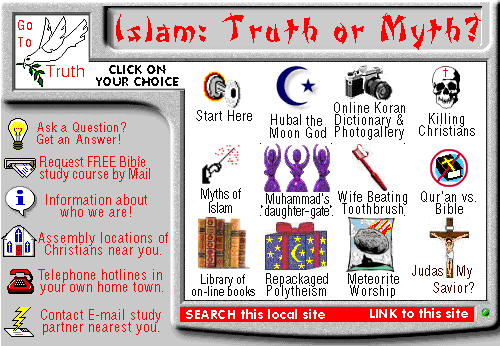
Islam: Truth or Myth? start page

Introduction to basic facts of history:

  1. Moon worship has been practiced in Arabia since 2000 BC. The crescent moon is the most common symbol of this pagan moon worship as far back as 2000 BC.
  2. In Mecca, there was a god named Hubal who was Lord of the Kabah.
  3. This Hubal was a moon god.
  4. One Muslim apologist confessed that the idol of moon god Hubal was placed upon the roof of the Kaba about 400 years before Muhammad. This may in fact be the origin of why the crescent moon is on top of every minaret at the Kaba today and the central symbol of Islam atop of every mosque throughout the world:
  5. About four hundred years before the birth of Muhammad one Amr bin Lahyo ... a descendant of Qahtan and king of Hijaz, had put an idol called Hubal on the roof of the Kaba. This was one of the chief deities of the Quraish before Islam. (Muhammad The Holy Prophet, Hafiz Ghulam Sarwar (Pakistan), p 18-19, Muslim)
  6. The moon god was also referred to as "al-ilah". This is not a proper name of a single specific god, but a generic reference meaning "the god". Each local pagan Arab tribe would refer to their own local tribal pagan god as "al-ilah".
  7. "al-ilah" was later shortened to Allah before Muhammad began promoting his new religion in 610 AD.
  8. There is evidence that Hubal was referred to as "Allah".
  9. When Muhammad came along, he dropped all references to the name "Hubal" but retained the generic "Allah".
  10. Muhammad retained almost all the pagan rituals of the Arabs at the Kaba and redefined them in monotheistic terms.
  11. Regardless of the specifics of the facts, it is clear that Islam is derived from paganism that once worshiped a moon-god.
  12. Although Islam is today a monotheist religion, its roots are in paganism.

Hubal the moon god of the Kabah

Allah the moon god of the Kabah

Remnants of pagan Moon god worship in the Koran

Pre-Islamic Origin of the word Allah

Photogallery of the ancient history of Moon god worship

Modern usage of moon god symbols in Islam today.

The Bible condemns moon god worship

Islam is repackaged polytheism.
Islam is paganism in monotheistic wrapping paper.
Islam is veiled neo-polytheism.

Written by Brother Andrew

Programas.TV.Online - Cuarto Milenio

Aqui podreis conseguir todos los programas habituales de Cuarto Milenio así como sus especiales:

http://programastvonline.blogspot.com/search/label/01.Lista%20programas%20Cuarto%20Milenio

Bitácoras de Referencia (XIV): Programas.TV.Online

Una completa bitácora repleta de programas de TV completos para descargar.

Ideal cuando tienes la tele rota y quieres seguir viendo "Cuarto Milenio"... Y no quieres recurrir a teles online ni programas baratos.

Enlace:

http://programastvonline.blogspot.com/

The pagan origin of the word, "Allah"

Fuente:

http://www.bible.ca/islam/islam-allah-pre-islamic-origin.htm

Información:

The pagan origin of the word, "Allah".

Islam: Truth or Myth? start page
Interestingly, not many Muslims want to accept that Allah was already being worshipped at the Ka'ba in Mecca by Arab pagans before Muhammad came. Some Muslims become angry when they are confronted with this fact. But history is not on their side. Pre-Islamic literature has proved this." (Who Is This Allah?, G. J. O. Moshay, 1994, p 138)

"But history establishes beyond the shadow of doubt that even the pagan Arabs, before Muhammad’s time, knew their chief god by the name of Allah and even, in a sense, proclaimed his unity...Among the pagan Arabs this term denoted the chief god of their pantheon, the Kaaba, with its three hundred and sixty idols." (The Moslem Doctrine of God, Samuel M. Zwemer 1905, p 24-25)

In fact, he did not at first intend to establish a new religion, but rather to reform the belief in Allah which already existed, and to show what this belief truly signified and rightfully demanded. (Mohammed: The man and his faith, Tor Andrae, 1936, Translated by Theophil Menzel, 1960, p13-30)

The pre-Islamic origin of "Allah"

  1. There is absolutely no question that Allah was worshipped by the pagan Arabs as one of many polytheistic gods.
  2. Allah was worshipped in the Kabah at Mecca before Muhammad was born. Muhammad merely proclaimed a god the Meccans were already familiar with. The pagan Arabs never accused Muhammad of preaching a different Allah than the one they already worshipped.
  3. Many scholars say "Allah" is derived from a compound Arabic word, AL + ILAH = Allah. "Ilah" in Arabic is "God" and "Al" in Arabic is a definite article like our word "the". So from an English equivalent "Allah" comes from "The + God". Others, like Arthur Jeffery say, "The common theory is that it is formed from ilah, the common word for a god, and the article al-; thus al-ilah, the god," becomes Allah, "God." This theory, however, is untenable. In fact, the name is one of the words borrowed into the language in pre-Islamic times from Aramaic." (
  4. Islam: Muhammad and His Religion, Arthur Jeffery, 1958, p 85)
  5. Although "Allah" has become known as the proper name for the Muslim god, Allah is not a name, but a descriptor that means literally, "the god". All pagan cultures have these generic terms that refer to their "top god" as "the god". In comparison to the perfect monotheism of Judaism and Christianity, "Allah" was originally no more a proper name for the Muslim God, than the word Hebrew "elohim" (god) or Greek "theos" (god) are proper names of the one true God of the Bible. "Jehovah" is the only revealed proper name for the "Elohim" of the Old Testament ( Ex 3:13; 6:3) and "Jesus" is the only revealed proper name of "Theos" in the New Testament. (Acts 4:12) Islam has no proper name for their god, but merely transformed, by universal use and confusion, the generic Allah into a proper name. So although today, Muslims use "Allah" as a proper name, it was never used this way originally. Allah, therefore is equivalent to "elohim" and "ho theos" but not "Jehovah" or "Jesus". Allah is not the name of the nameless Muslim God. However Muslims will claim that Allah is the name of God that corresponds to Jehovah. Both the Father and the Son are called "ho theos" (The God). Jesus is called "The God" many times in the New Testament: John 20:28; Heb 1:8. An important conclusion from this, is that the mere fact that "Allah" is equivalent to "elohim" and "ho theos" does not mean they are directly corresponded. It certainly doesn’t prove Allah is the same as the God of the Old or New Testament. It does not prove that Muslim’s worship the same God as Christians. If this correspondence proved the Muslim god was the same as the Christian God, then because pagan religions also have generics that correspond to "the god" (Allah), this correspondence would also prove that Allah is the same god as the Buddhist god, for Buddhists also refer to their god as "the god".

What scholars say about the origin of the word "Allah":

  1. It is not related that the Black Stone was connected with any special god. In the Ka'ba was the statue of the god Hubal who might be called the god of Mecca and of the Ka'ba. Caetani gives great prominence to the connection between the Ka'ba and Hubal. Besides him, however, al-Lat, al-`Uzza, and al-Manat were worshipped and are mentioned in the Kur'an; Hubal is never mentioned there. What position Allah held beside these is not exactly known. The Islamic tradition has certainly elevated him at the expense of other deities. It may be considered certain that the Black Stone was not the only idol in or at the Ka'ba. The Makam Ibrahim was of course a sacred stone from very early times. Its name has not been handed down. Beside it several idols are mentioned, among them the 360 statues. (
  2. First Encyclopedia of Islam, E.J. Brill, 1987, Islam, p. 587-591)
  3. "The verses of the Qur’an make it clear that the very name Allah existed in the Jahiliyya or pre-Islamic Arabia. Certain pagan tribes believed in a god whom they called ‘Allah’ and
  4. whom they believed to be the creator of heaven and earth and holder of the highest rank in the hierarchy of the gods. It is well known that the Quraish as well as other tribes believed in Allah, whom they designated as the ‘Lord of the House’ (i.e., of the Ka’ba)...It is therefore clear that the Qur’anic conception of Allah is not entirely new." (A Guide to the Contents of the Qur’an, Faruq Sherif, (Reading, 1995), pgs. 21-22., Muslim)
  5. According to al-Masudi (Murudj, iv. 47), certain people have regarded the Ka'ba as a temple devoted to the sun, the moon and the five planets. The 36o idols placed round the Ka'ba also point in this direction. It can therefore hardly be denied that traces exist of an astral symbolism. At the same time one can safely say that there can be no question of any general conception on these lines. The cult at the Ka'ba was in the heathen period syncretic as is usual in heathenism. (
  6. First Encyclopedia of Islam, E.J. Brill, 1987, Islam, p. 587-591)
  7. The name Allah, as the Qur'an itself is witness, was well known in pre-Islamic Arabia. Indeed, both it and its feminine form, Allat, are found not infrequently among the theophorous names in inscriptions from North Arabia.
  8. The common theory is that it is formed from ilah, the common word for a god, and the article al-; thus al-ilah, the god," becomes Allah, "God." This theory, however, is untenable. In fact, the name is one of the words borrowed into the language in pre-Islamic times from Aramaic. (Islam: Muhammad and His Religion, Arthur Jeffery, 1958, p 85)
  9. "If a Muslim says, "Your God and our God is the same," either he does not understand who Allah and Christ really are, or he intentionally glosses over the deep-rooted differences." (
  10. Who Is Allah In Islam?, Abd-Al Masih, Light of Life, 1985, p. 36.)
  11. Now there dwelt in Mecca a god called Allah. He was the provider, the most powerful of all the local deities, the one to whom every Meccan turned in time of need. But, for all his power, Allah was a remote god. At the time of Muhammad, however, he was on the ascendancy. He had replaced the moon god as lord of the Kaaba although still relegated to an inferior position below various tribal idols and three powerful goddesses: al-Manat, goddess of fate, al-Lat, mother of the gods, and al-Uzza, the planet Venus. (
  12. Islam and the Arabs, Rom Landau, 1958 p 11-21)
  13. Muhammad no more invented Allah than he did al-Lat, al-Uzza, and Manat. The Cult of the deity termed simply "thc god" (al-ilah) was known throughout southern Syria and northern Arabia," and it was obviously of central importance in Mecca, where the building called the Ka'ba was indisputably his house. Indeed, the Muslim profession of faith, 11 there is no ilah except al-ilah," attests to precisely that point: the Quraysh are being called upon to repudiate the very existence of all the other gods save this one. It seems equally certain that Allah was not merely a god in Mecca but was widely regarded as the "high god," the chief and head of the Meccan pantheon, perhaps the result, as has been argued, of a natural progression toward henotheism or of the growing influence of Jews and Christians in the peninsula." The most convincing piece of evidence that the latter was at work is the fact that of all the gods of Mecca, Allah alone was not represented by an idol. (
  14. The Hajj, F. E. Peters, p 3-41, 1994)
  15. Allah, we can be sure, was neither an unknown nor an unimportant deity to the Quraysh when Muhammad began preaching his worship at Mecca. What is equally certain is that Allah had what the Quran disdainfully calls "associates": other gods and goddesses who shared both his cult and his shrine. The processional chant of the pagans of the Age of Barbarism was, we are told, "Here I am, O Allah, here I am; You have no partner except such a partner as You have; You possess him and all that is his." 103 The last clause may reflect what we have already seen was an emerging tendency toward henotheism, the recognition of Allah as the "high god" of Mecca. But it was not sufficient for Muslims, who put in its place their own manifestly monotheistic hymn: "Here I am, O Allah, here I am; You have no partner; the praise and the grace are Yours, and the empire; You have no partner." (
  16. The Hajj, F. E. Peters, p 3-41, 1994)
  17. While Allah is best known as the principal god of Mecca, he was also worshiped in other places throughout Arabia as is shown by the occurrence of the name in Sabean, Minean and particularly Libyanite inscriptions." The Qur'an (xxix, 61) refers to the belief of the pagans in Allah as the creator of the heavens and the earth; and Muhammad's own father bore the name of `Abd Allah or `Abdullah, meaning the slave or worshiper of this god. In Mecca, Allah was worshiped in the Ka'bah and possibly represented by the famous Black Stone in that place. (
  18. The Archeology Of World Religions, Jack Finegan, 1952, p482-485, 492)
  19. In Mecca, Allah was worshiped in the Ka'bah and possibly represented by the famous Black Stone in that place. (
  20. The Archeology Of World Religions, Jack Finegan, 1952, p482-485, 492)
  21. Prior to the rise of Islam, these three goddesses were associated with Allah as his daughters and all were worshiped at Mecca and other places in the vicinity. (
  22. The Archeology Of World Religions, Jack Finegan, 1952, p482-485, 492)
  23. Allah (allah, al-ilah, the god) was the principal, though not the only, deity of Makkah. The name is an ancient one. It occurs in two South Arabic inscriptions, one a Minaean found at al-'Ula and the other a Sabaean, but abounds in the form HLH in the Lihyanite inscriptions of the fifth century- B.C. Lihyan, which evidently got the god from Syria, was the first Centre of the worship of this deity in Arabia. The name occurs as Hallah in the Safa inscriptions five centuries before Islam and also in a pre-Islamic Christian Arabic inscription found in umm-al-Jimal, Syria, and ascribed to the sixth century . The name of Muhammad's father was 'Abd-Allah ('Abdullah, the slave or worshipper of Allah). The esteem in which Allah was held by thepre-Islamic Makkans as the creator and supreme provider and the one to be invoked in time of special peril may be inferred from such koranic passages as 31 : 24, 31; 6 : 137, 109; to : 23. Evidently he was the tribal deity of the Quraysh. (
  24. History Of The Arabs, Philip K. Hitti, 1937, p 96-101)
  25. When Mohammed proclaimed his creed: 'There is no God but Allah,' he was not trying to introduce a new God. His pagan countrymen knew and acknowledged this divinity. His name, Allah, occurs already in pre-Mohammedan times, both in inscriptions and in compound personal names like Abd Allah, 'servant of Allah.' The effective note in Mohammed's evangelistic preaching is that he is able to accuse the pagans of acknowledging Allah as the creator of heaven and earth, and yet failing to draw the only possible conclusion from their belief; which is, to worship Allah and none else besides Him. 'If thou ask them who hath created the Heavens and the Earth, and hath imposed laws upon the sun and the moon, they will certainly say, "Allah". . If thou ask them who sendeth rain from Heaven, and by it quickeneth the earth after it hath been dead, they will certainly answer "Allah"' (Sura 29, 6 1 and 63). When in extreme danger, especially on the sea, the pagans call upon Allah (29, 65; 31, 31; 17, 69), but when they are on land again, and feel safe, they share His divine honour with other beings. Allah is supposed to have given certain commandments and taboos to men (Sura 6, 139 ff.), and the most sacred oaths are sworn in His name (Sura 3,r, 40; 16, 40). Thus, even though Allah was not worshipped as He deserved, the cult of Allah was not entirely neglected. A species of tithing, or offering of the first-fruits of grain and cattle, was offered to Allah as well as to the other gods (6, 137). But, above all, Allah was apparently regarded as ,the Lord of the Ka'ba,' the God to whom the cult of the highest sanctuary of Central Arabia was dedicated. In one of the oldest Suras (io6) Mohammed urges his tribesmen, the Quraish, to worship 'the Lord of this house, who allows the two annual trade caravans to be equipped, and who cares for them, and permits them to dwell in security. Concerning himself he says that he has received the commandment to worship 'the Lord of the house,' i.e. the Ka'ba. Apparently, then, the Prophet and his countrymen fully agree that the God who is worshipped through the ritual of the Ka'ba is Allah. (
  26. Mohammed: The man and his faith, Tor Andrae, 1936, Translated by Theophil Menzel, 1960, p13-30)
  27. "The religion of the Arabs, as well as their political life, was on a thoroughly primitive level...In particular the Semites regarded trees, caves, springs, and large stones as being inhabited by spirits; like the Black Stone of Islam in a corner of the Ka’bah at Mecca, in Petra and other places in Arabia stones were venerated also...Every tribe worshipped its own god, but also recognized the power of other tribal gods in their own sphere...Three goddesses in particular had elevated themselves above the circle of the inferior demons. The goddess of fate, al-Manat, corresponding to the Tyche Soteira of the Greeks, though known in Mecca, was worshipped chiefly among the neighboring Bedouin tribes of the Hudhayl. Allat—"the Goddess," who is Taif was called ar-Rabbah, "the Lady," and whom Herodotus equates with Urania—corresponded to the great mother of the gods, Astarte of the northern Semites; al-‘Uzza, "the Mightiest," worshipped in the planet Venus, was merely a variant form... In addition to all these gods and goddesses the Arabs, like many other primitive peoples, believed in a God who was creator of the world, Allah, whom the Arabs did not, as has often been thought, owe to the Jews and Christians...The more the significance of the cult declined, the greater became the value of a general religious temper associated with Allah. Among the Meccans he was already coming to take the place of the old moon-god Hubal as the lord of the Ka’bah...Allah was actually the guardian of contracts, though at first these were still settled at a special ritual locality and so subordinate to the supervision of an idol. In particular he was regarded as the guardian of the alien guest, though consideration for him still lagged behind duty to one’s kinsmen." (
  28. History of the Islamic Peoples, Carl Brockelmann, p 8-10)
  29. The god Il or Ilah was originally a phase of the Moon God, but early in Arabian history the name became a general term for god, and it was this name that the Hebrews used prominently in their personal names, such as Emanuel, Israel, etc., rather than the Bapal of the northern semites proper, which was the Sun. Similarly,
  30. under Mohammed's tutelage, the relatively anonymous Ilah became Al-Ilah, The God, or Allâh, the Supreme Being. (Southern Arabia, Carleton S. Coon, Washington, D.C. Smithsonian, 1944, p.399)
  31. "...a people of Arabia, of the race of the Joktanites...the Alilai living near the Red Sea in a district where gold is found; their name, children of the moon, so called from the worship of the moon, or Alilat." (
  32. Gesenius Hebrew and Chaldee Lexicon to the Old Testament Scriptures, translated by Samuel Prideaux Tregelles, 1979, p. 367)
  33. Al-Kindi, one of the early Christian apologists against Islam, pointed out that Islam and its god Allah did not come from the Bible but from the paganism of the Sabeans. They did not worship the God of the Bible but the moon-god and his daughters al-Uzza, al-Lat, and Manat (
  34. Three Early Christian-Muslim Debates, ed. by N. A. Newman, Hatfield, PA, IBRI, 1994, pp.357, 413, 426).
  35. "The cult of a deity termed simply "the god" (al-ilah) was known throughout southern Syria and northern Arabia in the days before Islam—Muhammad’s father was named ‘Abd Allah ("Servant of Allah")--and was obviously of central importance in Mecca, where the building called the Ka’bah was indisputably his house. Indeed, the Muslims shahadah attests to precisely that point: the Quraysh, the paramount tribe of Mecca, were being called on by Muhammad to repudiate the very existence of all the other gods save this one. It seems equally certain that Allah was not merely a god in Mecca but was widely regarded as the "high god," the chief and head of the Meccan pantheon, whether this was the result, as has been argued, of a natural progression toward henotheism or of the growing influence of Jews and Christians in the Arabian Peninsula...Thus Allah was neither an unknown nor an unimportant deity to the Quraysh when Muhammad began preaching his worship at Mecca." (
  36. The Oxford Encyclopedia of the Modern Islamic World, ed. John L. Esposito, 1995, p 76-77)
  37. "
  38. That Islam was conceived in idolatry is shown by the fact that many rituals performed in the name of Allah were connected with the pagan worship that existed before Islam. ... Before Islam Allah was reported to be know as: the supreme of a pantheon of gods; the name of a god whom the Arabs worshipped; the chief god of the pantheon; Ali-ilah; the god; the supreme; the all-powerful; all-knowing; and totally unknowable; the predeterminer of everyone’s life destiny; chief of the gods; the special deity of the Quraish; having three daughters: Al Uzzah (Venus), Manah (Destiny), and Alat; having the idol temple at Mecca under his name (House of Allah).; the mate of Alat, the goddess of fate. . ... Because of other Arabian history which points to heathen worship of the sun, moon, and the stars, as well as other gods, of which I believe Allah was in some way connected to. This then would prove to us that Allah is not the same as the true God of the Bible whom we worship, because God never changes." (Is Allah The Same God As The God Of The Bible?, M. J. Afshari, p 6, 8-9)
  39. "In pre-Islamic days, called the Days of Ignorance, the religious background of the Arabs was pagan, and basically animistic. Through wells, trees, stones, caves, springs, and other natural objects man could make contact with the deity... At Mekka, Allah was the chief of the gods and the special deity of the Quraish, the prophet’s tribe. Allah had three daughters: Al Uzzah (Venus) most revered of all and pleased with human sacrifice; Manah, the goddess of destiny, and Al Lat, the goddess of vegetable life. Hubal and more than 300 others made up the pantheon. The central shrine at Mekka was the Kaaba, a cube like stone structure which still stands though many times rebuilt. Imbedded in one corner is the black stone, probably a meteorite, the kissing of which is now an essential part of the pilgrimage." (
  40. Meet the Arab, John Van Ess, 1943, p. 29.)
  41. "Muslims are notoriously loathe to preserve traditions of earlier paganism and like to garble what pre-Islamic history they permit to survive in anachronistic terms" (
  42. Southern Arabia, Carleton S. Coon, Washington DC, Smithsonian, 1944, p 398)
  43. "But history establishes beyond the shadow of doubt that even the pagan Arabs, before Muhammad’s time, knew their chief god by the name of Allah and even, in a sense, proclaimed his unity...Among the pagan Arabs this term denoted the chief god of their pantheon, the Kaaba, with its three hundred and sixty idols." (
  44. The Moslem Doctrine of God, Samuel M. Zwemer 1905, p 24-25)
  45. "Historians like Vaqqidi have said Allah was actually the chief of the 360 gods [one for each day of the year] being worshipped in Arabia at the time Muhammad rose to prominence. Ibn Al-Kalbi gave 27 names of pre-Islamic deities...
  46. Interestingly, not many Muslims want to accept that Allah was already being worshipped at the Ka'ba in Mecca by Arab pagans before Muhammad came. Some Muslims become angry when they are confronted with this fact. But history is not on their side. Pre-Islamic literature has proved this." (Who Is This Allah?, G. J. O. Moshay, 1994, p 138)
  47. "Islam also owes the term "Allah" to the heathen Arabs. We have evidence that it entered into numerous personal names in Northern Arabia and among the Nabatians. It occurred among the Arabs of later times, in theophorous names and on its own." (
  48. Why I Am Not A Muslim, Ibn Warraq, 1995, p. 42)
  49. "Arabia in Muhammad’s time was polytheistic in its conception of the cosmos and tribal in its social structure. Each tribe had its own god(s) and goddess(es), which were manifest in the forms of idols, stones, trees, or stars in the sky." (
  50. Islamic Studies, A History of Religions Approach, Richard C. Martin, 2nd Ed., p 96)
  51. "Before Islam, the religions of the Arabic world involved the worship of many spirits, called jinn. Allah was but one of many gods worshiped in Mecca. But then Muhammad taught the worship of Allah as the only God, whom he identified as the same God worshiped by Christians and Jews." (
  52. A Short History of Philosophy, Robert C. Solomon, p. 130)
  53. "Allah: Originally applied to the moon; he seems to be preceded by Ilmaqah, the moon god... Allat: the female counterpart to Allah." (
  54. A Dictionary of Non-Classical Mythology, Marian Edwardes, Lewis Spence, Allah, p. 7)
  55. There were hundreds of such deities in pagan Arabia; the Ka'bah alone at one time housed three hundred and sixty-seven of them. Of all those mentioned in the Qur'an, four appeared to be most popularly revered on the eve of Islam, al`-Uzzah (power), al-Lat (the goddess), and Manah (fate); all three female deities, popularly worshiped by the tribes of the Hijaz, were regarded as the daughters of Allah (the god) who headed the Arabian pantheon when Muhammad began to preach. Allah, the paramount deity of pagan Arabia, was the target of worship in varying degrees of intensity from the southernmost tip of Arabia to the Mediterranean. To the Babylonians he was "Il" (god); to the Canaanites, and later the Israelites, he was "El"., the South Arabians worshipped him as "Ilah," and the Bedouins as "al-Ilah" (the deity). With Muhammad he becomes Allah, God of the Worlds, of all believers, the one and only who admits of no associates or consorts in the worship of Him. Judaic and Christian concepts of God abetted the transformation of Allah from a pagan deity to the God of all monotheists. There is no reason, therefore, to accept the idea that "Allah" passed to the Muslims from Christians and Jews. (
  56. Islam, Beliefs And Observances, Caesar E. Farah, p2-7, 26-35)
  57. Before the name [Allah] came into Islam, it had already long been part of the pre-Islamic system, and a considerably important part, too...the pagan concept of Allah, which is purely Arabian—the case in which we see the pre-Islamic Arabs themselves talking about "Allah" as they understand the word in their own peculiar way." (
  58. God and Man in The Koran, Toshihiko Izutsu, Chapter 4: Allah, p96-119, 1980)
  59. Let us begin by remarking that the name itself of Allah is common to Jahiliyyah and Islam.
  60. When, in other words, the Koranic Revelation began to use this word, it was not introducing a new name of God, a name strange and alien to the ears of the contemporary Arabs. The first problem, then, that we must answer is: Was the Koranic concept of Allah a continuation of the pre-Islamic one, or did the former represent a complete break with the latter? Were there some essential-not accidental-ties between the two concepts signified by one and the same name? Or was it a simple matter of a common word used for two different objects? ." (God and Man in The Koran, Toshihiko Izutsu, Chapter 4: Allah, p96-119, 1980)
  61. What does this mean from the semantical point of view? What are the implications of the fact that the name of Allah was not only known to both parties but was actually used by both parties in their discussion with each other? The very fact that the name of Allah was common to both the pagan Arabs and the Muslims, particularly the fact that it gave rise to much heated discussion about the concept of God, would seem to suggest conclusively that there was some common ground of understanding between the two. parties. Otherwise there, could have been neither debate nor discussion at all. And when the Prophet addressed his adversaries in the name of Allah all, he did so simply and solely because he knew that this name meant something and something important to their minds too. If this were not, so, his activity would have been quite pointless in this respect. " (
  62. God and Man in The Koran, Toshihiko Izutsu, Chapter 4: Allah, p96-119, 1980)
  63. As regards the 'basic' meaning of Allah, we may remark that many Western scholars have compared rightly -to my mind- the word in its formal aspect with the Greek "Ho Theos" which means quite simply 'the God'. On such an abstract level the name was common to all Arab tribes. In pre-Islamic times each tribe, as a rule, had its own local god or divinity known by a proper name. So, at first, each tribe may have meant its own local divinity, when it used an expression equivalent to "the God"; this is quite probable. But the very fact that people began to designate their own local divinity by the abstract form of "the God' must have paved, the way for the growth of an abstract notion of God without any localizing qualification and then, following this, for a belief in the supreme God common to all the tribes. We meet with similar instances all over the world. Besides, we must remember, there were the Jews and the Christians with whom the Arabs had constant opportunities of a close cultural contact. And naturally these Jews and Christians both used the same word Allah to denote their own Biblical God. This must have exerted a great influence on the development of the pre-Islamic concept of Allah among the Arabs towards a higher concept than that of a mere tribal divinity, not only among the town-dwellers but also among the pure Bedouins of the desert. However this may be, it is certain from the Koran alone, that by the time Muhammad began to preach, the pagan Arabs had come to cherish at least a vague idea, and perhaps also a vague belief, in Allah as the highest God standing above the level of local idols. This much we may reasonably assume as the 'basic' meaning, of the word Allah in Jahiliyah. And this much meaning, at least, must the word have carried into the Islamic system when the Koran began to use it as the name of the God of Islamic Revelation. For otherwise, as I have said, even a polemic discussion on this Islamic God could not have been possible between the Muslims and the Meccan pagans. " (
  64. God and Man in The Koran, Toshihiko Izutsu, Chapter 4: Allah, p96-119, 1980)
  65. However, this is not the whole picture. We would commit a grave mistake if we imagined that this 'basic' meaning was the sole point of contact between the two conceptions of God. The thing did not occur in such a way that the pure concept of Allah with its simple 'basic' meaning or which is suggested by its formal structure -Allah = ho theos - came straight into the Islamic conceptual system falling down, so to speak, from some metaphysical world of pure concepts. But actually, i.e. historically, it came into the Islamic system through another system, namely, the pre-Islamic system of religious concepts, however crude the latter might have been.
  66. Before the name came into Islam, it had already long been part of the pre-Islamic system, and a considerably important part, too. (God and Man in The Koran, Toshihiko Izutsu, Chapter 4: Allah, p96-119, 1980)
  67. To put it in another way, when the Islamic Revelation began, the pagan Arabs of Mecca could possibly have no other way of understanding the word Allah than by associating with it all the semantic elements that were already present in their minds. This was the first big semantic problem which faced the Prophet Muhammad when he started his prophetic career. ... The chief of those objectionable elements was the idea that Allah, although admittedly the supreme God, allowed of the existence of so-called "associates" shuraka' besides Him. But apart from this polytheistic element and some other less important points, the Koran acknowledges that the general concept of Allah entertained by the contemporary Arabs was surprisingly close to the Islamic concept of God. (
  68. God and Man in The Koran, Toshihiko Izutsu, Chapter 4: Allah, p96-119, 1980)
  69. The first is the pagan concept of Allah, which is purely Arabian-the case in which we see the pre-Islamic Arabs themselves talking about "Allah" as then, understand the word in their own peculiar way ... (II) The case in which we observe the Jews and the Christians of pre-Islamic times using the very word Allah in referring to their own God. In this case "Allah" means of course the God of the Bible, a typically monotheistic concept of God. Exceedingly interesting examples are found in this respect, for instance, in the work of 'Adi b. Zayd, a, well-known Arab Christian, the Court poet of al-Hirah. (III) Lastly, the case in which we see the pagan Arabs - non-Christian, non-Jewish pure Jahili Arabs - handling the Biblical concept of God under the name of "Allah".(
  70. God and Man in The Koran, Toshihiko Izutsu, Chapter 4: Allah, p96-119, 1980)
  71. II THE CONCEPT OF ALLAH IN ARABIAN PAGANISM (1) Allah in this conception, is the Creator of the world. (2) He is the Giver of rain, i.e., more generally, the Giver of life to all living things on earth. (3) He is the One who presides over the most solemn oaths. (4) He is the object of what we might justly describe as "momentary?' or "temporary" monotheism, the existence of which is evidenced by the recurrent expression in the Koran "making (momentarily) their faith pure for Him alone" (5) Finally, Allah is the Lord of Ka'bah. (
  72. God and Man in The Koran, Toshihiko Izutsu, Chapter 4: Allah, p96-119, 1980)
  73. "The relation of this name, which in Babylonia and Assyrian became a generic term simply meaning ‘god’, to the Arabian Ilah familiar to us in the form Allah, which is compounded of al, the definite article, and Ilah by eliding the vowel ‘i’, is not clear. Some scholars trace the name to the South Arabian Ilah, a title of the Moon god, but this is a matter of antiquarian interest...it is clear from Nabataen and other inscriptions that Allah meant ‘the god.’ The other gods mentioned in the Quran are all female deities: Al-Lat, al-Uzza, and Manat, which represented the Sun, the planet Venus, and Fortune, respectively; at Mecca they were regarded as the daughters of Allah... As Allah meant ‘the god’, so Al-Lat means ‘the goddess’." (
  74. Islam, Alfred Guillaume, 1956, p 6-7)
  75. Apparently, then, Allah was, already in the conception of the pre-Islamic Arabs the Creator of the world and the Giver of rain, i.e., the Giver of life to all that exists on earth. The only serious complaint brought against them by the Qur'an in this respect was that the pagans failed to draw the only reasonable conclusion from the acknowledgment of Allah's being the Creator of the heaven and the earth: that they should serve Allah alone and none else. (
  76. God and Man in The Koran, Toshihiko Izutsu, Chapter 4: Allah, p96-119, 1980)
  77. It is indeed remarkable that this expression implies that in an emergency when they really felt that their own life was in mortal danger, the pagan Arabs used to have recourse to 'temporary monotheism' apparently without any reflection on the grave implication of such an act. That the phrase "making one's religion pure for Allah" in contexts of this kind means what we might call 'momentary -or temporary- monotheism', and not simply "sincerity" or "earnestness" in one's prayer is clearly shown by the fact that in the majority of the verses in which this expression is used the Koran adds the remark that these pagans, as soon as they reach the shore and feel sure of absolute safety, forget about all that has passed and begin again "to ascribe partners to Allah", i.e., fall back into their original polytheism. (
  78. God and Man in The Koran, Toshihiko Izutsu, Chapter 4: Allah, p96-119, 1980)
  79. "The enemies tried hard against me", he says, "without desisting from doing anything that could harm me, by the Lord of Mecca and the ' Crucified". ... In this verse 'Adi b. Zayd claims his complete innocence and says that the misunderstanding on the part of the king has been produced only by the machination of the slanderers envious of his good fortune, and in order to give special weight to this declaration he swears by the Lord of Mecca and Christ putting together the two "Lords" into a single oath. What is important to remember regarding this verse is that the poet 'Adi b. Zayd was an Arab Christian, but he was neither a simple Arab nor an ordinary Christian. He was a man of the highest culture of his age. ... The fact that this man of highest culture and education put in one of his solemn oaths the Lord of Mecca and Christ together is significant, in My view, in two different ways: it is of importance, first of all, in connection with the problem of the relational meaning of the word Allah in its purely Arabian aspect. That a highly educated Christian, not a pagan Arab, living in Hirah, away from Mecca, did use this concept of the Lord of Ka'bah in this way shows better than anything else how wide-spread and influential was this particular connotation of Allah. ... The example of 'Adi b. Zayd's verse would seem to suggest, at least to my mind, that there was in the Christian psychology an unconscious tendency or inclination towards identifying -their Christian concept of Allah with the purely pagan Arabian concept of Allah as the Lord of the Meccan shrine. (
  80. God and Man in The Koran, Toshihiko Izutsu, Chapter 4: Allah, p96-119, 1980)
  81. Both the Jews and the Christians in Arabia used Arabic as their vernacular, and, as I have pointed out earlier, referred to their Biblical God by the very word Allah, which was something quite natural seeing that the 'basic' meaning conveyed by this word was a very abstract one that would correspond roughly to the Greek ho theos. (
  82. God and Man in The Koran, Toshihiko Izutsu, Chapter 4: Allah, p96-119, 1980)
  83. It is clear from the negative form of the Muslim creed, "There is no god except God," that the existence and lordship of Allah were known and recognized in pre-Islamic Arabia. The Prophet's mission was not to proclaim God's existence but to deny the existence of all lesser deities. The fact that Muhammad's own father bore the name 'Abd-Allah, slave of God, demonstrates that God was known by that name prior to Islam. The Qur'an in many passages refers to Muhammad's adversaries in Mecca, swearing by God, invoking Him, and recognizing His sovereignty as Creator. The name Allah is also evident in archaeological and literary remains of pre-Islamic Arabic. But the people of Mecca did not understand or allow that God alone should be worshipped. Indeed they contended against Muhammad that if God had willed it they would have refrained from believing in other deities (Surah vi. 148), clearly implying that God approved of their concurrent idolatry. (
  84. The Call of The Minaret, Kenneth Cragg, 1956, 35-41)
  85. There can be no doubt then that the Prophet's contemporaries knew of a Supreme Being, but He did not dominate their minds. Rather they thought more directly and frequently of the lesser gods, the daughters, perhaps even the sons, of Allah who were far more intimately related to their daily lives, their wars, their harvests, and their fertility. (
  86. The Call of The Minaret, Kenneth Cragg, 1956, 35-41)
  87. Certain trees and stones (especially meteorites and those shaped to resemble human forms) housed spirits and divinities. (
  88. Mohammed, Maxime Rodinson, 1961, translated by Anne Carter, 1971, p 16-17)
  89. This was especially true of Allah, 'the God, the Divinity', the personification of the divine world in its highest form, creator of the universe and keeper of sworn oaths. In the Hejaz three goddesses had pride of place as the 'daughters of Allah'. The first of these was Allat, mentioned by Herodotus under the name of Alilat. Her name means simply 'the goddess', and she may have stood for one aspect of Venus, the morning star, although hellenized Arabs identified her with Athene. Next came Uzza, 'the all-powerful', whom other sources identify with Venus. The third was Manat, the goddess of fate, who held the shears which cut the thread of life and who was worshipped in a shrine on the sea-shore. The great god of Mecca was Hubal, an idol made of red cornelian. (
  90. Mohammed, Maxime Rodinson, 1961, translated by Anne Carter, 1971, p 16-17)
  91. In recent years I have become increasingly convinced that for an adequate understanding of the career of Muhammad and the origins of Islam great importance must be attached to the existence in Mecca of belief in Allah as a ‘high god'. In a sense this is a form of paganism, but it is so different from paganism as commonly understood that it deserves separate treatment. Moreover there is much about it in the Qur'an. The first point to note is that the pagans are prepared to admit that Allah is the creator of the heavens and the earth. (
  92. Muhammad's Mecca, W. Montgomery Watt, Chapter 3: Religion In Pre-Islamic Arabia, p26-45)
  93. The Arabic word for 'God', Allah, is a contraction of al-ilah, which like the Greek ho theos simply means 'the god' but was commonly understood as 'the supreme god' or 'God'. It is possible that before the time of Muhammad the Meccan pagans used to indicate the principal deity of the Ka'bah, in the same way in which the deity worshipped at at-Ta'if was known simply as al-Lat, the goddess. If the word Allah was also used for God as acknowledged by Jews and Christians, the opportunities for confusion would be great. The probability therefore is that while some Meccans acknowledged God, they did not see that their old polytheistic beliefs were incompatible with belief in God and reject them. These premonitions of monotheism among the Arabs must have been due mainly to Christian and Jewish influences. The Arabs had many opportunities of contact with Christians and Jews. The Byzantine empire, whose power and higher civilization they greatly admired, was Christian, and so was Abyssinia. Even in the Persian empire Christianity was strong, and al-Hirah, the Persian vassal-state with which the Arabs were much in contact, was an outpost of the East Syrian or Nestorian Church. This combination of monotheism with military and political strength and a higher level of material civilization must have impressed the Arabs greatly. (
  94. Muhammad at Mecca, W. Montgomery Watt, 1953, p 23-29)
  95. All this material goes to show that among the pagans in Mecca and presumably also in the region round there was widespread recognition of Allah as high god. Such people may even have been more numerous than those who gave no special place to Allah, and they may have differed among themselves about the powers of a high god. This conclusion has been reached from a study of the Qur'an, and refers to a relatively small region during a restricted period. The study of inscriptions, however, has shown that belief in a high or supreme god was common throughout the Semitic Near East in the Greco-Roman period. It is worth quoting the conclusions of one who has made a thorough study of the inscriptions. It is worth quoting the conclusions of one who has made a thorough study of the inscriptions: "The epigraphical material reveals that the worship of a supreme god coexisted with that of other minor gods. The belief that one god is able to control all the other gods, or is supreme in that he has created and looks after the world, does not constitute monotheism. But the increasing emphasis on such beliefs is evidence of a trend towards monotheism, namely towards the exclusion of other gods' existence." [Javier Teixidor, The Pagan God: Popular Religion in the Greco-Roman Near East, Princeton 1977, 17.] " The authors of the inscriptions worshipped a supreme god who was alone in possessing a power that excelled any other divine power. He was believed to be a Weather god; heaven belonged to him. Lesser gods were his messengers and ministers. As stated in the first chapter, the cult of the angels became a significant feature of the religious life of the Near East during the Persian and Hellenistic times. It gave the angels their role of messengers, but also stressed the fact that the Lord of Heaven ranked at the top of a hierarchy of divine beings. On the other hand, the religious life of the various groups whose inscriptions have been studied in the preceding pages was rooted in the traditions of the ancestors." [Javier Teixidor, The Pagan God: Popular Religion in the Greco-Roman Near East, Princeton 1977, 161f.] In the light of this further evidence it becomes highly probable that when Muhammad began preaching the dominant view among thinking people in Mecca was the belief in Allah as high god. Pure paganism was in decline. (
  96. Muhammad's Mecca, W. Montgomery Watt, Chapter 3: Religion In Pre-Islamic Arabia, p26-45)
  97. North Arabian deities. Among the peoples around the northern perimeter of Arabia, "god," in the most generic sense, was El, or in a longer form of the same name, Ilah. (
  98. Britannica, Arabian Religions, p1057, 1979)
  99. "Allah: Before the birth of Muhammad, Allah was known as a supreme, but not sole, God." (
  100. Oxford Dictionary of World Religions, 1997, p. 48)
  101. "Origin- Nabataean and Arabic: Derived from the western Semitic god Il. ... Known period of worship: circa 300 BC until present. ... The creator god of Islam. Perceived in pre-Islamic times as the creator of the earth and water" (
  102. Encyclopedia of Gods, Michael Jordan, Allah, p 12)
  103. "Despite the prominence of the name elsewhere among Semitic peoples, the god Il (EI) appears to play a comparatively minor role in the South Arabian inscriptions. Some modem scholars have sought to explain this circumstance by equating Il with the moon god, but this opinion has not prevailed." ... "Among the peoples around the northern perimeter of Arabia, "god," in the most generic sense, was El, or in a longer form of the same name, Ilah. (Britannica,
  104. Arabian Religions, p1057, 1979)
  105. Allah was known to the pre-Islamic Arabs; he was one of the Meccan deities, possibly the supreme deity and certainly a creator-god (cf. Kur'an, xiii, 16; xxix, 61, 63; xxxi, 25; xxxix, 38; xliii, 87). He was already known, by antonomasia, as the God, al-Ilah (the most likely etymology; another suggestion is the Aramaic Alaha). For Allah before Islam, as shown by archaeological sources and the Kur'an, see ILAH. (
  106. The Encyclopaedia Of Islam, New Edition, Edited By B. Lewis, V. L. Menage, Ch. Pellat And J. Schacht, 1971, ALLAH, page 406)
  107. But the vague notion of supreme (not sole) divinity, which Allah seems to have connoted in Meccan religion, was to become both universal and transcendental; it was to be turned, by the Kur'anic preaching, into the affirmation of the Living God, the Exalted One. (
  108. The Encyclopaedia Of Islam, New Edition, Edited By B. Lewis, V. L. Menage, Ch. Pellat And J. Schacht, 1971, ALLAH, page 406)
  109. ALLAH is the proper name of God among Muslims, corresponding in usage to Jehovah (Jahweh) among the Hebrews. Thus it is not to be regarded as a common noun meaning 'God' (or 'god'), and the Muslim must use another word or form if he wishes to indicate any other than his own peculiar deity. Similarly, no plural can be formed from it, and though the liberal Muslim may admit that Christians or Jews call upon Allah, he could never s Peak of the Allah of the Christians or the Allah of tire Jews. (
  110. Encyclopedia of Religion and Ethics, James Hastings, Allah p 326)
  111. "The origin of this goes back to pre-Muslim times, as Prof. Noldeke has shown" (
  112. Encyclopedia of Religion and Ethics, James Hastings, Allah p 326)
  113. Muhammad found the Meccans believing in a supreme God whom they called Allah, thus already contracted. With Allah, however, they associated other minor deities, some evidently tribal, others called daughters of Allah. Muhammad's reform was to assert the solitary existence of Allah. The first article of the Muslim creed, therefore, La ilaha illa-llahu means only, as addressed by him to the Meccans, ' There exists no God except the one whom you already call Allah.' Naturally, this precise historical origin is not clear to the Muslin exegetes and theologians. But that Allah is a proper name, applicable only to their peculiar God, they are certain, and they mostly recognize that its force as a proper name has arisen rough contraction in form and limitation in usage. (
  114. Encyclopedia of Religion and Ethics, James Hastings, Allah p 326)
  115. The preferable view is that Allah is a proper name of God and has no derivation; this he defends with arguments based on the undoubted usage of the Qur'an and the impossibility of making a common noun apply to an individual only. (
  116. Encyclopedia of Religion and Ethics, James Hastings, Allah p 326)
  117. Broadly, Allah is used of the true God only, as also, in the first instance, al-ilah ; but the latter can by extension be applied to any god, as Allah Himself applies it in the Qur'an. (
  118. Encyclopedia of Religion and Ethics, James Hastings, Allah p 326) [This, of course, is a complete reversal of the historical fact.]
  119. "In any case it is extremely important fact that Muhammad did not find it necessary to introduce an altogether novel deity, but contented himself with ridding the heathen Allah of his companions subjecting him to a kind of dogmatic purification." (
  120. Encyclopedia of Religion and Ethics, I:664.)
  121. Comment: Allah is a term Muslims use to distinguish their moon god. The term was in existence before Muhammad was born. However it has no history of use outside the Arabic world, as Muslims claim. For example, it is not found in the Bible or in any Jewish or Christian writings. The moon god, however, does have a long history that dates back to the time of Abraham.
  122. The final divinity to be considered is Allah who was recognized before Islam as god, and if not as the only god at least as a supreme god. The Quran makes it quite clear that he was recognized at Mecca, though belief in him was certainly more widespread .78 How is this to be explained? Earlier scholars attributed the diffusion of this belief solely to Christian and Judaic influences. But now a growing number of authors maintain that this idea had older roots in Arabia. Wellhausen's view that Allah (al-ilah, "the god") is a sort of abstraction which (originating in the local gods) gave rise first to a common word, then a common concept that merged the various gods into one single god has rightly been judged inadequate. One must rather see in this pre-Islamic Allah one of those great supreme gods who created the world but who plays a minor role in the actual cult. 79 If, therefore, Allah is indigenous to Arabia, one must ask further: Are there indications of a nomadic origin? I think there are, based on a comparison of the beliefs of the nomads in central and northern Asia with those of northeastern Africa. Like the supreme being of many other nomads, Allah is a god of the sky and dispenser of rain. 80 These indications might not seem sufficiently peculiar to Bedouin, for the notion of such a god might just as well have been formed by settled farming people. But one must not forget that rain is even more important for nomads. (
  123. Studies on Islam, edited by Merlin L. Swartz, Pre-Islamic Bedouin Religion, by Joseph Henninger, 1981, p 3-22)
  124. "...the Ka’aba was dedicated to al-Ilah, the High God of the pagan Arabs, despite the presiding effigy of Hubal. By the beginning of the seventh century, al-Ilah had become more important than before in the religious life many of the Arabs. Many primitive religions develop a belief in a High God, who is sometimes called the Sky God...But they also carried on worshipping the other gods, who remained deeply important to them." (
  125. Karen Armstrong, Muhammad, (New York: San Francisco, 1992) p. 69.)
  126. From the Koran itself it is clear that monotheistic ideas were familiar in Western Arabia. The existence of a supreme God, Allah, is assumed as an axiom common to Mohammed and his opponents. The Koran never argues the point; what it does argue is that He is the one and only God. La ilaha illa'llah, ‘there is no god but Allah.’ Mohammedanism, An Historical Survey H.A.R. Gibb, 1950,
  127. The Koran, p 36-47
  128. "Allah, the Supreme Being of the Mussulmans: Before Islam.
  129. That the Arabs, before the time of Muhammed, accepted and worshipped, after a fashion, a supreme god called Allah,--"the Ilah, or the god, if the form is of genuine Arabic source; if of Aramaic, from Alaha, "the god"—seems absolutely certain. Whether he was an abstraction or a development from some individual god, such as Hubal, need not here be considered...But they also recognized and tended to worship more fervently and directly other strictly subordinate gods...It is certain that they regarded particular deities (mentioned in 1iii. 19-20 are al-‘Uzza, Manat or Manah, al-Lat’; some have interpreted vii, 179 as a reference to a perversion of Allah to Allat as daughters of Allah (vi. 100; xvi, 59; xxxvii, 149; 1iii, 21); they also asserted that he had sons (vi. 100)..."There was no god save Allah". This meant, for Muhammed and the Meccans, that of all the gods whom they worshipped, Allah was the only real deity. It took no account of the nature of God in the abstract, only of the personal position of Allah. ...ilah, the common noun from which Allah is probably derived..." (First Encyclopedia of Islam, E.J. Brill, 1987, Islam, p. 302)
  130. "The name Allah goes back before Muhammad" (
  131. The Facts on File Encyclopedia of World Mythology and Legend, Anthony S. Mercatante, I:41, 1983)

Written by Brother Andrew