domingo, 21 de febrero de 2010

13 - watchers and could I be a decendant of them

Fuente:

http://www.disclose.tv/forum/watchers-and-could-i-be-a-decendant-of-them-t12205-120.html

Información:

Post subject: Re: watchers and could I be a decendant of them
PostPosted: Thu Dec 03, 2009 2:42 am
Offline
Conspirator
Conspirator
User avatar

Joined: Thu Apr 17, 2008 12:04 pm
Posts: 2508
xhunter wrote:
vulcanic wrote:
watchers and giants are two different things, watchers were angels left to watch over man the giants also known as nephilims were children born not from the watchers but the fallen angels.

but to answer your question if they really were nephilims then yeah some of us can be related to them.

when the nephilims bred with humans they did not come out as tall as the nephilims.

angel + human = nephilim

nephilim + human = a waterd down nephilim and as time goes on breeding with humans will make them more and more human with each generation.

need be atleast 50% angel to be a true nephilim.

by now if there were offspring of nephilims left they only be around 1-5% angel / nephilim


WERE THE FUK DO YOUZ FIND THIS SHIT ?????????????? :headscratch:


we listed all the books names keep reading they are listed on every page :flop:

_________________
HONORI­FICABILI­TUDINI­TATIBUS
Image
Remiel
VULCANIC PNEUMONO­ULTRA­MICRO­SCOPIC­SILICO­VOLCANO­KONIOSIS


Top
Profile
Post subject: Re: watchers and could I be a decendant of them
PostPosted: Thu Dec 03, 2009 5:59 am
Offline
Writer
Writer
User avatar

Joined: Mon Jul 28, 2008 10:28 pm
Posts: 38
In the classic words of that nemesis of the Tick, known as Handy... READ A BOOK!


Top
Profile
Post subject: Re: watchers and could I be a decendant of them
PostPosted: Fri Dec 04, 2009 4:38 am
Offline
Conspirator
Conspirator
User avatar

Joined: Thu Apr 17, 2008 12:04 pm
Posts: 2508
sheeple wrote:
http://www.andrewcollins.com/page/news/News_vi_EQ12%20_1_May2009.htm
EarthQuest News, Andrew Collins Newsletter Vol. 12 No. 1 (May 2009)
Quote:
vi. The Genesis Secret
Image
One book that you might just notice in the top 20 bestseller section of W H Smith (or Barnes and Noble if you are in the USA) is The Genesis Secret by Thomas Knox (HarperCollins, 2009, and see also the website at http://thegenesissecret.com). It is a novel centred around the discovery in southeast Turkey of the pre-Neolithic megalithic complex of Gobeli Tepe, constructed c. 10,000 BC.

Thomas Knox is the nom-de-plume of British journalist Sean Thomas, who first contacted me back in 2007. He had become interested in Gobekli Tepe, which I have written about extensively since going there in 2004. He wanted to visit the megalithic complex, and so Sue and I gave him instructions on how to get there. A few months later his article on the subject appeared in newspapers worldwide. It highlighted the fact that Dr Klaus Schmidt, the German archaeologist in charge of excavations at the site, had unofficially admitted that the region was most probably the Garden of Eden. This, of course, was the conclusion I had made in my book From the Ashes of Angels, published in 1996, which provides ample evidence that Eden was located where the headwaters of the Tigris and Euphrates rivers arose, close to Lake Van in southeast Turkey (a new theory at this time).

My book appeared four years before the first announcements regarding the discovery of Gobekli Tepe, which is still being uncovered now. What I stated also was that the heretical Jewish work known as the book of Enoch, alluded to Eden, known also as "Paradise" and "Heaven", as being the home of the Watchers, a race of mythical beings often identified as human-like angels.
Image
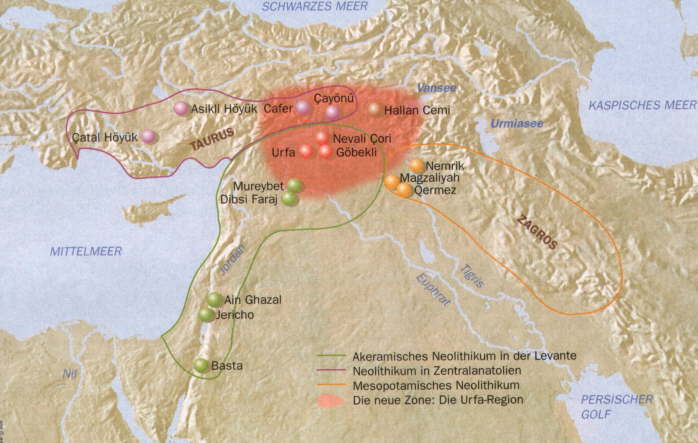
Map of the Near East showing Gobekli Tepe,
which is near the ancient city of Urfa in southeast Turkey

They are credited with having revealed the forbidden arts and sciences of Heaven to mortal kind, causing mankind's fall from divine grace, and his expulsion from the Garden of Eden.

The Story of the Watchers
In both the book of Genesis (chapter six) and the book of Enoch, the rebel Watchers are said also to have come upon the Daughters of Men, i.e. mortal women, who gave birth to giant offspring called Nephilim. For this transgression against the laws of Heaven, the renegades were incarcerated and punished by those Watchers who had remained loyal to Heaven. The rebel Watchers' offspring, the Nephilim (a word meaning "those who fell), were either killed outright, or were afterwards destroyed in the flood of Noah. Some, however, the book of Numbers tells us, survived and went on to become the ancestors of giant races, such as the Anakim and Rapheim.

I wrote that the story of the Watchers is in fact the memory of a priestly or shamanic elite, a group of highly intelligent human individuals, that entered the Upper Euphrates region from another part of the ancient world sometime around the end of the last Ice Age, c. 11,000-10,000 BC. On their arrival in what became known as the land or kingdom of Eden (a term actually used in the Old Testament), they assumed control of the gradually emerging agrarian communities, who were tutored in a semi-rural life style centred around agriculture, metal working and the rearing of animal live stock. More disconcertingly, these people were made to venerate their superiors, i.e. the Watchers, as living gods, or immortals.

The precise same region of the Near East, now thought to be the biblical Garden of Eden, has long been held to be the cradle of civilization. Here a number of "firsts" occurred at the beginning of the Neolithic revolution, which began c. 10,000-9000 BC. It was in southeast Turkey, northern Syria and northern Iraq, for example, that the first domestication of wild grasses took place, the first fired pottery and baked statues were produced, the first copper and lead were smelted, the first stone buildings and standing stones were erected, the first beautification of the eyes took place among woman, the first drilled beads in ultra hard stone were produced, the first alcohol was brewed and distilled, etc., etc. In fact, many of the arts and sciences of Heaven that the Watchers are said to have revealed to mortal kind were all reported first in this region of the globe, known to archaeologists as Upper Mesopotamia, and to the people of the region as Kurdistan.

Sean Thomas acknowledges my help at the beginning of the The Genesis Secret, which follows exactly the same themes as From the Ashes of Angels (and my later book Gods of Eden, published in 1998), including the fact that the Watchers and founders of Eden were bird man, i.e. shamans that wore cloaks of feathers, and that local angel worshipping cults in Kurdistan, such as the Yezidi, Yaresan and Alevi, preserve some semblance of knowledge regarding the former existence of the Watchers or angels as the bringers of civilization. Their leader, they say was Azazel, known also as Melek Taus (or Melek Tawas), the "Peacock Angel". Azazel is a name given in the book of Enoch for one of the two leaders of the rebel Watchers (the other being Shemyaza).

It is an honour for my work to be acknowledged in this manner by Sean Thomas, especially as The Genesis Secret has become a bestseller (as was From the Ashes of Angels in 1996). I won't spoil the plot, so will not reveal Sean's conclusions, or indeed the climax of the book, although I must warn you that it is extremely gory in places!


A Clue in Albinism
I am sure people will ask me about some of Sean's assumptions in his book regarding the origins of the Watchers. All I can say is that in my opinion accounts of the Watchers from so-called Enochian literature, the earliest forms of which were found among the Dead Sea Scrolls, tend to suggest that at least some of their number bore physical traits resembling those of tall albinos with long, serpentine faces, penetrating eyes, long wiry, white hair and skin as white as snow but also as red as a rose. It is even suggested that the Watchers might have used oils in order to protect their sensitive skin from the affects of direct sunlight, another common trait of albinos.

In medical science albinism is the result of a recessive gene that effects only one in every two or more generations of offspring. In other words, if the gene exists in previous generations of a family line then a couple with no albino traits themselves can produce offspring with albino traits. Such recessive genes cannot, in theory, produce whole families of albinos, even though extremely fair features in Caucasians can be classed as a form of mild albinism, and these traits can be passed on from one generation to the next.

This said, if in the past, albinism was seen as a special or mystical trait in humans, whereby (as was the case in parts of Africa in the past) albino children were set aside at birth, removed from their parents and trained as priests or shamans, then it is possible that elite groups of shamans could have contained a high proportion of individuals with such striking characteristics. Today, in various African cultures albinos are still seen as having magical powers, a belief that has degenerated in some regions into a macabre trade in albino body parts, which are used in spell potions by witch doctors, since they are believed to bring about good luck. In Tanzania in particular, albinos live in fear of being abducted, maimed and killed in this sick trade, something that has only recently been exposed by the international news media.

It is possible that groups of shamans, including individuals with distinctive albino features, were forced to migrate from one part of the ancient world to another at the end of the last Ice Age due, perhaps, to severe climatic upheavals (caused perhaps by a comet fragmentation, c. 11,000-10,000 BC, a matter I discuss in two books Gateway to Atlantis, 2000, and the new book Beneath the Pyramids). If so, then their entry into a foreign territory, such as Upper Mesopotamia, where the Palaeolithic hunter gatherers might have been, say, shorter with dark features and more rounded heads, could have led to this shamanistic group of individuals commanding instant recognition as social and/or religious leaders with virtual otherworldly qualities. An acceptance of their assigned rank might have been compounded not simply by their strange appearance and apparent difference in height, but also by their existing knowledge of life skills, such as agriculture, metal working and other forms of primitive technology, such as lapidary, ceramics, stone construction, and the manufacture of drugs and alcohol, beer in particular. It is thus possible that the Watchers used this situation to their advantage, perpetuating the belief that they were quite literally divine beings, the same stance adopted by the first Europeans to encounter native peoples of the Americas. In this manner the incoming Watchers, as they became known, were able to more easily control the emerging population of the Near East through fear, respect and total domination. In this manner, the memory of the Watchers has survived in ancient texts, such as the book of Enoch, as the sudden appearance of a race or gods, angels or immortals that came out of nowhere and revealed to mortal kind the forbidden arts and science of Heaven.

It is remotely possible that the Watchers, as flesh and blood individuals with albino traits, represented the last strains of a former branch of humanity, perhaps an offshoot of the Neanderthals or even Homo Heidelbergensis, who were the precursors of Homo sapien sapiens. Yet such an idea must remain speculation until we find anatomical evidence for the former existence of the Watchers, whose descendents, I have long suspected, existed through until the second millennium BC, when the last of their kind died out. This evidence will one day, hopefully, be found, yet until then the origins of the Watchers must remain a mystery.


Watcher Origins on the Nile
So where did the Watchers as the bringers of civilization come from in the first place? I have always maintained that prior to their appearance in Upper Mesopotamia, the original Garden of Eden, sometime around the end of the last Ice Age, the ancestors of the Watchers thrived among the advanced Palaeolithic communities of Upper Egypt. If so, then perhaps they were the social and religious motivators behind Palaeolithic groups such as the Isnan and Qadan, who thrived c. 13,500-10,500 BC, and possessed a superior form of microblade technology, unequalled anywhere else in either Europe or Western Asia. The Isnan and Qadan also lived in organized settlements, unlike anything else existing in the ancient world until the coming of the earliest Pre-Pottery Neolithic communities of Upper Mesopotamia, the builders of Gobekli Tepe, and would seem even to have developed a proto form of agriculture, the first anywhere in the world.

Did the ancestors of the Watchers leave Upper Egypt for new territories at the end of the last Ice Age, c. 10,500 BC, when the advanced life style of the Isnan and Qadan vanishes virtually over night? Was such a move prompted by climatic changes, perhaps instigated by some kind of global cataclysm, such as the aforementioned comet fragmentation, a subject much debated among scientists today?Others have seen fit to explain the sudden appearance of the Watchers as the bringers of civilization in Upper Mesopotamia around the end of the last Ice Age in different ways.
Image
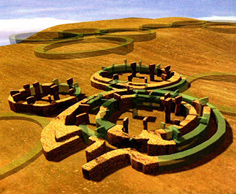
Reconstruction of Gobekli Tepe (Pic credit: DAI/German Archaeological Institute)

For instance, anthropological writer and physician Stephen Oppenheimer in his essential book East in the East (1998) saw the original homeland of the long-faced founders of civilization as the drowned regions of Southeast Asia. Some have seen the Watchers as having come down from the cold wastes of Siberia, where albinism might have thrived in low temperatures, giving rise to legends of the frost giants (or Northmen) of Nefilheim. Still others see the Watchers as having come from outer space, after the sensationalist books of Zecharia Sitchin, a theory that for me simply doesn't make good sense.


The Watchmen of Gobekli Tepe
Image
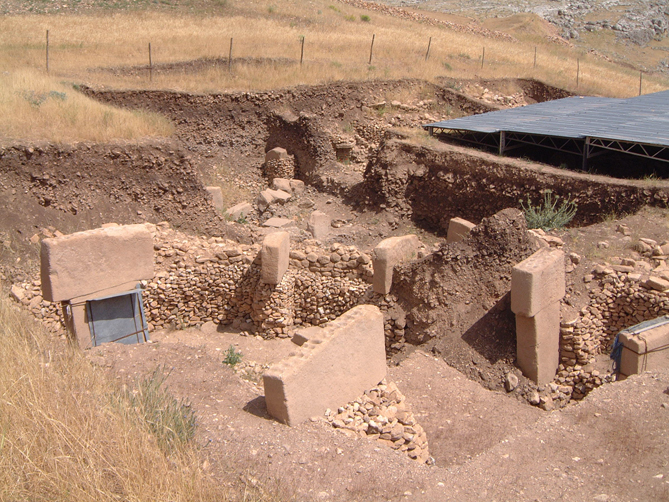
Gobekli Tepe (Pic Credit: Andrew Collins)

That the Watchers might have been behind the creation of Gobekli Tepe, now officially the "oldest temple in the world", and the oldest known megalithic (i.e. great stone) complex anywhere, is almost beyond question, as is their role in the genesis of civilization. As to where their advanced knowledge and wisdom might have come from, the answer is, I suspect, otherworldly journeys using shamanic flight, something clearly indicated by the astral nature of the art found at these proto-Neolithic cult centres, which is predominantly avian in nature.

Yet in addition to reliefs and carvings of birds, including the vulture and ostrich, many other examples of reliefs and sculptures have been found at Gobekli Tepe. These show animals, insects, spiders, reptiles, hybrids and humans, which head excavator Dr. Klaus Schmidt from the DAI (German Archaeological Institute) sees in terms of the "watchman (sic) of the period", a term he uses for those responsible for the construction of these strange, dark monuments of stone. The word "watchman" is so close to "Watcher" that this cannot be coincidence.

That Gobekli Tepe was constructed a full 7,000 years before either the Great Pyramid or Stonehenge is mind numbing in its implications for the history of human capability. More disturbing still is that the descendents of those Watchmen, or Watchers, who built Gobekli Tepe went on to construct further megalithic complexes. As these went on they became cruder and cruder, until the early Neolithic peoples of southeast Turkey were simply erecting uncut standing stones or slabs either in circles or in lines. Much of the finesse of Gobekli Tepe and its contemporaries (Karahan Tepe and Nevali Cori, for instance) was lost, tending to suggest that these people were losing the impetus to create more complex structures. Despite this, we can see here the foundation of the megalithic culture, who then spread, c. 7000-5000 BC, from Upper Mesopotamia carrying with them the technologies and sciences of the Neolithic age, including an understanding of plant domestication in order that the world could settle into a more sedentary life style, away from its previous course of constant hunter-gathering.

Yet it is clear that those who first emerged on the scene in southeast Turkey, c. 10,000 BC, and built Gobekli Tepe, were the ones who possessed the advanced capabilities that kick-started the Neolithic revolution. This is the story told in veiled form within the book of Enoch, unravelled by me in From the Ashes of Angels and Gods of Eden, and novelised in The Genesis Secret by Sean Thomas, writing as Thom Knox. His book is well recommended, although watch the gore, which is quite gruesome in places!


:flop:

_________________
HONORI­FICABILI­TUDINI­TATIBUS
Image
Remiel
VULCANIC PNEUMONO­ULTRA­MICRO­SCOPIC­SILICO­VOLCANO­KONIOSIS


Top
Profile
Post subject: Re: watchers and could I be a decendant of them
PostPosted: Fri Dec 04, 2009 9:17 pm
Offline
Initiate
Initiate
User avatar

Joined: Thu Jun 25, 2009 6:40 pm
Posts: 372
vulcanic wrote:
sheeple hats off to you :flop: get feeling you have a very old soul :flop:
vulcanic, some see it as a puzzle, when it seems that the world falls apart, actually the components of the puzzle rearrange into a new terrifying configuration, but it never ends as the entity that has the power to tear the puzzle apart keeps it steady. :flop:


Top
Profile
Post subject: Re: watchers and could I be a decendant of them
PostPosted: Fri Dec 04, 2009 9:25 pm
Offline
Initiate
Initiate
User avatar

Joined: Thu Jun 25, 2009 6:40 pm
Posts: 372
One theory is that Nephilim were actually surviving Neanderthals.
What if Neanderthals with their light-sensitive skin and red hair were actually descendants...


Top
Profile
Post subject: Re: watchers and could I be a decendant of them
PostPosted: Fri Dec 04, 2009 11:02 pm
Offline
Conspirator
Conspirator
User avatar

Joined: Thu Apr 17, 2008 12:04 pm
Posts: 2508
sheeple wrote:
One theory is that Nephilim were actually surviving Neanderthals.
What if Neanderthals with their light-sensitive skin and red hair were actually descendants...


I agree i posted alot about the connections of the neanderthals and nephilim in this thread a few pages back.

I read a greek story once that talked about them going around the world inviting people to the first games when they came acrossed a tribe of large hairy men they called them werewolfs and killed the whoile tribe, i believe that was one of the last tribes of neanderthals
left...

in ancient times we killed off anything that resembled man but was not a man..thouht it to be evil or satans spawn or made by the gods to torment man.

_________________
HONORI­FICABILI­TUDINI­TATIBUS
Image
Remiel
VULCANIC PNEUMONO­ULTRA­MICRO­SCOPIC­SILICO­VOLCANO­KONIOSIS


Top
Profile
Post subject: Re: watchers and could I be a decendant of them
PostPosted: Fri Dec 04, 2009 11:04 pm
Offline
Conspirator
Conspirator
User avatar

Joined: Thu Apr 17, 2008 12:04 pm
Posts: 2508
vulcanic wrote:
I'de like point out something to you all too..

theres good chance these giants they talk about were Neanderthals that survived ice age , they were older then man here before us and most likely ate mans flesh if no game was around to hunt...

not saying they were for fact but just food for thought.

Or

'''Antediluvian civilizations''' are civilizations believed to have existed before the Great flood of Noah. If the fossil record is indeed the result of the Biblical flood as described in the Bible, then it is somewhat expected for evidence of antediluvian (pre-flood) civilizations to exist. It is assumed by many that humans reached advanced stages of technological development before the flood. Such presuppositions are usually based on the Biblical genealogy, which states that ancient people lived to approximately 10 times our current life span. Also it is frequently mentioned that Adam and Eve would likely possess higher than normal intelligence since they were created as adults, with knowledge that subsequent humans obtain from their parents. Another theory states that the antediluvian race called the Nephilim was superior to other humans in this respect.

All accounts of the Great flood from civilizations around the world indicate that there were civilizations before the flood. However, as a result of the destruction during the flood and the passage of time, the remaining evidence is scanty. As a result of the flood, the earth was covered in hundreds of feet of sediment, and very little of the antediluvian horizon has been exposed. It is also problematic that the scientific community is quick to dismiss any artifacts that dispute their presupposed interpretation of the fossil record. Nevertheless, any truly advanced civilization would have left durable traces or constructions that would likely surface during excavations or by erosion. Relatively insightful accounts can be drawn from the Bible, apocrypha, and ancient Babylonian and Greek accounts of antediluvian civilization. Lets examine whether it is really logical to expect monuments such as the pyramids or better from the civilizations that lived before the flood?


:flop:

_________________
HONORI­FICABILI­TUDINI­TATIBUS
Image
Remiel
VULCANIC PNEUMONO­ULTRA­MICRO­SCOPIC­SILICO­VOLCANO­KONIOSIS


Top
Profile
Post subject: Re: watchers and could I be a decendant of them
PostPosted: Fri Dec 04, 2009 11:05 pm
Offline
Conspirator
Conspirator
User avatar

Joined: Thu Apr 17, 2008 12:04 pm
Posts: 2508
vulcanic wrote:
I found this it's a interesting read.

Could some fossil human bones and teeth that occur in caves be the remains of people who lived before the flood, who were destroyed in the great catastrophe? It seems unlikely that these cave sites all represent deliberate burials, or that whole races of man actually lived in caves in the past; the deeper recesses of cave systems are generally inhospitable places for man. It also seems implausible to say people kept falling down crevices and potholes, to become trapped inside caves, an explanation sometimes invoked to explain the presence of animal fossils in caves, which often include creatures that do not normally inhabit caves.
Many of the human fossils in European caves are Neanderthal types, a race which has become extinct. These were powerful, muscular people, such as Genesis 6:4 suggests was characteristic of at least some of the races of the antediluvians.

Most accounts of the human fossils mention stone implements associated with the fossil remains, which, if true, seems incompatible with an interpretation of these fossils as those due to drowning and burial in sediments of the flood, but perhaps there are other possible explanations for these objects. One suggestion is that investigators have mistaken naturally broken pebbles and stones of flint for tools worked by man. Dr Chris Stringer of Britain's Natural History Museum is quoted as saying:

"The argument is that these things may not be human artifacts at all. If you look at enough pebbles, you'll see some that look as if they have been artificially shaped." (The Times, 21 June 95, page 16. Cited in Britain's 'Oldest' Man.)
Genesis 4:22 indicates that the use of iron and brass was known to man before the flood, so, from a creationist viewpoint, it would seem that the evolutionary ideas of a "stone age" in man's early history may be simply misguided. Yet there are tribes still around, or that existed until quite recent times, that used primitive "stone age" technology, such as the Australian aborigines.

Some human fossils occur without alleged "tools" associated with them, but occur along with bones of extinct animals, which appears to fit the idea of these being the remains of antediluvian people. Some finds may represent reburials of fossil remains of flood victims. However, probably not all human remains from the caves are those of antediluvian man; some could represent burials of those who died since the flood, as suggested in the story in Genesis 25:9 about the burial of Abraham in a cave in Palestine. Where fossils occur lying in a fetal position, it seems to be a good indication of a deliberate burial.

The table below presents a list of some of the human fossils. Since about 6,000 human fossils are known, this is only a representative sample. In this list, the evolutionary sequence that is usually imposed on the fossil data has been discarded; references to dating schemes and associated implements, etc. have been dropped, as these involve interpretation. Other data that may possibly be appropriate for a proper interpretation may have been omitted. I encourage comments and suggestions for additions to the list and about any further details that may be relevant. I suggest that for a Creationist understanding of the human fossils, one should perhaps start with bare data, stripped of interpretations, (which is sometimes difficult to do) and consider how it may best fit the information God has provided us in Genesis about human origins. This list attempts to present bare facts; the order of fossils listed is roughly that of discovery, not the evolutionary one seen in most text books.

The statements in Genesis 6:1-13 about the conditions in antediluvian times may be helpful for our interpretation of these fossil finds; a possible mechanism by which they came to be buried in the caves is suggested by my disintegration theory of the drift. It is interesting and significant to note how many of the fossils listed below are from caves. I would be interested in hearing about other significant fossils that could be added to the list, and especially about references to the details on particular circumstances of burial of the fossils, as this seems especially relevant to the proper interpretation.

Summary of data on typical human fossils
In Belgium, a partial cranium of a 2.5 year old child was found in 1829. In 1936 it was identified as Neanderthal. (I am not sure if this one was in a cave.)
An adult cranium was found in cave on Gibraltar in 1848; it was identified as Neanderthal in 1864.
In 1856 the original 'Neanderthal' fossil bones were discovered during quarrying operations, in a cave, called Feldhofer Grotto, formed in Devonian limestone. The location was the Neander Valley, in the valley of the Dussel, Germany. He had a low vaulting skull, massive brow ridges and a prominent occipital bone. The fossil remains included thigh bones, part of a pelvis, some ribs, and some arm and shoulder bones. His limbs were stout and strong as can be inferred from the markings left on the bone by the once-attached muscle. The lower left arm had been broken in life, and as a result the bones of the left arm were smaller than those of the right. Estimates have put this individual at 50 years of age at the time of his death.
At Les Eyzies, France, in 1868, four human fossil skeletons of CroMagnon man were discovered accidentally when road builders broke into a cave in a cliff of Cretaceous limestone. Two of the skeletons were described as lying in a fetal position. Many other caves occur in the area. Bones of reindeer, bison and mammoth were also present. Among the CroMagnon people, women were shorter than the men. Fossils of the CroMagnon race are widely distributed in caves of Europe.
A limestone cavern in Brazil, on the borders of the Lagoa do Sumidouro, near from Santa Lucia, was excavated by Dr. P.W. Lund; he uncovered the bones of more than thirty individuals (human) of both sexes and various ages. The skeletons lay buried in hard clay overlying the original red soil forming the floor of the cave and mixed together in great confusion. They were not only jumbled with one another but with the remains of the Megatherium and other Pleistocene mammals. This precludes the idea that they had been entombed by man. All the bones, whether human or animal, showed evidence of having been contemporary with one another. In other caves investigated by Lund, bones of ancient men were found alongside those of the formidable Smilodon, a giant feline which became extinct during the last Pleistocene times. Referring to the evidence from these and other Brazilian fossiliferous caves, the Marquis de Nadaillac wrote in 1870 [quoted in Hapgood, p. 290]:
" ...Doubtless these men and animals lived together and perished together, common victims of catastrophes, the time and cause of which are alike unknown."
In 1886, Marcel de Puydt and Max Lohest discovered 2 almost complete Neanderthal skeletons, in a cave at Spy d'Orneau, Belgium. Along with the human fossils were fossils of extinct cave bear, mammoth, and wooly rhinocerous.
In 1899, Dragutin Gorjanovic-Kramberger excavated the cave of Krapina in Croatia. Amongst thousands of animal fossils, there were many human fossils including the remains of at least 60 Neanderthals including children. The presence of children and adults together in the same cave suggests they died in some unusual way, rather than by natural causes.
The "Mauer Jaw", or "Heidelberg Man", was discovered in a gravel pit near Heidelberg, Germany, in 1907. It consists of a lower jaw with a receding chin and all its teeth. The jaw is extremely large and robust. [This fits the statement about the antediluvian period in Genesis 6:4: "There were giants in the earth in those days."]
In a limestone cave near La-Chapelle-aux-Saints, France, a fossil of a Neanderthal dubbed the "Old Man" was discovered by three French priests, Abbes A. Bouyssonie, J. Bouyssanie and L. Bardon, in 1908. It was a nearly complete skeleton; skull with a brain size of 1620 cc. The specimen was between about 30 and 40 when he died, but had a healed broken rib, severe arthritis of the hip, lower neck, back and shoulders, and had lost most of his molar teeth. He was found along with fossil bones of numerous animals such as wooly rhinoceroses, reindeer, hyenas and bison.
Olduvai Gorge, Tanzania, was the site of the discovery in 1913 of a complete, anatomically modern human skeleton, by Hans Reck.
The fossil known as Rhodesian Man, from Broken Hill in Northern Rhodesia (now Kabwe in Zambia), was discovered in 1921. It consists of a complete cranium, very robust, with large brow ridges and a receding forehead. The brain size about 1280 cc.
Peking Man; Homo erectus (Sinanthropus pekinensis) was found at Zhoukoudian (or Choukoutien), in caves near Beijing (formerly Peking), in China, between 1929 and 1937. Various skulls and skull fragments of adults and children were found in the Lower Cave; a number of fossils of modern humans were also discovered in the Upper Cave at the same site in 1933. The original fossils disappeared in 1941 while being sent to the United States during World War II. Since then, other Homo erectus fossils have been found at this site and others in China.
The brain case of an adult Neanderthal was found in a cave at Sterkfontein, South Africa by Robert Broom, in 1936.
Shanidar cave, Iraq, excavated by Ralph Solecki between 1951 and 1960, yielded 9 Neandertal skeletons. One was partially blind, one-armed and crippled.
At Petralona, Greece, a skull, known as Petralona 1, was found in 1960. The brain size was 1220 cc. It has some Neandertal characteristics, featuring a large face with particularly wide jaws.
Jebel Qafzeh, Israel, is a cave site where human remains include those of adults, infants and one small child; tools of Levallois-Mousterian type were present.
A gravel pit at Steinheim, Germany, yielded the skull of a young female Neanderthal. The cranial capacity was 1070 cc. The skull itself was long and narrow and was missing the mandible, and the left side of the face. The large brow ridges and powerful jaw were those of a Neanderthal while the rounded back of the skull was that of a modern hominid. The features were less specialized than those of the classic Neanderthals.
Paviland Cave, on the Gower peninsula, Wales, contained the remains of a young man (originally thought to be a woman) which became known as "The Red Lady of Paviland" because the bones had been stained with red ochre. They were buried in red clay along with stone, bone, and ivory tools, a necklace of shells, and many types of animal bones. [This was probably the tomb of an ancient warrior.]
Several skull fragments were found in the Thames Valley, at Swanscombe, England, in a layer of river sediment located two feet below the surface. The fragments consist of a left and a right parietal which were pieced together like the pieces of a jigsaw puzzle. They were well preserved and indicate that the individual was a young adult, most possibly a female, with a cranial capacity of approximately 1325 cc. The pieces represent a modern-looking individual with the exception that the bone fragments found are thicker than in modern man. The human fossils were found with numerous remains of 26 animal species such as wolf, lion, and horse.
An almost complete fossil cranium of Homo erectus, known as KNM-ER 3733, was discovered at Koobi Fora, Kenya, in 1975. Brain size is about 850 cc. The skull is similar to the Peking Man fossils.
A fossil known as the "Saint-Cesaire Neandertal" was found in 1979 by Francois Leveque, at Pierrot's Rock, near the village of Saint-Cesaire in France. The site is situated along a small stream at the base of a limestone cliff.
In 1994 a human shin bone was found during excavations in a quarry at Boxgrove, near Chichester, West Sussex, South England. Boxgrove man is thought to have been powerfully built, and over 6 feet tall, possibly resembling Heidelberg Man. Two teeth have also been found, along with animal bones.


:flop:

_________________
HONORI­FICABILI­TUDINI­TATIBUS
Image
Remiel
VULCANIC PNEUMONO­ULTRA­MICRO­SCOPIC­SILICO­VOLCANO­KONIOSIS


Top
Profile
Post subject: Re: watchers and could I be a decendant of them
PostPosted: Fri Dec 04, 2009 11:07 pm
Offline
Conspirator
Conspirator
User avatar

Joined: Thu Apr 17, 2008 12:04 pm
Posts: 2508
sheeple wrote:
One theory is that Nephilim were actually surviving Neanderthals.
What if Neanderthals with their light-sensitive skin and red hair were actually descendants...


there were giants (in the earth) in those days....
cavemen ?

notice they did not say (on the earth) but they said (in the earth)

_________________
HONORI­FICABILI­TUDINI­TATIBUS
Image
Remiel
VULCANIC PNEUMONO­ULTRA­MICRO­SCOPIC­SILICO­VOLCANO­KONIOSIS


Top
Profile
Post subject: Re: watchers and could I be a decendant of them
PostPosted: Sat Dec 05, 2009 7:18 am
Offline
Writer
Writer

Joined: Tue Nov 24, 2009 6:43 pm
Posts: 44
Wow A lot to process, thank you all and Volcanic you are a wealth of info, so thank you so much, and thanks for the time you spent putting this info out there once again thank you.

peace and cheers