jueves, 13 de agosto de 2009

Webs de Referencia (78) :: Comic Vine

Un sitio lleno de información e imágenes de toda clase de comics y personajes. Una fuente de inspiración sensacional.

Enlace:

http://www.comicvine.com/

EL ROL ES PARA GRANDES MINORÍAS

No me canso de leer, y otros de escribir, con nostalgia y hastío, que los dorados años del Rol pasaron, que la gente nueva no está preparada, y que los juegos y las partidas han perdido calidad.

Como llevo casi veinte años jugando sin parar me parece que puedo ofrecer mi opinión.

El Rol siempre ha estado medio muerto y ha vivido para ver otro día. ¿Qué quiere decir esto? Que siempre hay poca gente que entienda y le guste el Rol. Con el tiempo, estos jugadores mejoran, se vuelven sofisticados, o lo abandonan y entran otros nuevos. Es ley de Vida. Pero el nicho ecológico, el espacio, permanece. Nunca desaparece. Siempre hay gente jugando y comprando libros, tanto de los "buenos" como de los "malos" (cada uno sabrá lo que le gusta)

Los jugadores de rol, y los que pretendemos crear, o creamos, Juegos de Rol, debemos centrarnos en crear maravillosas partidas y maravillosos Juegos, que es para lo que estamos. Otras consideraciones, más opinables, son innecesarias.

¿POR QUÉ TODOS LOS JUEGOS DE ROL SE PARECEN TANTO EN LA FORMA Y SON TAN LIMITADOS?

Una cosa que me irrita de los juegos de rol, tanto de los libros como de los mundos que crean para el jugador, es la casi simétrica similitud. Será que, como llevo más de quince años (casi veinte) jugando, leyendo, comprando y leyendo libros de rol ya estoy hastiado, pero cualquiera que hoy en día tenga emule o torrent sabrá que lo que digo es cierto.

Cuando cae en tus manos un libro de rol sabes que su contenido será:

- Introducción a lo que es un juego de rol.
- Introducción al mundo del juego.
- Creación del personaje. Con seis o siete razas, y seis o siete profesiones (como mucho).
- Equipo y/o conjuros.
- Sección de Geografía e Historia del Mundo
- Sección del Director de Juego, que jamás de los jamases nadie se lee.
- Todo escrito en un lenguaje mitad llano, mitad técnico, para que todos lo entiendas pero
sobre todo porque son instrucciones del juego.

No digo que lo anterior esté mal. De hecho, es necesario. Pero hay que saber innovar y ser original. Hay que saber atraer al lector a lo menos interesante, y desde luego hay que ir más allá de lo ya hecho.

Leonardo Davinci decía "inútil alumno el que no supera al maestro". Tengo la impresión de que, después de Tolkien y Gigax, y uno o dos más que merece la pena resaltar, el resto ha ido a remolque de los maestros. Y eso es grosero y vergonzoso. Por lo menos según mi opinión.

UN FINAL TRISTE ES UN FINAL INCONCLUSO

No creo en los finales tristes. Soy una persona que sabe que todo es para bien, y que todo es para mejor. Así que merece la pena alargar la historia que se cuenta hasta llegar a ese final feliz.

Sin embargo, sólo la Literatura Fantástica se puede permitir el lujo de ser siempre optimista. Todas las demás disciplinas creadas por el ser humano necesitan de "finales tristes" para lanzar su mensaje, o por lo menos ser coherentes con sus principios: Filosofía, Religión, Historia, Cine, Teatro...

Pero si te ves obligado a invertir un fin de semana entero en una obra de ficción, una novela, ¿qué menos que tenga un final feliz que te haga sentir bien contigo mismo, más feliz, más sabio?

Quizá por eso me dedico a escribir una obra de Ficción. Para traer ilusión, entusiasmo, optimismo, felicidad y radiante esperanza al mundo. Lo que a mí me gusta ver en esa clase de trabajos. Lo que yo pagaría por conseguir.

"Trata a los demás como te gustaría que te trataran a ti". El primer consejo que me dió mi madre de pequeñito, y todavía me acuerdo (¡Y tenía cinco años!) Qué gran verdad.

The break-up of the PrGmc speech-community

Fuente:

http://www.chiark.greenend.org.uk/~marisal/ie/germanic.html

Información:

The break-up of the PrGmc speech-community

Divisions may have appeared within Germanic around 100 AD.

The traditional classification of the Germanic family is as follows:

                          Proto-Germanic
___________________|____________________
| | |
Proto-West Germanic Proto-Norse East Germanic
_____|_____ ____|____________ (Gothic)
| | | |
Ingvaeonic | West Norse East Norse
__|_____ | __|__ ____|____
| | | | | | | | |
English | Dutch | Icelandic | Danish | Gutnish
| | | |
Frisian German Norwegian Swedish

Troll - Cyberclip

Fuente:

http://www.cyberclip.com/Katrine/NorwayInfo2/words/troll.html

Información:

Troll

(1616) [Norwegian troll and Danish trold, from Old Norse troll: a giant, demon]

A dwarf or giant inhabiting caves or hills. Ugly, powerful and generally dangerous humanlike creatures, but stupid and naive.

Some trolls were believed to be giants, and the biggest of them all was Dovregubben (their king in the mountain Dovre). They were shaggy and rough-haired, with trees and moss-like growth on their heads and noses, their noses were long and they would stir with it when cooking broth or porridge. Some even had two or three heads, some only had one eye in the middle of their foreheads. Their features differed from humans with four fingers and four toes and a tail ressembling that of a cow. The trolls lived to be hundreds of years old, but would die and turn into stone if the sun caught them. They might have looked frightening, but were actually often good natured and terribly naive, so sly peasants would successfully trick them. Their supernatural powers consisted among others of transforming themselves, for instance into beautiful young ladies. Many hunters and farmers were such lured into the mountains and captured, but the trolls could never hide their tails, if you only could get to see them from behind you would know if the captivating creature was a troll or just a beautiful shepardess.

The author Henrik Ibsen made them famous in his play Peer Gynt. Ibsen asked the composer Edvard Grieg to write the incidental music for this drama, and the music he wrote became one of the major works of the 1870s. In Grieg's own lifetime the "Peer Gynt" music scored a resounding international success thanks, not least, to the two orchestral suites which made the music accessible in the concert hall. The "Dovregubbens hall" (The hall of the king of the trolls) is one of the most known and famous part of this concert today.

Harold Bloom writes in The Western Canon:

"Ibsen's dramatic psychology centers upon the figure of the troll, suddenly popular again in children's dolls. The wild-haired little imps that I pass in the storefronts have, however, a rather more benign aura than Ibsen's trolls, who are authentic demons."

And H. Bloom says further on that in most humans there is a troll, and that Ibsen's play masterly shows this.

There are actually other Trolls in Norway today, known to be unusually sporty and dynamic - Ladies and Gentlemen: the Vålerenga Trolls who play American football!

Harold Bloom: The Western Canon, The Books and School of the Ages, Harcourt Brace & Co., New York, 1994

Saga - Cyberclip

Fuente:

http://www.cyberclip.com/Katrine/NorwayInfo2/words/saga.html

Información:

Saga

[Old Norse saga (related to segja, "to say") means "what is said, or told".
This derivation indicates the importance of oral tradition.]

Sagas are prose narrative recorded in Iceland in the 12th and 13th centuries of historic or legendary figures and events of Norway and Iceland. Modern sagas would then be heroic narrative resembling the Icelandic saga.

The so-called saga age was about 930 to 1050 and the sagas were written down during the period from about 1190 to 1320.

One of the greatest Icelandic skaldic poets was Egill Skallagrimsson (910-990). He wrote Egils saga (c. 1220), attributed to Snorri Sturluson. After the death of two sons, he composed Sonatorrek ("Loss of Sons," or "Revenge Denied") (961).

Another great Icelander was Snorri Sturluson (1179-1241), poet, historian, and chieftain, and a descendant of Egill Skallagrimsson.

The sagas are classified like this:

  • Kings' sagas; recounting the lives of Scandinavian rulers, and reflecting the continued interest of the Icelanders in their old homeland. The earliest collections of them appeared in the period from 1200 to 1235.
    • Morkinskinna, anonymous.
    • Fagrskinna, anonymous.
    • Heimskringla ("Orb of the World") by Snorri Sturluson. A history of the Norwegian kings from their legendary descent from the warrior-wizard god Odin down to Magnus Erlingsson (1184).
      A three-volume English translation by Samuel Laing (1844) has been frequently reprinted.
  • Icelanders' sagas, or family sagas; heroic prose narratives written 1200-20 about the great families who lived in Iceland from 930 to 1030. They represent the highest development of the classical age of Icelandic saga writing.
    • Egils saga, often attributed to Snorri Sturluson.
    • Gísla saga, a great outlaw story. The best English translation, by G. Johnstone, was published in 1963.
    • Njáls saga; usually considered the greatest Icelandic saga of all, telling of the fortunes of the hero Gunnar and of the wise Njáland his sons.
  • Legendary sagas; essentially romantic literature, with an idealized picture of the remote past, often strongly influenced by French romance literature. The main emphasis is on a lively narrative, entertainment being their primary aim and function. For the learned men on Iceland, the pagan past was a proud inspiration. They copied traditional poems on mythological and legendary themes. Some of these narrative poems served as the basis for sagas in prose.
    • Edda (probably written c. 1225), a handbook on poetics, by Snorri Sturluson. He arranges and recounts the legends of Norse mythology in an entertaining way.
    • Edda also contains a summary of the legendary Nibelungen cycle.
    • Hrólfs saga kraka; which is related to the Old English poem Beowulf.
    • ... and more ...

Skald - Cyberclip

Fuente:

http://www.cyberclip.com/Katrine/NorwayInfo2/words/skald.html

Información:

Skald

[from Old Norse skald]

The skalds were court poets composing skaldic verse in praise of chieftains of the Scandinavian lands. Skaldic verse was devised in Norway in the 9th century. It is not easy to understand because of the complexity of the syntax and of the numerous metaphors known as kennings alluding to specific myths. The skaldic poets wrote in short, eight-line strophes and used a complicated system of alliteration, as well as internal rhyme and consonance.

An ancient Scandinavian poet or historiographer. Synonym: bard.

The skaldic verse differs fundamentally from the traditional Germanic and Eddic forms in that the syllables are strictly counted and the lines must end in a given form.

Russians - cyberclip

Fuente:

http://www.cyberclip.com/Katrine/NorwayInfo2/words/russians.html

Información:

Russians

The Scandinavian Vikings did not only go raiding south, they also went east, all the way into the heart of Russia. They were at one time dominant at Novgorod, Kiev, and other centres, but were rapidly absorbed by the Slavonic population. They gave their name of Rus, "Russians" to these inhabitants

Webs de Referencia (78) :: The Viking Network

Fuente:

http://www.viking.no/

Información:


Besøk Vikingenes verden

Vikinge-funderinger

The Viking calender was different from the ones used today.

See the Viking calendar for 2006


Get to know the Vikings

Viking reflections


ET VISDOMSORD FRA HÅVAMÅL:
GJESTFRIHET
Vatn og handkle
og vennlige ord
trenger mannen før måltid;
gjestfritt sinn
vil han gjerne møte,
tale og taushet igjen.


A VIKING WORD OF WISDOM:
COURTESY
A guest needs
giving water
fine towels are friendliness.
A cheerful word
a chance to speak
kindness and concern.

Supported by the Royal Norwegian Ministry of Education, Research and Church Affairs

Designed by Yngve Skråmm, The Viking Network
Last updated January 4, 2006

Viking - ciberclip

Fuente:

http://www.cyberclip.com/Katrine/NorwayInfo2/words/viking.html

Información:

Viking

(1807) [from Old Norse vikingr].

Also called norseman, or northman. Pirate Norsemen (Danish, Norwegian and Swedish seafaring warriors) who plundered, raided and colonized wide areas of Europe from the 9th to the 11th century.

Viking took on the meaning of "pirate" in the early Scandinavian languages, but the name originally meant "a man from the Vik", the Vik meaning the huge "bay" between Norway and Sweden that has been called Skagerrak since 1500. The term Viking Age has come to denote those years from about 800 to 1050 when Scandinavians went on innumerable plundering expeditions abroad.

How the vikings dressed

Viking men first put on a long woolen shirt and long cloth trousers which were held up by a sash or a drawstring. On top of this was worn a sleeved jerkin or a three-quarter coat with a belt. On his feet he would wear socks and soft leather shoes or long leather boots. In battle he would wear an iron helmet and a mail-chain to protect himself.

Viking women wore long linen dresses. It could be either plain or pleated. Over the dress they wore a long woolen tunic, a little like an apron. It was held up by a pair of brooches, sometimes joined by a chain or string of beads. Over the tunic she might wear a shawl. Her legs and feet were covered with thick woolly socks and soft leather shoes.

Both men and women wore fur or woolen hats and cloaks in cold weather. The cloaks were fastened at the shoulder with a brooch or a pin.

Wool was important to keep warm in the cold northern climate. Wherever the Vikings traveled and settled, they brought sheep with them for wool and meat. "The Faeroe Islands" means "the Sheep islands"! The women spun and wove to sew clothes, as well as sails for the ship. They also dyed the threads and cloths with mineral and vegetable dyes of red, green, brown, yellow or blue.

The art and knowledge of dying is still kept alive today, just look at the vibrant colors in the picture above! The shoes to the right are an example of dyed wool made into felt and worked into the desired shape. Here, a child's slippers.

Viking heritage in England

Place names

standard English words with a Scandinavian etymology

art

Related links:

The Viking Network, an excellent site for finding information about the Viking heritige today, origins of place names, family names, standard English words with a Scandinavian etymology. Supported by the Royal Norwegian Ministry of Education, Research and Church Affairs.

Berserker - ciberclip

Fuente:

http://www.cyberclip.com/Katrine/NorwayInfo2/words/berserk.html

Información:

Berserker

Berserker

[Norwegian berserk, Old Norse berserkr ("bearskin")]

In premedieval and medieval Norse history and folklore: a member of unruly warrior gangs dressed in bearskin. They were believed to be able to transform themselves into bears (Old Norse ber means bear).

Their rage and wild behaviour are sometimes explained as the result of the poisonous effect of a mushroom, but it is not proved. The berserkers were Odin worshippers, and the rage could as well be psychopathic, with the worship of Odin and ecstasy as the main goal.

The berserkers attached themselves to royal and noble courts as bodyguards and shock troops. They formed, among others, the household guard of Norway's King Harald I Fairhair.

Webs de Referencia (77) :: Seeing for the people

Fuente:

http://www.seidh.org/

Información:


| Home | Articles and Essays | Workshops | Contact | Links | Site Map | Trance-Portation|


Diana Paxson's First Trance Book, Trance-Portation, Is Now Available!


High Seat Seeing Pythia
for the
People

Diana L. Paxson's Site
for High Seat Seið
and the Core Oracular Method

Since humans first became conscious beings we have sought to foresee the future and make wise choices. Every culture has some kind of oracular practice, from the pythia of Delphi and the völva of the Viking Age to the nabhi of ancient Israel and the nakaza of Japan. Today, modern seers are seeking to rediscover ancient techniques and develop a practice that will serve the community as the oracles did of old.

Background

I first became interested in the possibility of reviving oracular techniques for modern use when I started to explore Viking-Age spiritual practices similar to those attributed to shamans in other cultures. It became clear that in the skills listed under the headings of Seið and Galdor, the Germanic peoples had a magical tradition that was equal in depth and complexity to that of other traditional cultures, which, moreover I could explore without fear of cultural misappropriation. The more I learned about Germanic religion the more I realized that such skills, although they were by no means practiced by everyone, were an integral part of the spiritual life of the community. And in that case, they ought to play a part in the emerging movement to reconstruct Germanic religion (Heathenry or Asatru).

My work along these lines began in 1988 with the runes, which eventually resulted in a book, Taking Up the Runes (Weiser, 2005). In 1989 I gathered together a group to work on the oracular practice which in the lore is referred to as Seidh, Spá or Spæcraft (for a discussion of the terminology, see below). Since 1990, that group (now known as Seiðjallr) has been presenting oracular rituals as a regular service for the San Francisco Bay Area pagan and heathen communities. I have also taught numerous workshops on the practice in various parts of the U.S. and Europe.

Since then, Oracular Seidh (to distinguish it from other practices also listed as Seidh) has become accepted as an aspect of heathenry. However the response to our work at pan-pagan conventions such as Pantheacon has made it clear that people from many different traditions want to ask questions. And when I began doing the workshops, I found that many of those who wanted to learn seið came from pagan traditions other than Asatru. Since it is my feeling that traditional magic ought to be practiced within the context of the culture from which it comes, this presented a problem. However my research into oracular techniques had made it clear that some version of the practice is found in every culture. Thus, it ought to be possible to extract basic principles and practices analogous to the "core" shamanic practices identified by Michael Harner, which could then be combined with mythology and historical examples from given cultures to recreate versions of the practice appropriate for use in traditions such as the Celtic or Greek.

Oracular Skills

Oracle work requires the seer to be able to move into an altered state in which s/he becomes extremely receptive to rapport with the questioner, while at the same time retaining the inner discipline and skill to find and communicate an answer.

Basic skills include relaxation and breathing, working with power animals and spirit guides, structuring a journey, using archetypes and imagery, grounding and reintegration. An accurate understanding of our own strengths and vulnerabilities is essential. We develop these skills by learning to sense and manipulate energy and establish rapport, to clear the channels for information to come through, and acquire and remember information. We must also be prepared to deal with psychological effects and ethical issues.

Since I began presenting oracular sessions in 1990, we have learned a great deal about working with different audiences. For this reason, although all that the essential oracular process requires is one person with a question and another person who is able to move into a trance state in which s/he can find an answer, we have found that the process is much more safe and successful, and yes, entertaining, if it takes place within the context of ritual. Oracle work is most successful as a group activity, in which both questioner and seer are supported by others who are trained to facilitate what is happening. A ritual which evokes a specific cultural context helps questioners to become part of the process.

Terms

Seið, transliterated in English as Seidh or Seith, can also appear as SeiðR (Old Norse nominative form). It is used in the Viking-Age lore for a variety of magical practices involving altered states of consciousness. The list of seidh-skills attributed to the god Odin in Ynglingasaga VII includes:

  • knowing the fates of men and predicting events
  • causing harm by magic
  • causing mental and physical illness
  • taking or giving luck
  • spirit journeying in altered shape while the body lies in trance
  • controlling fire and weather

The first is clearly the oracular form (Oracular Seidh) which is the practice that appears most often in the sagas, especially in The Saga of Eric the Red IV. Modern writers such as H.R. Ellis Davidson refer to the oracular form as seidh, and this is still the best-known term.

Spá (Old Norse) or Spæ (Scots), is a more specific term for Germanic oracular practice, which many prefer. Etymologically it is related to spy, or words from the Latin spectio, "look or contemplate".

Oracle can refer to the medium, or person who gives a prophecy or commandment, the prophecy itself, or the place where the prophet practices. It comes from the Latin oro, "to speak".


Essays on seidh.org

By Diana L. Paxson

By Lorrie Wood

Presentation Schedule

2009-2010 Presentation Schedule: A schedule of where Diana Paxson and/or her working seið group, Seiðjallr, will be presenting during 2009-2010.

Workshops

Hosting a Seið or Core Oracular Workshop: Want to learn how to do this? Here's how to get us to come to you!


| Home | Articles and Essays | Workshops | Contact | Links | Site Map | Trance-Portation|

This page was last modified on Monday, 13 July, 2009 at 11:30:07.
This site and all documents copyright © 1989-2006 Diana L. Paxson and Lorrie Wood, except where otherwise stated. All rights reserved. Our linking and copying policy is simple and straightforward and may be found on our sister site, hrafnar.org

OGAM STONES & CROSS-PILLARS

Fuente:

http://www.irishmegaliths.org.uk/pillarstones2.htm

Información:


OGAM STONES

& CROSS-PILLARS


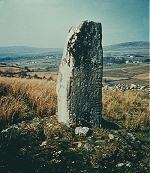
Aghascrebagh, county Tyrone


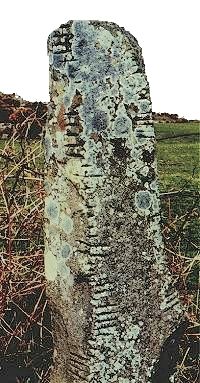
When ogam writing was introduced (probably to Ireland from Wales, though perhaps it was the other way round, or yet again, simultaneous) just before Christianity arrived, some long-standing stones were used for inscriptions which were mostly memorials of named people. The word 'ogam' is derived from Oigmi�, the smith-god who became the script-god. Another aspect of the smith-god is Nuad� of the silver arm (and horned helmet) whose statue (formerly in Armagh Cathedral) is the logo of this site.

He is shown holding his prosthesis. His maiming recalls that of Hephaistos, the smith-god of the Greeks.

Ogam, essentially notches, was admirably designed for carving by adze or axe on beams and large chunks of wood as well as by chisel or even axe on stone. The alphabet was designed in four groups of five letters, thus:


(V can also be read as F)

Detail of one of several stones at Dunloe, county Kerry


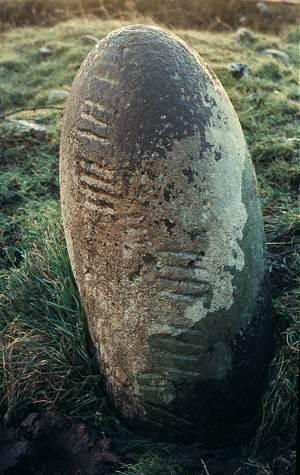
A typical inscription has the name of the person to be remembered, plus MAQI MUCOI ('son of the people of'), followed by the name of an ancestor or divinity.


Drumlohan, county Waterford
click on the picture to see another Waterford stone

Few are now entirely legible, due to weathering and other damage. The letters on the above stone have been enhanced by charcoal, which (unlike chalk) very quickly washes away.

photo by Jim Dempsey

Coláiste Íde, Burnham, county Kerry

As with standing-stones, an ogam-inscribed stone can be quite small. One, at Aghascrebagh in county Tyrone is only 1.5 metres high,


Lugnagappul, county Kerry

while three in the Field of Blood (Parc na Foladh) at Lugnagappul on the Dingle Peninsula, are less than one metre high. As with standing-stones and other prehistoric monuments, white quartzite pebbles are at their base.

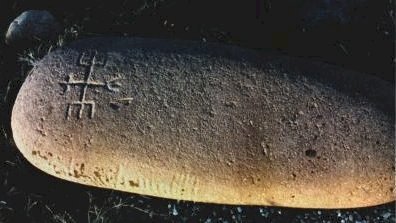
Following the uniquely peaceful Christianisation of Ireland, it was not long before Christian crosses appeared on ogam stones. The Dingle Penininsula has dozens of cross-pillars and cross-inscribed ogam stones, of all shapes and sizes.

Ballinvoher, county Kerry

Ballintaggart, county Kerry


Arraglen, county Kerry - with quartzite pebbles


click for larger photo

Maumanorig, county Kerry
click for a larger picture


Cross-inscribed ogam stones are usually associated with Celtic monasteries which, before the Westernisation of the Coptic-inspired Irish church (which was not completed until long after the Normans were invited over), were run by hereditary abbots.


Ratass, county Kerry


Perforated, ogam-inscribed pillarstone,
with crude cross in front of 12th century church, Kilmalkedar, county Kerry


In Killaloe Cathedral (county Clare) there is a bilingual stone bearing a dedication to a Norse warlord in Old Norse runes and ogam,

while at the great monastery of Clonmacnois one of the many gravestones or pillow-stones for deceased monks bears the name Colman in both ogam and modern characters.


Ogam faded out after the arrival of Christianity, and pillar-stones became more elaborately carved with cruciform and cycliform designs. These are discussed on the page entitled Cross-pillars and Cross-slabs


Kilfountan, county Kerry


Click here to go on to:


CROSS-PILLARS
AND CROSS-SLABS


back to first part


Click here to visit a specialised

OGAM SITE
which includes a stone bearing identical inscriptions in Ogam and in Viking runes.


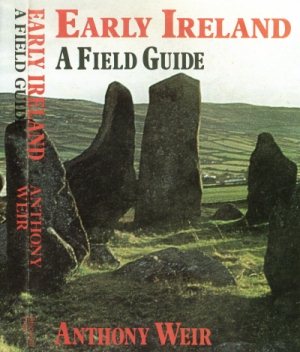
Photos and text anti-copyright by
Anthony Weir, whose
EARLY IRELAND: A FIELD GUIDE
was published in 1980, quickly sold out,
and was never reprinted.

Webs de Referencia (76) :: The Norse Sagas

Fuente:

http://www.timelessmyths.com/norse/sagas.html

Información:

Timeless Myths
Return to the Norse Myths home page Return to the Timeless Myths home page Asgard: information on gods, goddesses, giants and monsters Valhalla: information on heroes, heroines and dwarfs Norse Sagas: tales of Norse and German myths

Norse Sagas

The word "saga", probably mean "What is told". Norse sagas are similar to epic, but usually refer to works compiled during medieval Iceland. Saga is usually a narrative, either in poems or prose, dealing with historical, legendary and mythical subjects, written in Old Norse, during the 13th-14th century.

The Icelandic sagas can be divided into three different categories: Kings' Sagas, Family Sagas, and Heroic or Legendary Sagas. I have chosen to only to deal with the Heroic Sagas, which is often called fornaldar saga or "saga of antiquity". Heroic Sagas concentrated mainly on the Cycle of the Ring or the Nibelungen Cycle, with such heroes as Sigurd/Siegfried.

As for the modern usage of the word "saga", the term is much more confusing, and no longer confine to Iceland or Scandinavian countries. These days, sagas can mean any long novel in modern literature, usually written in the narrative form. I won't go any further about saga in the modern literature.


Norse Sagas contain stories of interest, particularly the Völsunga Saga. The Völsunga narrated the entire saga of family of Sigurd (Völsungs) and the Giukings or the Niflungs (the Nibelungs in the German myth). I had also written a German version of the Völsunga, known as the Nibelungenlied. A Norwegian version, called the Thidrekssaga was written around the same time as the Nibelungenlied, and used both Icelandic and German oral traditions. Thidrekssaga, however, was centred around the hero Thidrek of Bern, usually known in German as Dietrich of Verona.

You will find tales about Völsunga Saga and the Nibelungenlied in the button called Cycle of the Ring. I may include a third version, called Thidrekssaga sometimes in the future.

For those readers who are interested in the gods I have included the Norse creation and Ragnarök. The War of Aesir and Vanir as well a description of Asgard and Midgard can be found in the Creation myths.

I have included a number of tales about Odin, Thor and Loki, the most popular gods in Norse mythology.

You will find a number of German tales with the page titled Dietrich Legend and Other Germanic Tales, where you will find the story of Beowulf.


For those who are interested, I have included the Runic Alphabets in the new Facts and Figures: The Norse Way.


What's New?!!

Added a new page Saga of Hrolf Kraki.

Let me know what you think of it.


Please select one of the buttons below :


Regin reforging the sword for Sigurd

Regin reforging the sword for Sigurd (12th century)
Wood-carving on the door posts in Hylestad Church
Setesdal, Norway


Other useful information includes:

Fact & Figures:
The Norse Way
Enchanted Objects
Faithful Companions
Genealogy
Bibliography (Norse sources)
Copyright Notices

If you have a question or a problem, your answer may be found
in the Frequently Asked Questions (FAQs).
Or go to the Contact page, and email me.


Support Timeless Myths:

Donation to Timeless Myths


Searching for a character or story in the Norse myths?
Why not use the siteLevel Search Engine.

Search

This Site The Web

Get a Search Engine For Your Web Site

This search engine is powered by siteLevel.


Remember that everything written on my site is copyrighted.
Please do not copy anything without permission.

This website should be used as a guide or reference for educational purposes or personal uses.
No permission is granted for commercial use.

See Copyright Notices.


Norse Mythology is a division of Timeless Myths.


Timeless Myths


Timeless Myths and Norse Mythology were created by Bladesmaster.


Timeless Myths also contain Classical, Celtic and Arthurian myths.
Return to Timeless Myths' home page, and check out the other mythology.


www.timelessmyths.com


See Copyright Notices for permitted use.


For feedback, questions, or just to say "hello",
contact can made through the Contact page.
No mailing list or spamming, please.


Norse Creation | Search for Wisdom | Of Thor and Giants | Ragnarok |
Cycle of the Ring | Gautreks Saga | Dietrich Legend | Kudrun | Beowulf

Home | Norse Mythology | Asgard | Valhalla | Norse Sagas | Back

What's New? | About | Bibliography | Fact & Figures | Genealogy | FAQs | Links | Copyright | Contact