sábado, 8 de agosto de 2009

Carnival of the Etymologies

Fuente:

http://vernondent.blogspot.com/2005/10/carnival-of-etymologies_13.html

Información:

Thursday, October 13, 2005

Carnival of the Etymologies

Special Supersized Halloween Edition

Halloween is a mid-18th century Scottish shortening of Allhallow-even, the "Eve of All Saints," which was the last night of October. Hallowmas as the name for All-Saints Day is first attested in 1389. The Christian calendar day Halloween corresponds to the last night of the year in the old Celtic calendar, where it was Old Year's Night, a night for witches. Thus it is another example of a pagan holiday given a cursory baptism during the Dark Ages conversions and sent on its way.

The hallow in this word is Old English halgian "to make holy, to honor as holy," which of course is related to halig, the ancestor of modern holy. It was the word used in Christian translations to render Latin sanctificare. The group of words goes back to an ancient root, *kailo-, meaning "whole, uninjured, of good omen," which also produced health (Old English hælþ), heal (Old English hælan), and whole (Old English hal).


Mischief Nights in 19th century England were the eve of May Day and of Nov. 5, both major holidays, and perhaps the original point was pilfering for the next day's celebration and bonfire; but in Yorkshire, Scotland, and Ireland the night for mischief was Halloween.

Mischief originally came into English (c.1300) meaning "evil condition, misfortune, need, want." Its source is Old French meschief (Modern French méchef), a verbal noun from meschever "come or bring to grief, be unfortunate" (literally the opposite of achieve), which is formed from mes- "badly" and chever "happen," literally "come to a head," ultimately from Latin caput "head."

The meaning "harm or evil considered as the work of some agent or due to some cause" is attested from 1480; and the softened sense of "playful malice" first is recorded in 1784.

The useful Middle English verb mischieve has, for some reason, fallen from currency.


The phrase trick-or-treat is recorded only from 1947, though obviously the customs of dressing up in costumes, and of making food offerings, around this time of year have roots deep in historical and pagan practice.

Candy, on the other hand, was one of the first Asian words to be borrowed into English. It first is attested in a document from 1274, and the immediate source of the borrowing was Old French sucre candi "sugar candy." This word, from the time of the Crusades, was a Frenchified form of Arabic qandi, which itself was borrowed from Persian qand "cane sugar," whicch in turn probably came from Sanskrit khanda "piece (of sugar)." The Sanskrit word itself may have been a borrowing from an earlier Dravidian language of India, since it bears a similarity to Tamil kantu "candy," kattu "to harden, condense."


Jack o'lantern is attested from 1663, a local name for a Will-o-the-wisp (Latin ignis fatuus), the flickering lights sometimes seen over marshes at night. The Jack o'lantern personification is mainly attested in East Anglia but also in southwestern England. The extension to carved pumpkins is first recorded in 1837, in the U.S.

Pumpkin is a 17th century alteration of earlier pumpion "melon, pumpkin," a word known since 1545 (Shakespeare used it in "Merry Wives of Windsor").

Evidently the French encountered pumpkins in their exploration of the New World, gave them a French name that means roughly "large melon," and the word passed from French to English. The word is Middle French pompon, which comes from Latin peponem "melon," which the Romans borrowed from Greek pepon "melon." This probably originally meant "cooked by the sun, ripe," since it seems to be related to the Greek verb peptein "to cook."

Thus the name of the American Halloween pumpkin comes from the language of Socrates and Homer, who never met the thing.

The first record of pumpkin-pie is from 1654. In the time of the American Revolution, when long hair for men was the fashion, pumpkin-head was colloquial for "person with hair cut short all around."


Skeleton was a medical word originally (our non-medical ancestors likely would have referred to it simply as "bones"). It first was used in English around 1578, adopted from Medical Latin sceleton, which in turn was taken from Greek skeleton soma "dried-up body, mummy." The root of this is the verb skellein "to dry up" (source also of sclerosis), from the Proto-Indo-European base *skele- "to parch, whither."

The Greek word had been borrowed into Late Latin as sceletus, which was the direct source of French squelette, Spanish esqueleto, and Italian scheletro.

The meaning "bare outline" is first recorded for skeleton in 1607. This is somewhat obscure now, but it is preserved in the phrases skeleton crew (1778) and skeleton key. The phrase skeleton in the closet meaning "source of secret shame to a person or family" was popularized in 1845 by Thackeray, though he likely didn't coin it.


Ghost is easily recognizable in Old English gast, which meant "soul, spirit, life, breath." It comes from the reconstructed Proto-Germanic root *ghoizdoz, which provided the general word for "supernatural being" across the range of the West Germanic language group (cf. Old Saxon gest, Old Frisian jest, Middle Dutch gheest, German Geist "spirit, ghost").

The surviving senses from Old English, however, are in Christian writing, where the word is used to render Latin spiritus, a sense preserved in Holy Ghost. But comparison with the other German languages makes it clear that the English word, too, certainly originally had a sense more macabre than theological.

In fact, the source of the Germanic words seems to be the Proto-Indo-European base *ghois- "to be excited, frightened" (cf. Sanskrit hedah "wrath;" Avestan zaesha- "horrible, frightful;" Gothic usgaisjan, Old English gæstan "to frighten").

Thus the modern English ghost in the sense of "disembodied spirit of a dead person" (attested from c.1385) returns the word toward its ancient sense.

The gh- spelling was used in works printed by William Caxton, the first English printer, who set up his business in Flanders, then the center of the nascent printing industry, and was influenced by Flemish and Middle Dutch gheest. But this spelling did not become common in English until after c.1550.

Most Indo-European words for "soul, spirit" also double as the word for "supernatural spirit." Many have a base sense of "appearance" (e.g. Greek phantasma; French spectre; Polish widmo, from Old Church Slavonic videti "to see;" and Old English scin, Old High German giskin, originally "appearance, apparition," related to O.E. scinan, Old High German skinan "to shine").

Other "supernatural spirit" concepts are found in French revenant, literally "returning" (from the other world), and Old Norse aptr-ganga, literally "back-comer."

Breton bugelnoz is literally "night-child." Latin manes, literally "the good ones," is a euphemism, a result of Roman superstition against even saying the word for "ghost."

Just as skeleton came to mean "bare outline," ghost in the early 17th century acquired a metaphoric sense of "slight suggestion" (preserved in ghost image, ghost of a chance, etc.). The sense in ghost writing is attested from 1884, but that exact term is not found until 1927.


Witch belongs here, too. I already did that one, but it's fun, so let's do it again.

Witch is Old English wicce "female magician, sorceress," in later use especially "a woman supposed to have dealings with the devil or evil spirits and to be able by their cooperation to perform supernatural acts."

English used to be a fully inflected language, with genders like German or Latin, and wicce is the feminine form of wicca "sorcerer, wizard, man who practices witchcraft or magic."

The nouns all come from the verb wiccian "to practice witchcraft," which has relatives in Low German. But the exact origin of it is lost in the murk of history.

The Oxford English Dictionary simply dismisses it as of uncertain origin. Ernest Klein's etymology dictionary suggests a connection with Old English wigle "divination," and wig, wih "idol."

Calvert Watkins, another noted modern etymology writer, suggests the nouns represent a Proto-Germanic *wikkjaz "necromancer," and thinks this may mean literally "one who wakes the dead." He bases this on the notion that the root of the word is Proto-Indo-European *weg- "to be strong, be lively" (the root of wake (v.) and vigil).

The early 20th century English etymologist Ernest Weekly notes a possible connection to Gothic weihs "holy" and German weihan "consecrate," and writes, "the priests of a suppressed religion naturally become magicians to its successors or opponents."

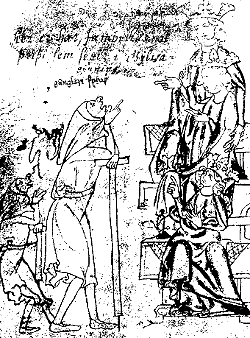
That wicce once had a more specific sense than the later general one of "female magician, sorceress" perhaps is suggested by the presence of other words in Anglo-Saxon describing more specific kinds of magical craft. In the Laws of Ælfred (c.890), for instance, witchcraft was specifically singled out as a woman's craft, whose practitioners were not to be suffered to live among the West Saxons:

"Ða fæmnan þe gewuniað onfon gealdorcræftigan & scinlæcan & wiccan, ne læt þu ða libban."

The other two words combined with it here are gealdricge, a woman who practices "incantations," and scinlæce "female wizard, woman magician," from a root meaning "phantom, evil spirit."

Another word that appears in the Anglo-Saxon laws is lyblæca "wizard, sorcerer," but with suggestions of skill in the use of drugs, since the root of the word is lybb "drug, poison, charm." Lybbestre was a feminine noun meaning "sorceress," and lybcorn was the name of a certain medicinal seed (perhaps wild saffron).

In Anglo-Saxon glossaries, wicca renders Latin augur (c.1100), and wicce stands for "pythoness, divinatricem." One glossary translates Latin necromantia ("demonum invocatio") with galdre, wiccecræft.

But the Anglo-Saxon poem called "Men's Crafts" has wiccræft, which appears to be the same word, and by its context means "skill with horses." And in a c.1250 translation of "Exodus," witches is used as a word for the Egyptian midwives who save the newborn sons of the Hebrews: "Ðe wicches hidden hem for-ðan, Biforen pharaun nolden he ben."

If witch once had a narrower meaning, after the Christian conquest it acquired a much broader one. "At this day," Reginald Scot wrote in "The Discoverie of Witchcraft" (1584), "it is indifferent to say in the English tongue, 'she is a witch,' or 'she is a wise woman.' "


The word bat meaning "flying rodent" is a strange 16th century dialect alteration of Middle English bakke, which probably is related to Scandinavian words like Old Swedish natbakka and Old Danish nathbakkæ, both meaning "night bat," and Old Norse leðrblaka, literally "leather flapper." So the original sense of bat likely is "flapper," and the word may have been somehow imitative of the sound of flapping wings. The shift from -k- to -t- may have come through confusion with the extinct Middle English bakke "nocturnal insect," which derives from Latin blatta "moth."

Given the Scandinavian connections, bat likely is one of the words the Vikings brought to England which displaced the local word. The Anglo-Saxon word for the animal was hreremus, literally "shaky mouse," from hreran "to shake." That's closer to the German fledermaus.


Goblin is a mystery word. It turns up in English about 1327, and it seems pretty clear that it comes from Old French gobelin, but there the trail goes cold. The French word is known from the 12th century, as Gobelinus, the name of a spirit haunting the region of Evreux.

Perhaps the word is related to German kobold "goblin," a compound formed from Middle High German kobe "hut, shed" and *holt "goblin." The second term in this was a euphemism (like Latin manes, under ghost, above), from hold "gracious, friendly." Complimentary words were used to avoid the wrath of troublesome beings.

Harz Mountains silver miners used kobold as their term for rock laced with arsenic and sulphur (so called probably because it made them ill). A metal was extracted from this rock, and identified in the 18th century as an element. It was given the name cobalt.

But it's just as possible that gobelin comes from Medieval Latin cabalus, from Greek kobalos "rogue, knave," kobaloi "wicked spirits invoked by rogues." Yet another suggestion is that it is a diminutive of the proper name Gobel.


Haunt is another Middle English word from French, in this case from Old French hanter "to frequent, resort to, be familiar with." Most of French is from Latin, but French, like English, has a body of words from Old Norse, brought over by the Vikings who settled extensively in Normandy and elsewhere in the Dark Ages.

Thus hanter probably comes from Old Norse heimta "bring home," from the Germanic root of home. The sense is of a spirit returning to the house where it had lived.

The verb originally was not limited to supernatural presences, and it could be applied to living beings, too (a sense preserved in the noun haunts "place or places one frequents"). But the ghostly sense probably was present in ancient Germanic, and its modern use was reinforced by Shakespeare's plays, where it is first recorded in "A Midsummer Night's Dream" (1590).

By coincidence, the Old English verb formed from the word for "home" was hæman, which evolved from "to bring home" to "take home as a sexual partner, co-habit with."

ICELAND - THE VIKINGS

Fuente:

http://www.nat.is/travelguideeng/icelandic_vikings.htm

Información:

ICELAND - THE VIKINGS
.

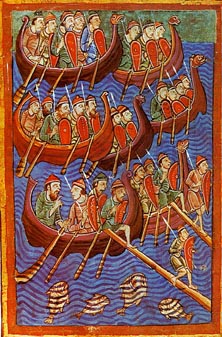
The word Viking is a collective designation of Nordic peoples, Danes, Swedes, Norwegians and Icelanders, who ranged abroad during a period of dynamic Scandinavian expansion in the Middle Ages, from about AD 800 to 1100. Called the Viking Age, the period has long been popularly associated with unbridled piracy, when freebooters came swarming out of the northlands in their predatory long ships to burn and pillage their way across civilized Europe. This, however, is now recognized as a gross simplification. Modern scholarship emphasizes the achievements of the Viking Age in terms of Scandinavian art and craftsmanship, marine technology, exploration, and the development of commerce, the Vikings as traders, not raiders.

Extension of Viking Activities. The derivation of the word “Viking” is disputed. t may be from Old Norse
vik (a bay or creek) or Old English wic (a fortified trade settlement). Not every Scandinavian, however, was a professional warrior or a Viking, and not every Viking was a pirate. The motive causes of Viking Age expansion are complex. Land shortage in Scandinavia, improved iron production, and the need for new markets probably all played a part.

The first recorded Viking raid was a sea borne assault (793) by Norwegian marauders on the holy island of Lindisfarne, just off the northeastern coast of England. Growing evidence indicates, however, that considerable overseas Viking migration, west across the North Sea and east across the Baltic, occurred long before that. Swedish entrepreneurs penetrated the hinterland of Russia, pioneering new trade routes down the Volga and the Dnepr, founding city-states such as Kiev and Novgorod, and opening the way to Constantinople and the exotic markets of Arabia and the Far East. In Constantinople, Vikings formed the elite bodyguard of the Byzantine emperors, the feared and famous Varangian Guard. Danish warriors hammered at the cities of the crumbling Carolingian Empire, Hamburg, Dorestad, Rouen, Paris, Nantes, Bordeaux, until one of the armies in 911 accepted by treaty huge tracts of land in northern France (now known as Normandy, “Land of the Northmen”) and settled there.

Briefly, under King Canute (Knut) II in the 11th century, a Scandinavian empire of the North Sea was established, comprising England, Denmark, and Norway. Norwegian adventurers joined Danish Vikings in subjugating much of northern England (the Danelaw) before settling there as farmers and traders and developing great mercantile cities such as York, while gradually extending their settlement into unconquered northern areas such as Cumbria. They also took over the Northern Isles of Scotland (Shetland and the Orkneys), the Hebrides, and much of mainland Scotland as well. In Ireland they played a lusty part in the internecine squabbles of rival Irish clans, and they founded Ireland’s first trading towns: Dublin, Waterford, Wexford, Wicklow, and Limerick. Viking exploration brought the discovery and settlement of uninhabited lands in the Atlantic—first the Faroes, then Iceland, then Greenland. From Greenland the Vikings launched ambitious expeditions to settle on the eastern seaboard of North America (Vinland), but these attempts to colonize the New World 500 years before Columbus were soon abandoned in the face of hostility from the indigenous peoples. Stories of the abortive American venture are recorded in the medieval Icelandic sagas; but little authentic evidence of the Viking presence has been found, apart from substantial traces of a Viking Age settlement at L’Anse-aux-Meadows, in northern Newfoundland. All other Viking “finds”, such as the Kensington Stone, have been exposed as forgeries or hoaxes, or merely wishful thinking.

Lasting Influences. The impact of the Vikings was less enduring than might have been expected. In general, they had a great capacity for being assimilated into local populations. In some areas of Britain, especially in Cumbria and other locations where settlements were established in previously unpopulated land, concentrations of Norse and Danish place names are the most notable residue of their presence. A century and a half after settling in Normandy, however, their Franco-Viking descendants were strong enough to conquer England (1066) and Sicily (1060-1090). The settlers brought to the British Isles energetic Viking art forms, new farming techniques, mercantile acumen, and a vigorous language; Scandinavian traces are still apparent in the dialects of Scotland and northern England. They introduced new forms of administration and justice, such as the jury system; even the word “law” is from an Old Norse word. Perhaps the most enduring legacy of the Viking Age is to be found in Iceland, which produced the great medieval literature of the sagas.

In their time, the Vikings had criss-crossed half the world in their open boats and vastly extended its horizons. Having achieved that, however, they had neither the manpower nor the staying power, neither the reserves of wealth nor the political experience, neither the cohesion at home nor the confidence abroad to master effectively the older, richer, more stable states they tried to overrun. Their dynamism was gradually exhausted, and even their swift, magnificent ships were superseded—replaced by much larger, more prosaic vessels better suited to bulk cargo carrying.


Víkingaheimar
Fitjum
260 Reykjanesbaer
Ytri-Njardvik
Tel.: 422-2000
info@vikingaheimar.com

Vikingaheimar is open everyday from 11:00 to 18:00

Maritime Museum / Boat Models / Art Museum Reykjanesbaer
Duus hus, Duusgata 230 Reykjanesbaer
Tel: 421-6700 / 421-3155


save

Vikings : The Middle Ages . net

Fuente:

http://www.themiddleages.net/people/vikings.html

Información:

Vikings

vikingsThe term Viking commonly denotes the ship-born warriors and traders of Norsemen (literally, men from the north) who originated in Scandinavia and raided the coasts of Britain, Ireland and mainland Europe as far east as the Volga River in Russia from the late 8th–11th century. This period (generally dated 793–1066) is often referred to as the Viking Age. The term Viking has also denoted entire populations of Viking Age Scandinavia and their settlements, as an expanded meaning.
Famed for their longships, Vikings founded settlements for three centuries along the coasts and rivers of mainland Europe, Ireland, Great Britain, Normandy, the Shetland, Orkney, and Faroe Islands, Iceland, Greenland, Newfoundland circa 1000.[1] They reached south to North Africa and east to Russia and Constantinople, as looters, traders, or mercenaries. Vikings under Leif Ericson, heir to Erik the Red, reached North America, with putative expeditions to present-day Canada, Maine and Southeastern Massachusetts, Including Cape cod in the 10th century. Viking voyages decreased with the introduction of Christianity to Scandinavia in the late 10th and 11th century.
The word Viking was introduced to the English language with romantic connotations in the 18th century. However, etymologists trace the word to Anglo-Frankish writers, who referred to "víkingr" as one who set about to raid and pillage,[2] as in the saga of Egil Skallagrimsson. In current Scandinavian languages, the term Viking is applied to the people who went away on Viking expeditions, be it for raiding or trading. In English and many other languages, Viking might refer to the Viking Age Scandinavians in general.[3] The pre-Christian Scandinavian population is also referred to as Norse, although that term is properly applied to the whole civilization of Old-Norse speaking people.

Ships

There were two distinct classes of Viking ships: the longship (sometimes erroneously called "drakkar", a corruption of "dragon" in Norse) and the knarr. The longship, intended for warfare and exploration, was designed for speed and agility, and were equipped with oars to complement the sail as well as making it able to navigate independently of the wind. The longship had a long and narrow hull, as well as a shallow draft, in order to facilitate landings and troop deployments in shallow water. The knarr, on the other hand, was a slower merchant vessel with a greater cargo capacity than the longship. It was designed with a short and broad hull, and a deep draft. It also lacked the oars of the longship.
Longships were used extensively by the Leidang, the Scandinavian defense fleets. The term "Viking ships" has entered common usage, however, possibly because of its romantic associations (discussed below).
In Roskilde are the well-preserved remains of five ships, excavated from nearby Roskilde Fjord in the late 1960s. The ships were scuttled there in the 11th century to block a navigation channel, thus protecting the city, which was then the Danish capital, from seaborne assault. These five ships represent the two distinct classes of the Viking Ships, the longship and the knarr.
Longships are not to be confused with longboats.

Heathenry - Yawiki.org

Fuente:

http://yawiki.org/proc/Heathenry

Información:

Heathenry is one of several modern revivals of historical Germanic paganism. Heathenry is the term used by many adherents of Germanic neopaganism, especially in the UK.


Heathenry
Overview
Heathenry and reconstruction
Practices and discourses (what Heathens do and say)
Worldview and discourse
Runic magic
Galdr
Seidr
Web resources relevant to Heathenry in Britain
Other sources

top

Overview
While some practitioners use the term Heathenry as equivalent to Paganism, others use it much more specifically. It is used by those who are re-creating the old religion and worldview from the literary and archaeological sources, who describe themselves as "Heathen" in part to distinguish themselves from other pagans whose rituals come from other sources. Some North Americans use Heathenism with a similar intent.

Heathenry differs from Ásatrú in North America in being generally more rooted in the landscape (Blain, 2002a, Harvey 2006 forthcoming) and in this may possibly be more akin to Ásatrú in Iceland and similar religious expression in Scandinavia. Heathenry draws on ideas of a living landscape, close to some expressed by indigenous religions elsewhere. Heathenry, therefore, for many adherents, is about creating a connection between humans and landscape, through the acknowledgement of land- and other wights, ancestors (spiritual and cultural, not necessarily physical) and other beings; it is therefore an animist religion drawing on (for instance) the Old English healing charms, the Icelandic Eddas and Sagas, and folklore elements in creating a religion from today from these and other resources.Shamanic or shamanistic elements are evident and practitioners may use seid and galdr, or shamanistic magic and sung magic, in rituals.

Heathenry relates to both the practices and worldviews of Heathens and to the practitioners - thus Heathenry can mean people who are Heathen, or what they do. In general, Heathens consider that people are called to the religion, perhaps by the gods or by the landscape, regardless of their ethnic origins. In this sense, Heathens are new-indigenes (Blain and Wallis, 2002).

top

Heathenry and reconstruction
Heathenry is often described as polytheistic reconstructionism. Not all Heathens agree with this - saying that their goal is to create religious practice and personal empowerment for today, rather than to imitate or re-enact past rituals. Basically, such construction or reconstruction works from the principle that earlier documents or artefacts (from literature or archaeology) hold clues to religious or spiritual practice and relationships with deities or spirits, and in particular to world-views or religious philosophies. These practices and worldviews and relationships can be used or adopted meaningfully within today's world, with practitioners concerned to locate practices, deities, etc, within culture and time, and to be able to point to some documentation or other justification for what they do.

The deities of Heathenry are those of Anglo-Saxon religion and of Norse Mythology - see list of Norse gods. Some British Heathens may also honour one or more Brythonic or Gaelic deities of Celtic Mythology. As with other polytheist religions, it is quite common for individuals to owe personal allegiance to a small number of deities while also recognising and honouring many others. In North America there is also Theodism or Þéodisc Geléafa ("tribal belief") which started out as a form of Germanic Neopaganism which sought to reconstruct the beliefs and practices of the Anglo-Saxon tribes which settled in England. þéodisc is the adjective of þéod "people, tribe", cognate to deutsch.

top

Practices and discourses (what Heathens do and say)
Many of the ritual forms of blót - making an offering - and sumble (or symbel)- a ritual of toasting - are discussed under Asatru. Indeed these forms generally serve to separate Germanic/Nordic religion from other pagan and neo-pagan practices. Heathenry is defined, however, as much by worldview and discourse as by specific rituals. The following list is given by Blain (2006, based on 2002a) for this article, from her ethnographic work with today's Heathens, of understandings or discourses of Heathenry that shape what Heathens do.

For more informationon blots, see the Book of Blotar.

top

Worldview and discourse
The following list is given by Blain (2006, based on 2002a) for this article, from her ethnographic work with today's Heathens, of understandings or discourses of Heathenry that shape what Heathens do.

  1. references to myths and stories of the Aesir and Vanir - ‘the lore’, found in the Eddas and Sagas and some other mediaeval writings. Heathens will make reference to particular stories or poems, and explain to others where these can be found.


  2. polytheism: a sense of gods or wights as discrete individuals, each with 'their own agendas'. That is, Heathens do not usually consider that different goddesses are 'aspects' of each other, but particular individual beings who can be spoken to.

  3. cultural specificity or locatedness of myths or deities and ways of approaching these, including ritual forms (sparsely described in the lore). This means that the stories and poems – the understanding of the goddesses and gods and of the earth – have come from a particular period in history and particular places in the world. In a sense, the telling of the poetry and stories is rooted in culture and place.

  4. the possibility of direct communication with deities or wights – not only can be spoken to but they will often speak back.

  5. the possibility of manipulation of consciousness or ‘reality’ by the wights or deities, or through magic inspired by them: including galdr or sung spells, runic magic, and seidr or 'shamanistic' magic.

  6. a sense that spirituality is not separate from everyday life, but informs it. For instance, Heathens will talk about their gardening, how they are raising their children, their voluntary work in the community, or how they deal with people at their workplace, linking these to examples in 'the lore'.

  7. a sense of individual merit and responsibility, combined with community worth. In particular ideas about fair play, taking responsibility for one's own actions, honouring the motives and actions of others, are seen to come from 'the lore'.

  8. an elaborate concept of 'soul' and 'self’, personal ørlög, and overall Wyrd. People's personal destinies are shaped in part by what is past, in part by what they and others are now doing, by the vows they take and contracts they enter into.

  9. the Elder Kin (i.e. deities of Northern Europe) and other wights also are subject to the workings of Wyrd (Blain 2006, available http://ebooks.abc-clio.com).


For most Heathens, Heathenry is part of daily life. While Heathen ritual practices vary from the construction of elaborate blots or seid-rituals, to a daily communing with wights or deities, it seems to be worldview that most matters. Therefore, Heathens do not necessarily see 'magic' as an important or central constituent of their personal practice: but, as polytheists and, often, animists, the possibility of magic exists, and magical specialists form part of the Heathen community in the UK.

Heathens meeting in small groups on a regular (monthly, quarterly) basis will often refer to this as their blót. Offerings during a blot usually involve mead or other alcohol, sometimes food, sometimes song or poetry, specially written for the occasion or for a particular deity, is delivered as an offering. Rituals of blot (most Heathens in Britain will omit the Icelandic accented 'o') may be designed or even scripted for the occasion or may be spontaneous. Usual dress for a blot is whatever suits the seasons - many blots are outdoors, sometimes at sacred sites. Some Heathens will wear clothing reminiscent of Anglo-Saxon or Norse 'Viking' times, especially if the blot is open to the public or part of a larger pagan event (camps, conferences, etc.) Heathens who are also involved in reenactment are most likely to do this.

There is no single Heathen calendar of sacred days on which to make blot, and different groups or organisations celebrate their own festivals or sacred days as they see fit or as the season dictates: thus Winternights, for the end of summer and coming of winter, may be celebrated from early October to mid November in different areas of the UK. The festival most commonly celebrated is Yule, often over 12 days from the evening before winter solstice until New Year.

top

Runic magic
Many British Heathens use the runes of the Common Germanic Futhark (24 runes), others use Anglo-Saxon Futhorcs with from five to nine 'extra' runes, up to 33 in the case of the Northumbrian Futhorc, and a few, particularly Scottish Heathens, may also use the Scandinavian and Icelandic Younger Futharks. (The names Futhark and Futhorc relate to the sound of the first six 'letters' and the difference in spelling addresses a difference in sound arising over time and place.) Rune magic may involve galdr singing of rune names, carving taufr (charms), or drawing runes in the air or on materials, in addition to using runes on small slips for divination. Many Heathens use runes in some of their work, drawing runes for personal guidance or engraving their own ritual objects or indeed household items. However some heathens are known as rune specialists and others seek them out for teaching or for 'readings'.

top

Galdr
Galdr, already mentioned, may refer to chanted runes, but often refers to sung 'spells' of some kind. These include both 'new' poems and chants, and those from parts of the Eddas or from the Old English healing charms, such as the Nine Herbs Charm. Galdr-singers have many different ways to shape or craft their songs, and these may be combined with, for example, seid.

top

Seidr
Seid (Old Norse: seiðr, sometimes anglicized as "seidhr", "seidh", "seidr", "seithr" or "seith") and Spae (Old Norse: spá) may be seen as forms of "sorcery" or "witchcraft" related to shamanism elsewhere. Seid and/or spae may be constituted as community practices, the best known of which is 'Oracular Seidr', i.e. ritual performed to gain knowledge, in which a seeress or seer, in an altered consciousness, speaks prophecy. Oracular Seidr is constructed differently in the UK, the US and elsewhere. US constructions (often including guided meditation, etc) are more formalised: in the UK, a community seid for knowledge is more likely to be related to contact with Landwights and local deities, with a ritual that is less formally prescribed (see Blain, 2002a). The singing of participants provides energy for the seeing and speaking of the seer, and in some UK practices this singing may be the only ritualised part of proceedings.

Seidr is however a term used for other purposes, including working alone or in company for healing (Blain, 2002b), protection, and for developing links with land and ancestors. It may be related - in past and present - to alterations of consciousness and negotiations with otherworld beings. Many British practitioners see this work as related to indigenous 'shamanic' practices dating back to the Iron and Bronze ages of Northern Europe, and potentially further. Other obvious links for seidr as ‘shamanic’ practice are with Sámi shamanism (Dubois 1999, Price 2002), (the Sámi being the nomadic reindeer-herding people indigenous to the north of Scandinavia and western Russia.)

Various practitioners such as 'Runic John' have recently written about their experiences with Seidr, Runes and Galdr, and the recent book by Johnson and Wallis (2005) explores in detail how one group in the south of England has developed its own ways of working with these techniques and traditions.

top

Web resources relevant to Heathenry in Britain


top

Other sources

    Heithni comes from the Old Norse word heiðni.
    Brasil
      http://br.geocities.com/visgothbr/visigoalian.html Aliança da Águia Visigoda América
      http://br.geocities.com/visgothbr/apresentacao.html O Clã Falkar
    Mexico
      http://www.angelfire.com/folk/sagradofuego/ HERMANDAD ODINISTA DEL FUEGO SAGRADO MEXICO Alianza del Águila Visigoda América
      http://odinismovisigodo.blogspot.com/ Alianza del Águila Visigoda América

Webs de Referencia (75) :: Vikings :: Their World & Gods

Una excelente fuente de información, muy bien organizada.

Enlace:

http://www.angelfire.com/realm/shades/vikings/titlepage.htm

Berserker - Vikings: Their world & Gods

Fuente:

http://www.angelfire.com/realm/shades/vikings/berserker.htm

Información:
the Pages of Shades - Vikings, their World & their Gods

Berserk

  • Berserk adjective aggressive or angry: extremely aggressive or angry go berserk
  • [Early 19th century. From Old Norse berserk "wild warrior," probably from the stem of bjorn "bear" + serkr "shirt," because either they wore bearskins or were fierce like bears.]

Berserker

  • Frenzied Norse warrior: a member of a group of Norse warriors who fought with wild unrestrained aggression.
  • Legendary Scandinavian warrior, whose frenzy in battle transformed him into a wolf or bear.

Encarta® World English Dictionary [North American Edition] © & (P) 2001 Microsoft Corporation. All rights reserved. Developed for Microsoft by Bloomsbury Publishing Plc.

See also my Werewolf Chapter

Berserks

In old-Norse sagas, they were warriors who dressed themselves in bear skins, to make use of the fear common people had for wild animals. They whipped themselves up to a sort of battle frenzy, biting their shields and howling like animals. They were ferocious fighters and seemingly insensitive to pain while this madness lasted; berserks made formidable enemies. In their rage they even attacked the boulders and trees of the forest; it was not uncommon that they killed their own people. The belief in berserks can be compared with the belief in werewolves; both are magical transformations of humans who assume the shape of an kindred animal.

from the Encyclopedia Mythica

Description of the Berserk

The modern popular conception of the Viking warrior is one of a murderous savage, clad in animal skins, howling into battle. This conception probably owes more to literary tradition than to historical fact: it reflects not the ordinary Scandinavian warriors, but rather a special group of fighters known as *berserks* or *berserkers*.

The etymology of the term *berserk* is disputed. It may mean "*bare*-sark," as in "bare of shirt" and refer to the berserker's habit of going unarmored into battle. Ynglingasaga records this tradition, saying of the warriors of Odhinn that "they went without coats of mail, and acted like mad dogs and wolves" (Snorri Sturluson. Heimskringla: History of the Kings of Norway. trans. Lee M. Holander. Austin: U of Texas P. 1964. p.10).

Others have contended that the term should be read "*bear*-sark," and describes the animal-skin garb of ther berserker. Grettirs Saga calls King Harald's berserkers "Wolf-Skins," and in King Harald's Saga they are called *ulfhedinn* or "wolf-coats," a term which appears in Vatnsdoela Saga and Hrafnsmal (Hilda R. Ellis-Davidson,"Shape-Changing in the Old Norse Sagas, " in Animals in Folklore. eds. J.R. Porter and W.M.S. Russell. Totowa NJ: Rowman and Littlefield. 1978. pp. 132-133), as well as in Grettirs Saga (Denton Fox and Hermann Palsson, trans. Grettir's Saga." Toronto: U of Toronto P. 1961. p. 3).

The berserker is closely associated in many respects with the god Odhinn. Adam of Bremen in describing the Allfather says, "Wodan --- id est furor" or "Wodan --- that means fury." The name Odhinn derives from the Old Norse *odur*. This is related to the German *wut*, "rage, fury," and to the Gothic *wods*, "possessed" (Georges Dumezil. The Destiny of the Warrior. Chicago, U of Chicago P. 1969. p. 36). This certainly brings to mind the madness associated with the berserker, and other Odhinnic qualities are seen to be possessed by the berserk. Ynglingasaga recounts that Odhinn could shape-shift into the form of a bird, fish, or wild animal (Snorri Sturluson, p. 10). The berserker, too, was often said to change into bestial form, or at least to assume the ferocious qualities of the wolf or bear. Kveldulfr in Egils Saga Skallagrimsonar was spoken of as a shapechanger (Hermann Palsson and Paul Edwards, trans. Egil's Saga. NY: Penguin. 1976. p. 21), and Hrolf's Saga tells of the hero Bjarki, who takes on the shape of a bear in battle:

Men saw that agreat bear went before King Hrolf's men, keeping always near the king. He slew more men with his forepaws than any five of the king's champions. Blades and weapons glanced off him, and he brought down both men and horses in King Hjorvard's forces, and everything which came in his path he crushed to death with his teeth, so that panic and terror swept through King Hjorvard's army..." (Gwyn Jones. Eirik the Red and Other Icelandic Sagas. NY: Oxford U.P. 1961. p. 313).

Dumezil refers to this phenomenon as the *hamingja* ("spirit" or "soul") or *fylgja* ("spirit form") of the berserker, which may appear in animal form in dreams or in visions, as well as in reality (Georges Dumezil. Gods of the Ancient Northmen. Los Angeles: U of California P. 1973. p. 142).

The berserk was sometimes inherently possessed of this immunity, or performed spells to induce it, or even had special powers to blunt weapons by his gaze. Many tales say of their berserkers, "no weapon could bite them" or "iron could not bite into him." This immunity to weapons may also have been connected with the animal-skin garments worn by the berserk. As we saw above, while in animal form, "blades and weapons glanced off" Bodvar Bjarki. Similarly, Vatnsdoela Saga says that "those ebrserks who were called *ulfhednar* had wolf shirts for mail-coats" (Ellis-Davidson, "Shape Changing," p. 133). This concept of immunity may have evolved from the berserker's rage, during which the berserk might receive wounds, but due to his state of frenzy take no note of them until the madness passed from him. A warrior who continued fighting while bearing mortal wounds would surely have been a terrifying opponent.

It is likely that the berserk was actually a member of the cult of Odhinn. The practices of such a cult would have been a secret of the group's initiates, although the Byzantine emperor Constantine VII refers in his Book of Ceremonies to a "Gothic Dance" performed by members of his Varangian guard, who took part wearing animal skins and masks: this may have been connected with berserker rites Hilda R. Ellis-Davidson. Pagan Scandinavia. NY: Frederick A. Praeger. 1967. p. 100). This type of costumed dance is also seen in figures from Swedish helmet plates and scabbard ornaments, which depict human figures with the heads of bears or wolves, dressed in animal skins but having human hands and feet. These figures often carry spears or swords, and are depicted as running or dancing. One plate from Torslunda, Sweden, may show the figure of Odhinn dancing with such a bear figure.

Other ritual practices attributed to berserks may represent the initiation of the young warrior into a band of berserkers. Such bands are mentioned in the sagas, oftentimes numbering twelve warriors. Another commin feature of these bands is the name of the leaser, which is often "Bjorn" or a variant, meaning 'bear." The form of this initiation is a battle, either real or simulated, with a bear or other fearsome adversary. Grettirs Saga tells of a situation of this sort, when a man named Bjorn throws Grettir's cloak into the den of a bear. Grettir slays the bear, recovers his claok, and returns with the bear's paw as a token of his victory (Fox and Palsson, pp. 62-67). Bodvar Bjarki has a protege, Hjalti, who undergoes a simulated encounter as his initiation in Hrolf's Saga. Bodvar first slays a dragon-like beast, then sets its skin up on a frame. Hjalti then "attacks" the beast and symbolically kills it before witnesses, earning his place among the warriors (Jones, pp. 282-285). Bronze helmet plates from locations in Sweden and designs upon the Sutton Hoo pyrse lid seem to show examples of these initiatory encounters, where a human figure is seen grappling with one, or often two, bear-like animals (Margaret A. Arent. "The Heroic Pattern: Old German Helmets, Beowulf, and Grettis Saga." in Old Norse Literature and Mythology. ed. Edgar C. Polome. Austin, U of Texas P. 1969. pp. 133-139).

Modern scholars believe that certain examples of berserker rage to have been induced coluntarily by the consumption of drugs such as the hallucinogenic mushroom *Amanita muscaria* (Howard D. Fabing. "On Going Berserk: A Neurochemical Inquiry." Scientific Monthly. 83 [Nov. 1956] p. 232), or massive quantities of alcohol (Robert Wernick. The Vikings. Alexandria VA: Time-Life Books. 1979. p. 285). While such practices would fit in with ritual usages, other explanations for the berserker's madness have been put forward, including self-induced hysteria, epilepsy, mental illness or genetic flaws (Peter G. Foote and David m. Wilson. the Viking Achievement. London: Sidgewick & Jackson. 1970. p. 285).

The physical appearance of the berserk was one calculated to present an image of terror. Dumezil draws parallels between the berserk and the tribe of Harii mentioned in Tacitus's Germania who used not only "natural ferocity" but also dyed their bodues to cause panic and terror in their enemies, just as the berserk combined his fearsome reputation with animal skin dress to suggest the terrifying metamorphosis of the shape changer (Dumezil, Destiny of the Warriro, p. 141). Indeed, berserkers had much in common with those thought to be werewolves. Ulf, a retired berserker, is mentioned in this light in Egils saga Skallagrimsonar:

But every day, as it drew towards evening, he would grow so ill-tempered that no-one could speak to him, and it wasn't long before he would go to bed. There was talk about his being a shape-changer, and people called him Kveld-Ulf ["Evening Wolf"] (Palsson and Edwards, Egil's Saga, p.21).

In the sagas, berserks are often described as being fantastically ugly, often being mistaken for trolls, as were Skallagrim and his kinsmen in Egils saga Skallagrimsonar (Palsson and Edwards, Egil's Saga, p. 66). Egil himself is described as being "black-haired and as ugly as his father" (Ibid., p. 79), and at a feast in the court of the English king Athelstan, Egil is said to have made such terrible faces that Athelstan was forced to give him a gold ring to make him stop:

His eyes were black and his eyebrows joined in the middle. He refused to touch a drink even though people were serving him, and did nothing but pull his eyebrows up and down, now this one, now the other.. (Ibid., pp. 128-129).

Going Berserk - a Description of the Berserkergang

The actual fit or madness the berserk experienced was known as *berserkergang*. This condition is described as follows:

This fury, which was called berserkergang, occurred not only in the heat of battle, but also during laborious work. Men who were thus seized performed things which otherwise seemed impossible for human power. This condition is said to have begun with shivering, chattering of the teeth, and chill in the body, and then the face swelled and changed its color. With this was connected a great hot-headedness, which at last gave over into a great rage, under which they howled as wild animals, bit the edge of their shields, and cut down everything they met without dicriminating bewteen friend or foe. When this condition ceased, a great dulling of the mind and feeble- ness followed, which could last for one or several days (Fabing, p. 234).

During the berserkergang, the berserk seemed to lose all human reason, a condition in which he could not distinguish between friend and enemy, and which was marked by animalistic screaming. In Arrow-Odd's Saga, Odd remarks upon hearing a group of berserkers, "Sometimes I seem to hear a bull bellowing or a dog howling, and sometimes it's like people screaming" (Edwards and Palsson, Arrow-Odd, p. 40).

Another characteristic of berserkergang was the great strength showed by the berserk. This strength was sometimes expressed in the sagas by describing the berserker as a giant or as a troll. The berserker was thought not only to have assumed the ferocity of an animal, but also to have acquired the strength of the bear. In token of this, the berserk might assume a "bear name," that is, a name containing the element *bjorn* or *biorn*, such as Gerbiorn, Gunbiorn, Arinbiorn, Esbiorn or Thorbiorn (Saxo Grammaticus. The History fo the Danes. trans. Peter Fisher. Totowa NJ: Rowman and Littlefield. 1979. Vol II, p. 95). Bjarki, whose name means "Little Bear," was said to actually take the shape of the bear in combat.

To gain this bear-like strength, the berserk might drink the blood of a bear or wolf (Ibid., p. 45):

Straight away bring your throat to its steaming blood and devour the feast of its body with ravenous jaws. Then new force will enter your frame, an unlooked-for vigor will come to your muscles, accumulation of solid strength soak through every sinew" (Saxo, Vol. I, p. 25).

The aftermath of the berserkergang was characterized by complete physical disability. Egils saga Skallagrimssonar says:

What peoplke say about shape-changers or those who go into berserk fits is this: that as long as they're in the frenzy they're so strong that nothing is too much for them, but as soon as they're out of it they become much weaker than normal. That's how it was with Kveldulf; as soon as the frenzy left him he felt so worn out by the battle he'd been fighting, and grew so weak as a result of it all that he had to take to his bed (Palsson and Edwards, Egil's Saga, p. 72).

A common technique used by saga heroes to overcome berserks was to catch them after their madness had left them, as Hjalmar and Arrow-Odd do in Herverar Saga, and slay the berserkers while they lay in their enfeebled state after their fury (Christopher Tolkein, trans. The Saga of King Heidrek the Wise. NY: Thomas Nelson & Sons. 1960. pp. 5-7).

The Role of the Berserker in Viking Society

The berserker's place in society was limited by the terror and violence that was associated with berserkergang. As superb warriors, they were due admiration. However, their tendency to turn indicriminately upon their friends while the madness was upon them went squarely against the heroic ethic, which demanded loyalty and fidelity to one's friends. The berserk skirted the classification of *ni(dh)ingr*, one who was the lowest of men and the object of hate and scorn. An eleventh-century monument raised in Soderby in Uppland, Sweden in memory of a brother reads: "And Sassur killed him and did the deed of a *nidingr* --- he betrayed his comrade" (Foote and Wilson, p. 426).

The primary role of the berserk was as a warrior attacked to a king's army. Both King Harald and King Halfdan had berserker shock-troops. Aside from their military value, the berserker's ties to Odhinn would have been welcome in a royal army, since Odhinn also had a particular association with rulership, being venerated in Anglo-Saxon England as the ancestor of chieftains, and throughout the North as god of kings and protector of their royal power (Dumezil, Gods of the Ancient Northmen, p. 26). Outside of this role, however, the berserker became the stock villain of the sagas, typified as murderous, stupid brutes, or as one modern critic has it, "a predatory group of brawlers and killers who disrupted the peace of the Viking community repeatedly" (Fabing, p. 232). Saxo Grammaticus speaks of such a band in his Gesta Danorum:

The young warriors would harry and pillage the neighborhood, and frequently spilt great quantities of blood. They considered it manly and proper to devastate homes, cut down cattle, rifle everything and take away vast hauls of booty, burn to the ground houses they had sacked, and butcher men and women indicriminately" (Saxo, Vol. I, p. 163).

In addition to their warlike activities within their communities, berserkers are characterized by their sexual excesses, carrying off wives, daughters and betrothed maids who then must be rescued by the heroes of the sagas.

It was no doubt due to these excesses of the berserker that resulted in their demise. In 1015 King Erik outlawed berserks, along with *holmganga* or duels (Fabing, p. 235): it had become a common practice for a berserker to challenge men of property to holmgang, and upon slaying the unfortunate victim, to take possession of his goods, wealth, and women. This was a difficult tactic to counter, since a man so challenged had to appear, have a champion fight for him, or else be named *ni(dh)ingr* and coward.

National Geographic LOTR - Languaje & Culture

Fuente:

http://www.nationalgeographic.com/ngbeyond/rings/language.html

Información:

Cultural and Linguistic Conservation

What does it mean when one culture changes or vanishes from the Earth? How does a language influence or embody a given culture? And what does it mean to a people, or to the rest of the world, when a language dies?

Many believe that the world is experiencing a mass extinction of cultures, and that a loss of one culture—the collective intellect, memory, and values of a people transmitted from one generation to the next through language, stories, and art and other objects—is as profound as the loss of a biological species.

One of the best indicators of the health of the world's cultures may be the state of its languages—and many are rapidly disappearing. Cultural anthropologist and National Geographic Explorer-in-Residence Wade Davis explains: "A language isn't just a body of vocabulary or a set of grammatical rules. It is a flash of the human spirit, a vehicle though which the soul of a particular culture comes into the material world. And when we lose a language, we lose a vital element of the human dream."

Despair over the loss of cultures and languages resonates throughout Tolkien's narrative in The Lord of the Rings. The Elves are disappearing from Middle-earth. High and Common Elvish, languages that few outside of the Elves speak or understand, are vanishing along with thousands of years of Elvish culture and knowledge.

Likewise, the cultural realm of the Dwarves is dwindling, with only a few strongholds remaining. And though in many ways the hobbits live an idyllic life, they are culturally isolated and have little knowledge of the outside world—a characteristic that threatens to destroy them.

Yet it is from the hobbits—thought of by Elves and Dwarves as insignificant and powerless—that hope arises against the threat of extinction for all of Middle-earth's cultures.

Return to top

Tolkien's Love of Languages

Tolkien was a scholar with deep knowledge of languages both modern and ancient. His mother introduced him to the study of languages and cultures by teaching him Latin, French, and German at home; he expanded into others when he entered grammar school. He continued to learn many other languages throughout his schooling and career, including Welsh, Finnish, and Old Norse.

Tolkien's fascination with language and culture resonates throughout The Lord of the Rings. Professor of English Jane Chance explains that Tolkien was enchanted by language and by the power of language:

Tolkien well understood the power of the written and spoken word, philologist that he was—he knew that words were magic. ... For Tolkien, words provide the means to unify and extend the social community, to understand the various species of nature, and to cross the boundaries of time (past and present) and space (the equivalent of earthly supernal, and infernal in Middle-earth).*

One of the most vivid expressions of Tolkien's ability and interest in languages was the creation of his own. Over the course of his life he invented several languages, such as Elvish (including Quenya and Sindarin), Dwarvish (Khuzdul), Entish, and Black Speech.

For Tolkien, language was the beginning of a culture rather than merely a product of it. "The invention of languages," he wrote, "is the foundation. The 'stories' were made rather to provide a world for the languages than the reverse."**

Return to top

Reflections of "Real" Languages in Tolkien's Tongues

Many character and place names in The Lord of the Rings are related to words from old and modern languages. In his book Hobbits, Elves, and Wizards, Michael N. Stanton provides examples of the historical links for some of Tolkien's characters and settings. A few examples follow:

  • Saruman's name derives from the Anglo-Saxon, or Old English, root "searu-" for "treachery" or "cunning."
  • "Sauron" is linked to the Old Norse or Icelandic stem meaning "filth" or "dung" or "uncleanness."
  • "Mordor" derives from the Old English word "morthor," which means "murder."
  • "Middle-earth" is related to the name "middan-geard," which was the name for the Earth itself in Old English poetry and was considered to be the battleground between the forces of good and evil.***

Tolkien's High Elvish language, Quenya, was inspired by Finnish. Tolkien taught himself Finnish in order to read the Kalevala, a 19th-century compilation of old Finnish songs and stories arranged by Elias Lönnrot into a linear epic poem and completed in 1835 and revised in the mid-1800s.

The Kalevala epic parallels the real history of the Finns. It played a key role in preserving the oral legends and songs of the Finns, which linguists think date back to preagricultural Finland. As cultural anthropologist Wade Davis notes, "it goes back to the time of the shaman ... when people lived by poetry of an oral tradition. ... By definition, the entire language was the vocabulary of the best storyteller." In 2001 Wade Davis traveled to Finland to meet Jussi Juovinen, one of Finland's last great rune singers, and to hear him sing the Kalevala. Juovinen began to learn the poems from the elders of his village when he was a child and committed the songs to memory.

Hear part of the Kalevala.

The publication of the Kalevala helped protect the ancient Finnish poems and the Finnish language itself, while helping to solidify a sense of national identity among many Finns. Although Finnish is now safeguarded by its status as a national language, it was once in danger of fading, as are many languages today.

Some experts believe as many as 10,000 languages were once spoken around the world. Today around 6,000 languages remain, and that number could be reduced to 3,000 in the next hundred years.

Tolkien created Middle-earth as a home for his invented languages. Just as the artistry, beauty, and essence of the Kalevala is intricately tied to the Finnish language, each invented language in The Lord of the Rings plays a seminal role in the evolution of events and development of the characters in Tolkien's story.

Examples of Tolkien's Languages in The Lord of the Rings

• Black Speech: "Ash nazg durbatulûk, ash nazg gimbatul, ash nazg thrakatulûk agh burzum-ishi krimpatul—One Ring to rule them all, One Ring to find them, One Ring to bring them all and in the darkness bind them"

• Quenya: "Elen sila lûmenn' omentielvo—A star shines on the hour of our meeting" (

• Dwarvish: "Khazâd-ai-mênu!—The Dwarves are upon you!"

ADDITIONAL RESOURCES

    Books
    Noel, Ruth S. The Languages of Middle-earth. Houghton Mifflin, 1980.

    Stanton, Michael N. Hobbits, Elves, and Wizards. Palgrave, 2001.

    Web sites
    The Elvish Linguistic Fellowship
    A Web site devoted to the scholarly study of the invented languages of J.R.R. Tolkien

    Viena Karelian Folklore Villages
    More about the past and future of Finland's rich folklore legacy


*Reprinted from The Lord of the Rings: The Mythology of Power, (Revised Edition, by Jane Chance, copyright 2001) by permission of the University Press of Kentucky

**Reprinted from J.R.R. Tolkien: Author of the Century, (by T.A. Shippey, copyright 2001) by permission of Houghton Mifflin

***Reprinted from Hobbits, Elves, and Wizards: Exploring the Wonders and Worlds of J.R.R. Tolkien's The Lord of the Rings, (by Michael N. Stanton, copyright 2001) by permission of Palgrave

Who is Loki? - Wisegeek

Fuente:

http://www.wisegeek.com/who-is-loki.htm

Información:

Loki is one of the more famous figures in Scandinavian mythology, thanks to his mischievous nature. He is the trickster of the Norse gods, constantly upsetting the balance of the world and relations between the gods. Unfortunately for Loki, he took his pranks too far, and ended up chained to a rock until the end of the world.

Many traditional mythologies have a trickster god, who often facilitates change, as well as undertaking heroic actions to save other gods or mortals. In the beginning, this was Loki's role among the Norse gods. He is the son of two giants, Farbauti and Laufey, although he quickly tricked his way into the pantheon of Norse gods, called the Aesir. His presence was not always welcome: Loki was known to invade parties that he had not been invited to, demanding food and drink.

Loki has an assortment of children from a variety of goddesses, thanks to his three wives and wandering nature. His children include Jormungand, the Earth circling serpent, Hel, the underworld goddess, and Fenrir the giant wolf. These three children are prophesied to play an important role in the end of the world, known as Ragnarok. One of his more famous children is Sleipnir, an eight legged stallion that Loki actually gave birth to while in the form of a mare, and gave to Odin as a gift.

In addition to making trouble, Loki also sometimes assisted the gods with finding valuable tools, such as Thor's hammer. He also used his craftiness to get several members of the Aesir, including Freya, out of tight spots. The two companions most frequently seen with Loki were Odin and Thor, who often benefited from Loki's clever tricks and manipulations. Loki, of course, sometimes turned the tables on the two gods, embarrassing them in front of the other Aesir.

While living among the gods, Loki's tricks ranged from silly to sometimes cruel. In addition to being a trickster, Loki is also known as a shape shifter, and sometimes takes on the form of other animals or people in the stories told about him. His chameleon like nature allowed him to get away with a wide variety of pranks on the gods, sometimes with the unwitting assistance of other deities.

Loki took his trickster nature too far, however, when he was involved in the death of Baldur, the god of light. To punish him, the other gods chained him to a rock in the world underneath a giant serpent who continually drips venom that causes Loki to writhe in agony. According to Norse tradition, this is what causes earthquakes. When Ragnarok arrives, Loki will be set free to wreak havoc on the world once more.

Norse Literature

Fuente:

http://www.hurstwic.org/history/articles/literature/text/literature.htm

Información:

Norse Literature

Manuscript

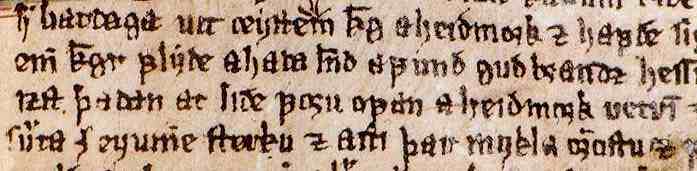
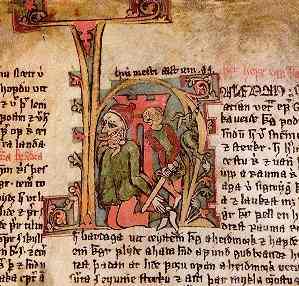
13th century manuscript


Our knowledge of the Norse people comes from several sources. One valuable source is the literature from the period. Norse people must have loved stories, and some of the stories and poems they and their descendants wrote about themselves still survive. Stories about the Norsemen were also written by their contemporaries, including both their trading partners (such as the Arabs) and the victims of their raids (such as the Christian clerics who kept the historical records in Europe). This section describes written records the Norse people left behind.


Language

The Norsemen spoke Old Norse, which they called dönsk tunga (the Danish tongue). With minor variations, this language was spoken throughout the Norse lands during the Viking period. Old Norse is one of ten branches that make up the Indo-European family of languages which have been spoken throughout Europe and southern Asia for the last 3000 years. Old Norse is the root language from which the modern Scandinavian languages descended, and is a close relative of modern English, Dutch, and German.

During the period from 550-750 AD, rapid linguistic changes occurred, which separated the Norse from other Germanic people on the European continent to the south and west. During the Viking age, language was no barrier to communication across the Norse lands; from Greenland to the Baltic, nearly the same language was spoken throughout. However, there is evidence that, despite the common language, a man's homeland could be identified by his accent. Some scholars today would go further and say that by the start of the Norse era, significant differences already existed between East Norse (Sweden and Denmark) and West Norse (Norway and the Atlantic settlements such as Iceland).


Writing and Runes

Futhork alphabet

The futhork runic alphabet (so called for the sounds of the first six letters in the alphabet) was in wide use throughout northern Europe from roughly the 3rd to the 12th century. At first, 24 letters were used, but in the 9th century, the futhork alphabet was simplified to 16 letters, beginning in Denmark, then spreading throughout the region. Many variations of the futhork alphabet were used; one of the Danish variants is shown above.

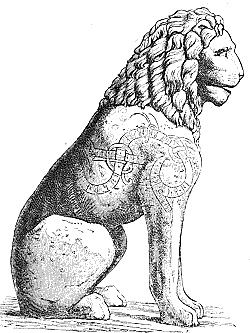
rune lion

All the letters consist of straight lines, making them easy to carve into wood, bone, or stone, which were the normal writing materials among the Norse. Runes are found carved into historical buildings and statuary not just in northern Europe, but all across the continent, clearly showing the extent to which the Norsemen roamed over Europe. The marble lion shown in the sketch to the left is from outside Piraeus, near Athens, where some unknown Norse traveler carved runic graffiti into the shoulder of the beast.

Judging from the number of inscriptions on stones intended to be seen and read, and from the number of everyday objects inscribed with runes, it is possible that much of the Norse population could read runes. Many of the inscriptions are in the form of memorial stones, such as those illustrated below on this page. These stones are highly public memorials. There's scarcely any reason to erect them if most of the population could not read them.

Many everyday objects are found inscribed with the owner's name, or the maker's name, or other messages. Runic inscriptions have been found ranging from trade and legal documents such as bills of sale, all the way to coarse lavatory scribblings. Some runic inscriptions are clearly just for fun; a comb was found inscribed "I am a comb". Some inscriptions may have been the equivalent of "Post-It" notes; one wooden runestick from Bergen is inscribed: "Gytha says come home".

runes on silver

Additional evidence of widespread literacy comes from the Norse literature. In an episode from Morkinskinna (ch 34), it was not considered the least bit remarkable that a poor, unnamed Icelander from the northern quarter was able to read the inscription on a buried treasure chest.

writing tablet

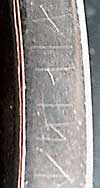
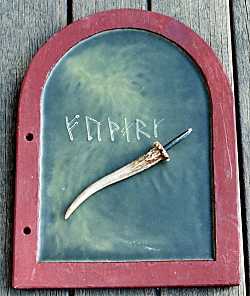
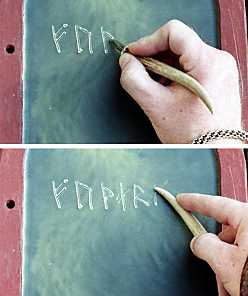
Wooden writing tablets provide additional evidence of the widespread use of runic writing among ordinary people. The tablet shown in the photos is a modern reproduction. The historic tablets are about 20-30cm high (about 8-12 in) and were filled with blackened wax within their raised borders. A pointed iron stylus was used to write in the wax (top right). The reproduction stylus in the photos is set in an antler which allows a nice grip and which can be used to smooth the wax and erase unwanted writing (bottom right).

The wooden surface of historical tablets from the Norse era bear marks where the stylus broke through the wax, and the marks show that the runic alphabet was being used. These tablets are more commonly found in rural areas, rather than in towns, suggesting that even remote farm dwellers could read and write runes.

writing tablet

On the other hand, objects have been found inscribed with runes which appear to be utter nonsense, or filled with errors. Perhaps it made perfect sense to the craftsman who made the object. Or perhaps, realizing that the object he just made needed to decorated with runes, but not knowing the futhork, the artisan simply made up something rune-like.

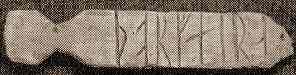
The medium of choice for runic inscriptions was probably a stick or scrap of wood, which explains why few runic inscriptions are found today. Extraordinary conditions are required for the preservation of these wood scraps over the centuries since the Norse era. The runic writing shown to the right is one of a number of wooden merchant's markers excavated in Bergen. It indicates the owner's name, and was meant to be stuck in or tied to a pile of merchandise.

futhork on sticks
Runes in zoomorphic design

It can be difficult to transcribe and translate runic writings. One difficulty is that there are more sounds in the language than there are runes to represent them. So a single character could represent one of several sounds. Another difficulty is the variations in the various futhork alphabets that were in use during the period. Further, archaic or otherwise unknown words were used in runic inscriptions. Additionally, runes were frequently incorporated into the zoomorphic designs (left) favored by the Norse, with no breaks between words or between sentences.

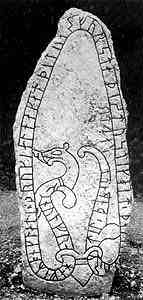
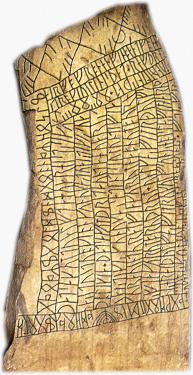
Runes could be written left to right or right to left. The "facing" of the runes makes it clear which way to read. For inscriptions longer than one line, alternating lines were frequently written in opposite directions, first leftwards, then rightwards. Sometimes, the lines bent around at the end, so that one line reads left to right and the next line right to left and upside down. Some rune stones (such as the Rök stone shown to the right) have text crammed onto every surface of the stone, with lines reading upwards, downwards, leftwards, and rightwards.

Runic stone carving
ship runes

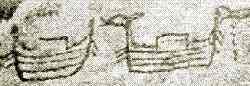
Further, runes could be coded into other figures, called cryptic runes, where the number of "twigs" in a figure indicated two numbers. The rune was coded by these two numbers. The first represented a particular ætt (grouping of runes within the futhork), and the second indicated which rune in the grouping was meant. Shown to the left are two figures from a series of cryptic runes in an Icelandic manuscript. The two are skiprúnar (ship runes) where the twigs adorn the stem and stern of the ship.

With the coming of Christianity, and its educated clergy speaking and writing Latin, runes were displaced by the Roman alphabet (modified to fit the needs of the various northern European languages), written with pen and ink on vellum. However, runes continued to be used for many centuries, since the materials for runic writing were always readily at hand: everyone carried a knife, and a stick could be picked up from anywhere.

The Norse did not develop a written culture until the coming of Christianity and the adoption of the Roman alphabet. Runes were used for short notes only. Runes certainly could have been used for longer messages in the same way as Roman characters. Perhaps the Norse people saw no need to do so. Only a single rune stone containing a complete poem survives, although many stones contain individual verses. In chapter 78 of Egils saga, Þorgerður asks her father Egill to compose a memorial poem, telling him she will carve it into a rune stick (rísta á kefli). Whether that was common practice or not is highly conjectural.

The Rök stone, shown above to the right, is an extraordinary rune stone over four meters high (13 feet) and is covered on all five sides with runic inscriptions. Many of the rune stones, particularly later ones, are memorial stones which served as declarations of inheritance.


Poetry

Surviving poems show a wide range of topics and tones: respectful and reverent; boastful and proud; witty and humorous; threatening and defiant; vile and obscene. However, scurrilous or satirical poems were banned because of the injury they caused to the subject and to his reputation. Poems, being a divine gift from Óðin (the highest of the gods), were thought to have special power. Poems had the power to bestow honor on a worthy man and to remove honor from a wretch. A skillful poet could earn a valuable reward from a generous king, or save his head from an angry king, by creating a well composed poem.

Poems praising a woman were banned, both because of the publicity and the possible effect it might have on her reputation, but also because of possible spell binding effects the poem might have. (Surviving love poems suggest the ban was regularly ignored.) On hearing certain kinds of poetry (for instance, poetry implying that a man was womanish), a man was at liberty to kill the person reciting the poem. The proscribed types of poetry are described in the medieval Icelandic lawbook Grágás (K 238).

Norse poetry does not have the regular rhythm and end-rhyme that one conventionally associates with poetry, but rather uses alliteration and irregular stress which falls on the most significant words in each line. Norse poetry can be divided into three classes, depending on form and content.

Rune poems were usually inscribed on monuments and serve to praise an individual. They are brief and usually have a simple meter and style.

Eddic poems describe the Norse gods and ancient Norse heroes and their exploits. Eddic poetry also has relatively simple meter and style. The stories are exciting, packed with action, and frequently contain valuable object lessons. Little can be said about the development of eddic poetry, but it was probably in place and in use at the start of the Norse era.

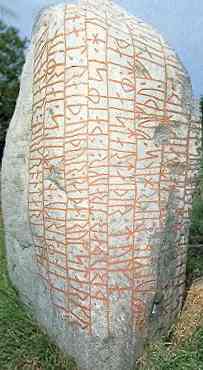
Skaldic poems typically praise the deeds of notable people, and they were usually written during the lifetime of the person being praised. While most of the surviving skaldic poetry dates from the medieval period, at least some of the poems are believed to date from the Norse period. The Rök runestone shown above on this page records one stanza of skaldic poetry and dates from the middle of the 9th century. The Karlevi runestone shown to the right is the only skaldic verse in the elaborate dróttkvætt meter known to have been written down in the Viking age. It dates from roughly the year 1000 and is located in Öland in Sweden. While the eddic poetry is uniformly anonymous, much of the surviving skaldic poetry is credited to a particular poet at a particular place and time.

skaldic runestone

The skaldic poems have complicated meters, strict patterns of alliteration, and ornate metaphoric language, with wordplay to delight the sophisticated listener. The poems usually celebrate the exploits of a particular king or leader, and are thought to be reliable testimony to the events, even though (in some cases) they weren't committed to writing for centuries after their composition. Unfortunately, the factual information in such poetry tends to be limited.

Skaldic poetry uses a variety of circumlocutions, such as kennings. A kenning uses a phrase as a metaphor to represent an idea. The usual form is a noun, qualified by another noun in the genitive case. For instance sweat of the sword is used to mean blood, or horse of the sea to mean ship. Some of the kennings can only be understood by someone with an extensive knowledge of the culture and of the great stories. For example, flame of the Rhine is used to mean gold but would probably be understood only by someone who is familiar with the Völsunga saga in which the great gold treasure of the Völsungar ended up at the bottom of the river Rhine.

Kennings can have multiple levels. For example, a poet might use a kenning for gold, and then use that phrase in place of the word "gold" in yet another kenning, such as flame of the sea-stead's path. Sea-stead's (ship) path is water, so flame of the water refers to gold. Some kennings depend on hyperbole. Enemy of gold refers to a man who does not like gold and gives it away: a generous man. Some kennings take the form of puns, such as using sky of the eel to represent ice in identifying someone as an Icelander.

Norse art

The form of Norse poetry is complicated beyond the wordplay of the kennings. The need to fit strict rules of alliteration and rhyming and rhythm result in verses in which multiple ideas are being formed simultaneously. (This concept is illustrated on the skaldic stanza page.) Because Icelandic is a highly inflected language (words change considerably depending on their usage in a sentence), it's possible to jumble the word order yet retain the meaning of a sentence.

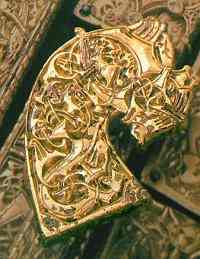
Norse visual arts share this property (left). Exceedingly complicated forms are used all over a figure to create a single unified image. It's been suggested that this similarity between poetry and visual arts derives from the same underlying sensibility, some innate appreciation of the baroque form in Norse culture.

Because of its complexity and wordplay, I wonder whether skaldic poetry could be understood by a listener hearing a verse for the first time. There are examples in the stories that support this belief, such as chapter 18 of Gísla saga. Þordís overheard a verse spoken by her brother, Gísli, in which he took credit for the killing of her husband, Þorgrímr. Not until she returned home did Þordís interpret the verse and understand its meaning.

I may be overstating my case. At least one scholar of skaldic poetry has told me that he believes the verses were easily understood by a listener in the saga age.

Additionally, in an oral culture, it would be important to recall poetry without error. Because of the complexities of Norse verse, a defect in a recalled verse would be immediately apparent, since the rhyme, rhythm, or alliteration would no longer work. Any erroneous substitution would stand out. Thus, the complexity of the verse acted as a mnemonic aid to help recall the verse and to identify errors. This built-in error detection was one of the reasons that information conveyed by poetry during the Viking age was thought to be more reliable than information in prose. The 12th century authors who first wrote the histories and stories of Iceland viewed the words of poets to be more authoritative than other oral sources. Modern scholarship tends to disagree and suggests that in oral form, even poetry is unlikely to remain unchanged over long periods of time.


Literature

Many of the important poems were composed in the 10th through 12th century. These were part of the oral tradition, and were kept alive by repetition as they were passed from one generation to another.

Poetry was likely a major form of entertainment for the Norse. Poets were held in high regard, not only for their ability to improvise poetic entertainment on the spot, but also because they were the repository of the shared cultural experience. They were the vessel through which the culture was passed from generation to generation. Once committed to poetry, a thought was expected to last "as long as the land is inhabited" or "as long as the Norse language is spoken".

skald

Beginning in the 12th century, educated men in Iceland, where the oral tradition was strongest, began to write down the important stories. Iceland was unique among European countries at this time in having a population comprised of a large number of relatively free, land-owning farmers. These men had the means to commission the creation of books in their own language, rather than in Latin as was the rule throughout the rest of Europe. The oral story-telling tradition of the Icelanders also favored writings in the vernacular. A wide variety of material was written down in the Icelandic language.

One of the first books was Íslendingabók, a history of Iceland written circa 1130, probably by Ari fróði. Law books were written around this time when Icelandic legislators decided to write down the laws which before had been committed to memory. Scholars wrote books describing how to use Roman letters to represent the sounds of the Icelandic language. The First Grammatical Treatise was followed by three others. The genealogy and history of Icelandic settlers were written down in Landnámabók.

European literature was translated into Icelandic, including stories of the lives of saints, and learned books on topics including astronomy, natural history, and geography. Travel books were written by Icelandic visitors to Europe.

New stories were written to commemorate the exploits of kings or other great leaders. Some of these books were in the form of histories, such as Heimskringla, a history of the kings of Norway. Others described contemporary events, such as the sagas of bishops, and the Sturlunga saga, a compilation of sagas describing the events in the turbulent times when the sons of Sturla Þórðarson were changing the political landscape of the Iceland.

Manuscript

Icelanders also wrote down the stories of their ancestors. These Íslendingasögur (Sagas of Icelanders, also called family sagas) remain compelling and entertaining reading today. Most of these sagas are thought to have been composed in the 13th century. These stories tell of the tales of farmers and chieftains living in Iceland from the 9th through the 12th century. Many of them follow families for generation after generation, from the settlement era to the commonwealth period in Iceland's history. They are distinctive in that they tell heroic tales not about heroes, but about just plain folks: the early Icelanders. Although distorted by the time that separates the events depicted and the writing of the stories, the family sagas present one of the best pictures we have of Norse society.

Snorri Sturluson

We know the names of only a very few of the writers of these works. It was not customary to put the author's name on the manuscript. However, one author who can be identified with some certainty is Snorri Sturluson (1179-1241). A 20th century sculpture of Snorri by Vigeland is shown to the left.

Snorri feared that the tradition of composing poetry to commemorate great men and great events was dying. For this, and other reasons, he wrote the Snorra edda, a four part textbook on writing skaldic poetry. The book summarizes Norse mythology (necessary for the poet to understand the kennings), teaches the language of poetry, and presents examples of the various verse forms. The illustration to the right is from the section Gylfaginning (the tricking of Gylfi), showing Gylfi in a contest of wisdom with three Æsir. The book not only provides us with a unique overview of the Norse mythology, but Snorri quotes excerpts from poems and stories as examples of proper form and technique. In most cases, the full works are now lost, so the quotes from Snorra edda are the only way we have any knowledge of these stories.

Gylfi

Over the centuries, the original manuscripts of the old stories were copied, transcribed, combined, interpolated, and edited. Material was deleted and new material written to bridge the gap. In some cases, the original stories may have been distorted, but in some cases, the stories may well have been improved.

None of the surviving manuscripts represent the "original" version of the stories as set down by the first author. All the surviving manuscripts date from well after the time the stories were written down. Thus, each represents a different version of the story, and none represent the "original" version. Both early and late manuscripts survive for some stories, and occasionally, the differences are quite significant.

Thingeyrar

In some cases, bored copyists may simply have made scribal errors. Many of the copies were made at the monastery at Þingeyrar. (The Þingeyrar church is shown as it appears today to the left). The monastery held one of medieval Iceland's largest libraries, and it's likely that many of the histories and sagas were composed there, as well.

Like the poetry, the form of some of these sagas is complicated. Seemingly unrelated plot lines and characters are introduced and dropped and "stranded", only to be picked up later. But the sagas are a "verbal braid" of many strands whose meaning is not stated outright, but implied by the various juxtapositions and intersections. A Norse author of the time compared it to running water, which flows from many sources, yet all comes together to flow into a single place, the sea.

The sagas are narrated in a sparse, objective style. The author rarely tells anything that could not be observed by a witness. Any internal thoughts or emotions a character might have are related to the reader through behavior or dialog observable by a witness. The author rarely explains or judges characters or events and rarely intrudes on the narrative.

The stories survive today in the form of hand written manuscripts on vellum and (Iater) on paper, dating from the 13th through the 17th century. Scholars combed Iceland during the 17th and 18th century in search of surviving manuscripts. One of the best known of these scholars was the Icelander Árni Magnússon (right). When found, the manuscripts were brought to Denmark (which governed Iceland at that time) for preservation. Tragically, fire swept through Copenhagen in 1728. While the best manuscripts were saved, many lesser works were lost.

Arni Magnusson portrait
Arnagardur

Some of the manuscripts survive only in a single copy. For instance, most of the poems in The Elder Edda exist only in the manuscript called the Codex Regius. On the other hand, seven manuscripts or fragments of Snorri Sturluson's Edda survive. Today, most of the manuscripts have been repatriated to Iceland for safekeeping at Stofnun Árna Magnússonar (the Árni Magnússon Institute) in Reykjavík (left).

The accuracy of the sagas (especially the Icelandic family sagas) has long been debated. They were not written down until centuries after the events they depict took place. We don't know the authors of any of the sagas. We don't know where or when they were written. Are they factual records or simply stories and legends to while away the hours on long winter nights? Are they a wistful look backwards from the turbulence of the Sturlunga era and the loss of Icelandic independence (in which they were written) back to the golden age of Iceland's settlement (in which they are set)? Are they literary creations, composed by an author, or merely the written transcription of an older oral narrative?

I feel unqualified to step into this scholarly debate and so prefer to use the term "historical novel". On one hand, one takes a risk when one uses a saga as a primary reference or as a source of "facts". On the other hand, the sagas clearly are a valuable resource for information about society and culture and behavioral norms during the Viking age in Iceland.

An introduction to the Sagas of Icelanders and their use as a historical source is available here (700KB pdf file).


Spelling and Pronunciation

The original documents that form the basis for our knowledge of this period were written in Old Icelandic, not far removed from Old Norse, the language spoken throughout northern Europe during the period. The written Icelandic language has changed comparatively little over the centuries, such that modern speakers of Icelandic have less trouble reading the sagas in the original than do modern speakers of English reading Shakespeare, despite the sagas being twice as old. (However, I've recently been told by Icelanders that I overstate the case; the archaic vocabulary and phrasing make it difficult for modern Icelanders to read the sagas in the original.)

Throughout these pages, I've tried to use the Icelandic spelling of names and places. As my knowledge of the language has increased, I've tried to be careful about usage and spelling, but I know I have not been consistent. Limitations in the characters available in HTML require me to use modern Icelandic substitutes in place of some of the old Norse characters.

The Icelandic language has many sounds not present in modern English, and so it uses additional characters to represent those sounds. There are two additional consonants. "Thorn" (Þ þ) which represents the sound "th" as in Thor, and "edh" (Ð ð) which represents the sound "th" as in father.

There are many additional vowel sounds, which are represented by accents (such as á), ligatures (such as æ) and umlauts (such as ö). There are no equivalent sounds in English, so pronounce them as you like.

I have seen several conflicting guides to the pronunciation of old Icelandic. I now understand that some of my confusion relates to my not comprehending all the pronunciation changes and dialect variations that occurred over the centuries that Old Norse was spoken. Since I don't know, I'm not even going to try to provide a guide. Barnes' recent old Norse textbook provides a detailed guide to pronunciation, as well as a fascinating discussion of the differences between old Norse and modern Icelandic pronunciation. I refer interested readers to his text. The full citation is on the references page.

So as not to leave readers totally in the dark about pronunciation, I conclude with an audio recording of a short excerpt from Völuspá performed by Sveinbjörn Beinsteinsson in old Icelandic. This excerpt is the first half-verse from the poem in which the speaker calls for the attention of the audience.

       Hlióðs bið ek allar     helgar kindir,
meiri ok minni, mögo Heimdallar.