Fuente:
http://www.hurstwic.org/history/articles/literature/text/literature.htmInformación:
Norse Literature

13th century manuscript
Our knowledge of the Norse people comes from several sources. One valuable source is the literature from the period. Norse people must have loved stories, and some of the stories and poems they and their descendants wrote about themselves still survive. Stories about the Norsemen were also written by their contemporaries, including both their trading partners (such as the Arabs) and the victims of their raids (such as the Christian clerics who kept the historical records in Europe). This section describes written records the Norse people left behind.
Language
The Norsemen spoke Old Norse, which they called dönsk tunga (the Danish tongue). With minor variations, this language was spoken throughout the Norse lands during the Viking period. Old Norse is one of ten branches that make up the Indo-European family of languages which have been spoken throughout Europe and southern Asia for the last 3000 years. Old Norse is the root language from which the modern Scandinavian languages descended, and is a close relative of modern English, Dutch, and German.
During the period from 550-750 AD, rapid linguistic changes occurred, which separated the Norse from other Germanic people on the European continent to the south and west. During the Viking age, language was no barrier to communication across the Norse lands; from Greenland to the Baltic, nearly the same language was spoken throughout. However, there is evidence that, despite the common language, a man's homeland could be identified by his accent. Some scholars today would go further and say that by the start of the Norse era, significant differences already existed between East Norse (Sweden and Denmark) and West Norse (Norway and the Atlantic settlements such as Iceland).
Writing and Runes

The futhork runic alphabet (so called for the sounds of the first six letters in the alphabet) was in wide use throughout northern Europe from roughly the 3rd to the 12th century. At first, 24 letters were used, but in the 9th century, the futhork alphabet was simplified to 16 letters, beginning in Denmark, then spreading throughout the region. Many variations of the futhork alphabet were used; one of the Danish variants is shown above.
 | All the letters consist of straight lines, making them easy to carve into wood, bone, or stone, which were the normal writing materials among the Norse. Runes are found carved into historical buildings and statuary not just in northern Europe, but all across the continent, clearly showing the extent to which the Norsemen roamed over Europe. The marble lion shown in the sketch to the left is from outside Piraeus, near Athens, where some unknown Norse traveler carved runic graffiti into the shoulder of the beast. Judging from the number of inscriptions on stones intended to be seen and read, and from the number of everyday objects inscribed with runes, it is possible that much of the Norse population could read runes. Many of the inscriptions are in the form of memorial stones, such as those illustrated below on this page. These stones are highly public memorials. There's scarcely any reason to erect them if most of the population could not read them. |
| Many everyday objects are found inscribed with the owner's name, or the maker's name, or other messages. Runic inscriptions have been found ranging from trade and legal documents such as bills of sale, all the way to coarse lavatory scribblings. Some runic inscriptions are clearly just for fun; a comb was found inscribed "I am a comb". Some inscriptions may have been the equivalent of "Post-It" notes; one wooden runestick from Bergen is inscribed: "Gytha says come home". |  |
Additional evidence of widespread literacy comes from the Norse literature. In an episode from Morkinskinna (ch 34), it was not considered the least bit remarkable that a poor, unnamed Icelander from the northern quarter was able to read the inscription on a buried treasure chest.
 | Wooden writing tablets provide additional evidence of the widespread use of runic writing among ordinary people. The tablet shown in the photos is a modern reproduction. The historic tablets are about 20-30cm high (about 8-12 in) and were filled with blackened wax within their raised borders. A pointed iron stylus was used to write in the wax (top right). The reproduction stylus in the photos is set in an antler which allows a nice grip and which can be used to smooth the wax and erase unwanted writing (bottom right). The wooden surface of historical tablets from the Norse era bear marks where the stylus broke through the wax, and the marks show that the runic alphabet was being used. These tablets are more commonly found in rural areas, rather than in towns, suggesting that even remote farm dwellers could read and write runes. |  |
On the other hand, objects have been found inscribed with runes which appear to be utter nonsense, or filled with errors. Perhaps it made perfect sense to the craftsman who made the object. Or perhaps, realizing that the object he just made needed to decorated with runes, but not knowing the futhork, the artisan simply made up something rune-like.
| The medium of choice for runic inscriptions was probably a stick or scrap of wood, which explains why few runic inscriptions are found today. Extraordinary conditions are required for the preservation of these wood scraps over the centuries since the Norse era. The runic writing shown to the right is one of a number of wooden merchant's markers excavated in Bergen. It indicates the owner's name, and was meant to be stuck in or tied to a pile of merchandise. |  |
 | It can be difficult to transcribe and translate runic writings. One difficulty is that there are more sounds in the language than there are runes to represent them. So a single character could represent one of several sounds. Another difficulty is the variations in the various futhork alphabets that were in use during the period. Further, archaic or otherwise unknown words were used in runic inscriptions. Additionally, runes were frequently incorporated into the zoomorphic designs (left) favored by the Norse, with no breaks between words or between sentences. |
| Runes could be written left to right or right to left. The "facing" of the runes makes it clear which way to read. For inscriptions longer than one line, alternating lines were frequently written in opposite directions, first leftwards, then rightwards. Sometimes, the lines bent around at the end, so that one line reads left to right and the next line right to left and upside down. Some rune stones (such as the Rök stone shown to the right) have text crammed onto every surface of the stone, with lines reading upwards, downwards, leftwards, and rightwards. |  |
 | Further, runes could be coded into other figures, called cryptic runes, where the number of "twigs" in a figure indicated two numbers. The rune was coded by these two numbers. The first represented a particular ætt (grouping of runes within the futhork), and the second indicated which rune in the grouping was meant. Shown to the left are two figures from a series of cryptic runes in an Icelandic manuscript. The two are skiprúnar (ship runes) where the twigs adorn the stem and stern of the ship. |
With the coming of Christianity, and its educated clergy speaking and writing Latin, runes were displaced by the Roman alphabet (modified to fit the needs of the various northern European languages), written with pen and ink on vellum. However, runes continued to be used for many centuries, since the materials for runic writing were always readily at hand: everyone carried a knife, and a stick could be picked up from anywhere.
The Norse did not develop a written culture until the coming of Christianity and the adoption of the Roman alphabet. Runes were used for short notes only. Runes certainly could have been used for longer messages in the same way as Roman characters. Perhaps the Norse people saw no need to do so. Only a single rune stone containing a complete poem survives, although many stones contain individual verses. In chapter 78 of Egils saga, Þorgerður asks her father Egill to compose a memorial poem, telling him she will carve it into a rune stick (rísta á kefli). Whether that was common practice or not is highly conjectural.
The Rök stone, shown above to the right, is an extraordinary rune stone over four meters high (13 feet) and is covered on all five sides with runic inscriptions. Many of the rune stones, particularly later ones, are memorial stones which served as declarations of inheritance.
Poetry
Surviving poems show a wide range of topics and tones: respectful and reverent; boastful and proud; witty and humorous; threatening and defiant; vile and obscene. However, scurrilous or satirical poems were banned because of the injury they caused to the subject and to his reputation. Poems, being a divine gift from Óðin (the highest of the gods), were thought to have special power. Poems had the power to bestow honor on a worthy man and to remove honor from a wretch. A skillful poet could earn a valuable reward from a generous king, or save his head from an angry king, by creating a well composed poem.
Poems praising a woman were banned, both because of the publicity and the possible effect it might have on her reputation, but also because of possible spell binding effects the poem might have. (Surviving love poems suggest the ban was regularly ignored.) On hearing certain kinds of poetry (for instance, poetry implying that a man was womanish), a man was at liberty to kill the person reciting the poem. The proscribed types of poetry are described in the medieval Icelandic lawbook Grágás (K 238).
Norse poetry does not have the regular rhythm and end-rhyme that one conventionally associates with poetry, but rather uses alliteration and irregular stress which falls on the most significant words in each line. Norse poetry can be divided into three classes, depending on form and content.
| Rune poems were usually inscribed on monuments and serve to praise an individual. They are brief and usually have a simple meter and style. Eddic poems describe the Norse gods and ancient Norse heroes and their exploits. Eddic poetry also has relatively simple meter and style. The stories are exciting, packed with action, and frequently contain valuable object lessons. Little can be said about the development of eddic poetry, but it was probably in place and in use at the start of the Norse era. Skaldic poems typically praise the deeds of notable people, and they were usually written during the lifetime of the person being praised. While most of the surviving skaldic poetry dates from the medieval period, at least some of the poems are believed to date from the Norse period. The Rök runestone shown above on this page records one stanza of skaldic poetry and dates from the middle of the 9th century. The Karlevi runestone shown to the right is the only skaldic verse in the elaborate dróttkvætt meter known to have been written down in the Viking age. It dates from roughly the year 1000 and is located in Öland in Sweden. While the eddic poetry is uniformly anonymous, much of the surviving skaldic poetry is credited to a particular poet at a particular place and time. |  |
The skaldic poems have complicated meters, strict patterns of alliteration, and ornate metaphoric language, with wordplay to delight the sophisticated listener. The poems usually celebrate the exploits of a particular king or leader, and are thought to be reliable testimony to the events, even though (in some cases) they weren't committed to writing for centuries after their composition. Unfortunately, the factual information in such poetry tends to be limited.
Skaldic poetry uses a variety of circumlocutions, such as kennings. A kenning uses a phrase as a metaphor to represent an idea. The usual form is a noun, qualified by another noun in the genitive case. For instance sweat of the sword is used to mean blood, or horse of the sea to mean ship. Some of the kennings can only be understood by someone with an extensive knowledge of the culture and of the great stories. For example, flame of the Rhine is used to mean gold but would probably be understood only by someone who is familiar with the Völsunga saga in which the great gold treasure of the Völsungar ended up at the bottom of the river Rhine.
Kennings can have multiple levels. For example, a poet might use a kenning for gold, and then use that phrase in place of the word "gold" in yet another kenning, such as flame of the sea-stead's path. Sea-stead's (ship) path is water, so flame of the water refers to gold. Some kennings depend on hyperbole. Enemy of gold refers to a man who does not like gold and gives it away: a generous man. Some kennings take the form of puns, such as using sky of the eel to represent ice in identifying someone as an Icelander.
 | The form of Norse poetry is complicated beyond the wordplay of the kennings. The need to fit strict rules of alliteration and rhyming and rhythm result in verses in which multiple ideas are being formed simultaneously. (This concept is illustrated on the skaldic stanza page.) Because Icelandic is a highly inflected language (words change considerably depending on their usage in a sentence), it's possible to jumble the word order yet retain the meaning of a sentence. Norse visual arts share this property (left). Exceedingly complicated forms are used all over a figure to create a single unified image. It's been suggested that this similarity between poetry and visual arts derives from the same underlying sensibility, some innate appreciation of the baroque form in Norse culture. Because of its complexity and wordplay, I wonder whether skaldic poetry could be understood by a listener hearing a verse for the first time. There are examples in the stories that support this belief, such as chapter 18 of Gísla saga. Þordís overheard a verse spoken by her brother, Gísli, in which he took credit for the killing of her husband, Þorgrímr. Not until she returned home did Þordís interpret the verse and understand its meaning. I may be overstating my case. At least one scholar of skaldic poetry has told me that he believes the verses were easily understood by a listener in the saga age. |
Additionally, in an oral culture, it would be important to recall poetry without error. Because of the complexities of Norse verse, a defect in a recalled verse would be immediately apparent, since the rhyme, rhythm, or alliteration would no longer work. Any erroneous substitution would stand out. Thus, the complexity of the verse acted as a mnemonic aid to help recall the verse and to identify errors. This built-in error detection was one of the reasons that information conveyed by poetry during the Viking age was thought to be more reliable than information in prose. The 12th century authors who first wrote the histories and stories of Iceland viewed the words of poets to be more authoritative than other oral sources. Modern scholarship tends to disagree and suggests that in oral form, even poetry is unlikely to remain unchanged over long periods of time.
Literature
| Many of the important poems were composed in the 10th through 12th century. These were part of the oral tradition, and were kept alive by repetition as they were passed from one generation to another. Poetry was likely a major form of entertainment for the Norse. Poets were held in high regard, not only for their ability to improvise poetic entertainment on the spot, but also because they were the repository of the shared cultural experience. They were the vessel through which the culture was passed from generation to generation. Once committed to poetry, a thought was expected to last "as long as the land is inhabited" or "as long as the Norse language is spoken". | 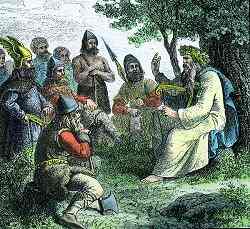 |
Beginning in the 12th century, educated men in Iceland, where the oral tradition was strongest, began to write down the important stories. Iceland was unique among European countries at this time in having a population comprised of a large number of relatively free, land-owning farmers. These men had the means to commission the creation of books in their own language, rather than in Latin as was the rule throughout the rest of Europe. The oral story-telling tradition of the Icelanders also favored writings in the vernacular. A wide variety of material was written down in the Icelandic language.
One of the first books was Íslendingabók, a history of Iceland written circa 1130, probably by Ari fróði. Law books were written around this time when Icelandic legislators decided to write down the laws which before had been committed to memory. Scholars wrote books describing how to use Roman letters to represent the sounds of the Icelandic language. The First Grammatical Treatise was followed by three others. The genealogy and history of Icelandic settlers were written down in Landnámabók.
European literature was translated into Icelandic, including stories of the lives of saints, and learned books on topics including astronomy, natural history, and geography. Travel books were written by Icelandic visitors to Europe.
| New stories were written to commemorate the exploits of kings or other great leaders. Some of these books were in the form of histories, such as Heimskringla, a history of the kings of Norway. Others described contemporary events, such as the sagas of bishops, and the Sturlunga saga, a compilation of sagas describing the events in the turbulent times when the sons of Sturla Þórðarson were changing the political landscape of the Iceland. |  |
Icelanders also wrote down the stories of their ancestors. These Íslendingasögur (Sagas of Icelanders, also called family sagas) remain compelling and entertaining reading today. Most of these sagas are thought to have been composed in the 13th century. These stories tell of the tales of farmers and chieftains living in Iceland from the 9th through the 12th century. Many of them follow families for generation after generation, from the settlement era to the commonwealth period in Iceland's history. They are distinctive in that they tell heroic tales not about heroes, but about just plain folks: the early Icelanders. Although distorted by the time that separates the events depicted and the writing of the stories, the family sagas present one of the best pictures we have of Norse society.
 | We know the names of only a very few of the writers of these works. It was not customary to put the author's name on the manuscript. However, one author who can be identified with some certainty is Snorri Sturluson (1179-1241). A 20th century sculpture of Snorri by Vigeland is shown to the left. Snorri feared that the tradition of composing poetry to commemorate great men and great events was dying. For this, and other reasons, he wrote the Snorra edda, a four part textbook on writing skaldic poetry. The book summarizes Norse mythology (necessary for the poet to understand the kennings), teaches the language of poetry, and presents examples of the various verse forms. The illustration to the right is from the section Gylfaginning (the tricking of Gylfi), showing Gylfi in a contest of wisdom with three Æsir. The book not only provides us with a unique overview of the Norse mythology, but Snorri quotes excerpts from poems and stories as examples of proper form and technique. In most cases, the full works are now lost, so the quotes from Snorra edda are the only way we have any knowledge of these stories. |  |
Over the centuries, the original manuscripts of the old stories were copied, transcribed, combined, interpolated, and edited. Material was deleted and new material written to bridge the gap. In some cases, the original stories may have been distorted, but in some cases, the stories may well have been improved.
None of the surviving manuscripts represent the "original" version of the stories as set down by the first author. All the surviving manuscripts date from well after the time the stories were written down. Thus, each represents a different version of the story, and none represent the "original" version. Both early and late manuscripts survive for some stories, and occasionally, the differences are quite significant.
 | In some cases, bored copyists may simply have made scribal errors. Many of the copies were made at the monastery at Þingeyrar. (The Þingeyrar church is shown as it appears today to the left). The monastery held one of medieval Iceland's largest libraries, and it's likely that many of the histories and sagas were composed there, as well. |
Like the poetry, the form of some of these sagas is complicated. Seemingly unrelated plot lines and characters are introduced and dropped and "stranded", only to be picked up later. But the sagas are a "verbal braid" of many strands whose meaning is not stated outright, but implied by the various juxtapositions and intersections. A Norse author of the time compared it to running water, which flows from many sources, yet all comes together to flow into a single place, the sea.
The sagas are narrated in a sparse, objective style. The author rarely tells anything that could not be observed by a witness. Any internal thoughts or emotions a character might have are related to the reader through behavior or dialog observable by a witness. The author rarely explains or judges characters or events and rarely intrudes on the narrative.
| The stories survive today in the form of hand written manuscripts on vellum and (Iater) on paper, dating from the 13th through the 17th century. Scholars combed Iceland during the 17th and 18th century in search of surviving manuscripts. One of the best known of these scholars was the Icelander Árni Magnússon (right). When found, the manuscripts were brought to Denmark (which governed Iceland at that time) for preservation. Tragically, fire swept through Copenhagen in 1728. While the best manuscripts were saved, many lesser works were lost. |  |
 | Some of the manuscripts survive only in a single copy. For instance, most of the poems in The Elder Edda exist only in the manuscript called the Codex Regius. On the other hand, seven manuscripts or fragments of Snorri Sturluson's Edda survive. Today, most of the manuscripts have been repatriated to Iceland for safekeeping at Stofnun Árna Magnússonar (the Árni Magnússon Institute) in Reykjavík (left). |
The accuracy of the sagas (especially the Icelandic family sagas) has long been debated. They were not written down until centuries after the events they depict took place. We don't know the authors of any of the sagas. We don't know where or when they were written. Are they factual records or simply stories and legends to while away the hours on long winter nights? Are they a wistful look backwards from the turbulence of the Sturlunga era and the loss of Icelandic independence (in which they were written) back to the golden age of Iceland's settlement (in which they are set)? Are they literary creations, composed by an author, or merely the written transcription of an older oral narrative?
I feel unqualified to step into this scholarly debate and so prefer to use the term "historical novel". On one hand, one takes a risk when one uses a saga as a primary reference or as a source of "facts". On the other hand, the sagas clearly are a valuable resource for information about society and culture and behavioral norms during the Viking age in Iceland.
An introduction to the Sagas of Icelanders and their use as a historical source is available here (700KB pdf file).
Spelling and Pronunciation
The original documents that form the basis for our knowledge of this period were written in Old Icelandic, not far removed from Old Norse, the language spoken throughout northern Europe during the period. The written Icelandic language has changed comparatively little over the centuries, such that modern speakers of Icelandic have less trouble reading the sagas in the original than do modern speakers of English reading Shakespeare, despite the sagas being twice as old. (However, I've recently been told by Icelanders that I overstate the case; the archaic vocabulary and phrasing make it difficult for modern Icelanders to read the sagas in the original.)
Throughout these pages, I've tried to use the Icelandic spelling of names and places. As my knowledge of the language has increased, I've tried to be careful about usage and spelling, but I know I have not been consistent. Limitations in the characters available in HTML require me to use modern Icelandic substitutes in place of some of the old Norse characters.
The Icelandic language has many sounds not present in modern English, and so it uses additional characters to represent those sounds. There are two additional consonants. "Thorn" (Þ þ) which represents the sound "th" as in Thor, and "edh" (Ð ð) which represents the sound "th" as in father.
There are many additional vowel sounds, which are represented by accents (such as á), ligatures (such as æ) and umlauts (such as ö). There are no equivalent sounds in English, so pronounce them as you like.
I have seen several conflicting guides to the pronunciation of old Icelandic. I now understand that some of my confusion relates to my not comprehending all the pronunciation changes and dialect variations that occurred over the centuries that Old Norse was spoken. Since I don't know, I'm not even going to try to provide a guide. Barnes' recent old Norse textbook provides a detailed guide to pronunciation, as well as a fascinating discussion of the differences between old Norse and modern Icelandic pronunciation. I refer interested readers to his text. The full citation is on the references page.
So as not to leave readers totally in the dark about pronunciation, I conclude with an audio recording of a short excerpt from Völuspá performed by Sveinbjörn Beinsteinsson in old Icelandic. This excerpt is the first half-verse from the poem in which the speaker calls for the attention of the audience.
       Hlióðs bið ek allar     helgar kindir,
      meiri ok minni,     mögo Heimdallar.


 Entradas








