sábado, 8 de agosto de 2009

Vikings : The Middle Ages . net

Fuente:

http://www.themiddleages.net/people/vikings.html

Información:

Vikings

vikingsThe term Viking commonly denotes the ship-born warriors and traders of Norsemen (literally, men from the north) who originated in Scandinavia and raided the coasts of Britain, Ireland and mainland Europe as far east as the Volga River in Russia from the late 8th–11th century. This period (generally dated 793–1066) is often referred to as the Viking Age. The term Viking has also denoted entire populations of Viking Age Scandinavia and their settlements, as an expanded meaning.
Famed for their longships, Vikings founded settlements for three centuries along the coasts and rivers of mainland Europe, Ireland, Great Britain, Normandy, the Shetland, Orkney, and Faroe Islands, Iceland, Greenland, Newfoundland circa 1000.[1] They reached south to North Africa and east to Russia and Constantinople, as looters, traders, or mercenaries. Vikings under Leif Ericson, heir to Erik the Red, reached North America, with putative expeditions to present-day Canada, Maine and Southeastern Massachusetts, Including Cape cod in the 10th century. Viking voyages decreased with the introduction of Christianity to Scandinavia in the late 10th and 11th century.
The word Viking was introduced to the English language with romantic connotations in the 18th century. However, etymologists trace the word to Anglo-Frankish writers, who referred to "víkingr" as one who set about to raid and pillage,[2] as in the saga of Egil Skallagrimsson. In current Scandinavian languages, the term Viking is applied to the people who went away on Viking expeditions, be it for raiding or trading. In English and many other languages, Viking might refer to the Viking Age Scandinavians in general.[3] The pre-Christian Scandinavian population is also referred to as Norse, although that term is properly applied to the whole civilization of Old-Norse speaking people.

Ships

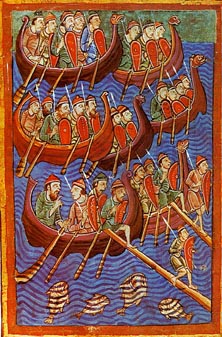
There were two distinct classes of Viking ships: the longship (sometimes erroneously called "drakkar", a corruption of "dragon" in Norse) and the knarr. The longship, intended for warfare and exploration, was designed for speed and agility, and were equipped with oars to complement the sail as well as making it able to navigate independently of the wind. The longship had a long and narrow hull, as well as a shallow draft, in order to facilitate landings and troop deployments in shallow water. The knarr, on the other hand, was a slower merchant vessel with a greater cargo capacity than the longship. It was designed with a short and broad hull, and a deep draft. It also lacked the oars of the longship.
Longships were used extensively by the Leidang, the Scandinavian defense fleets. The term "Viking ships" has entered common usage, however, possibly because of its romantic associations (discussed below).
In Roskilde are the well-preserved remains of five ships, excavated from nearby Roskilde Fjord in the late 1960s. The ships were scuttled there in the 11th century to block a navigation channel, thus protecting the city, which was then the Danish capital, from seaborne assault. These five ships represent the two distinct classes of the Viking Ships, the longship and the knarr.
Longships are not to be confused with longboats.

Heathenry - Yawiki.org

Fuente:

http://yawiki.org/proc/Heathenry

Información:

Heathenry is one of several modern revivals of historical Germanic paganism. Heathenry is the term used by many adherents of Germanic neopaganism, especially in the UK.


Heathenry
Overview
Heathenry and reconstruction
Practices and discourses (what Heathens do and say)
Worldview and discourse
Runic magic
Galdr
Seidr
Web resources relevant to Heathenry in Britain
Other sources

top

Overview
While some practitioners use the term Heathenry as equivalent to Paganism, others use it much more specifically. It is used by those who are re-creating the old religion and worldview from the literary and archaeological sources, who describe themselves as "Heathen" in part to distinguish themselves from other pagans whose rituals come from other sources. Some North Americans use Heathenism with a similar intent.

Heathenry differs from Ásatrú in North America in being generally more rooted in the landscape (Blain, 2002a, Harvey 2006 forthcoming) and in this may possibly be more akin to Ásatrú in Iceland and similar religious expression in Scandinavia. Heathenry draws on ideas of a living landscape, close to some expressed by indigenous religions elsewhere. Heathenry, therefore, for many adherents, is about creating a connection between humans and landscape, through the acknowledgement of land- and other wights, ancestors (spiritual and cultural, not necessarily physical) and other beings; it is therefore an animist religion drawing on (for instance) the Old English healing charms, the Icelandic Eddas and Sagas, and folklore elements in creating a religion from today from these and other resources.Shamanic or shamanistic elements are evident and practitioners may use seid and galdr, or shamanistic magic and sung magic, in rituals.

Heathenry relates to both the practices and worldviews of Heathens and to the practitioners - thus Heathenry can mean people who are Heathen, or what they do. In general, Heathens consider that people are called to the religion, perhaps by the gods or by the landscape, regardless of their ethnic origins. In this sense, Heathens are new-indigenes (Blain and Wallis, 2002).

top

Heathenry and reconstruction
Heathenry is often described as polytheistic reconstructionism. Not all Heathens agree with this - saying that their goal is to create religious practice and personal empowerment for today, rather than to imitate or re-enact past rituals. Basically, such construction or reconstruction works from the principle that earlier documents or artefacts (from literature or archaeology) hold clues to religious or spiritual practice and relationships with deities or spirits, and in particular to world-views or religious philosophies. These practices and worldviews and relationships can be used or adopted meaningfully within today's world, with practitioners concerned to locate practices, deities, etc, within culture and time, and to be able to point to some documentation or other justification for what they do.

The deities of Heathenry are those of Anglo-Saxon religion and of Norse Mythology - see list of Norse gods. Some British Heathens may also honour one or more Brythonic or Gaelic deities of Celtic Mythology. As with other polytheist religions, it is quite common for individuals to owe personal allegiance to a small number of deities while also recognising and honouring many others. In North America there is also Theodism or Þéodisc Geléafa ("tribal belief") which started out as a form of Germanic Neopaganism which sought to reconstruct the beliefs and practices of the Anglo-Saxon tribes which settled in England. þéodisc is the adjective of þéod "people, tribe", cognate to deutsch.

top

Practices and discourses (what Heathens do and say)
Many of the ritual forms of blót - making an offering - and sumble (or symbel)- a ritual of toasting - are discussed under Asatru. Indeed these forms generally serve to separate Germanic/Nordic religion from other pagan and neo-pagan practices. Heathenry is defined, however, as much by worldview and discourse as by specific rituals. The following list is given by Blain (2006, based on 2002a) for this article, from her ethnographic work with today's Heathens, of understandings or discourses of Heathenry that shape what Heathens do.

For more informationon blots, see the Book of Blotar.

top

Worldview and discourse
The following list is given by Blain (2006, based on 2002a) for this article, from her ethnographic work with today's Heathens, of understandings or discourses of Heathenry that shape what Heathens do.

  1. references to myths and stories of the Aesir and Vanir - ‘the lore’, found in the Eddas and Sagas and some other mediaeval writings. Heathens will make reference to particular stories or poems, and explain to others where these can be found.


  2. polytheism: a sense of gods or wights as discrete individuals, each with 'their own agendas'. That is, Heathens do not usually consider that different goddesses are 'aspects' of each other, but particular individual beings who can be spoken to.

  3. cultural specificity or locatedness of myths or deities and ways of approaching these, including ritual forms (sparsely described in the lore). This means that the stories and poems – the understanding of the goddesses and gods and of the earth – have come from a particular period in history and particular places in the world. In a sense, the telling of the poetry and stories is rooted in culture and place.

  4. the possibility of direct communication with deities or wights – not only can be spoken to but they will often speak back.

  5. the possibility of manipulation of consciousness or ‘reality’ by the wights or deities, or through magic inspired by them: including galdr or sung spells, runic magic, and seidr or 'shamanistic' magic.

  6. a sense that spirituality is not separate from everyday life, but informs it. For instance, Heathens will talk about their gardening, how they are raising their children, their voluntary work in the community, or how they deal with people at their workplace, linking these to examples in 'the lore'.

  7. a sense of individual merit and responsibility, combined with community worth. In particular ideas about fair play, taking responsibility for one's own actions, honouring the motives and actions of others, are seen to come from 'the lore'.

  8. an elaborate concept of 'soul' and 'self’, personal ørlög, and overall Wyrd. People's personal destinies are shaped in part by what is past, in part by what they and others are now doing, by the vows they take and contracts they enter into.

  9. the Elder Kin (i.e. deities of Northern Europe) and other wights also are subject to the workings of Wyrd (Blain 2006, available http://ebooks.abc-clio.com).


For most Heathens, Heathenry is part of daily life. While Heathen ritual practices vary from the construction of elaborate blots or seid-rituals, to a daily communing with wights or deities, it seems to be worldview that most matters. Therefore, Heathens do not necessarily see 'magic' as an important or central constituent of their personal practice: but, as polytheists and, often, animists, the possibility of magic exists, and magical specialists form part of the Heathen community in the UK.

Heathens meeting in small groups on a regular (monthly, quarterly) basis will often refer to this as their blót. Offerings during a blot usually involve mead or other alcohol, sometimes food, sometimes song or poetry, specially written for the occasion or for a particular deity, is delivered as an offering. Rituals of blot (most Heathens in Britain will omit the Icelandic accented 'o') may be designed or even scripted for the occasion or may be spontaneous. Usual dress for a blot is whatever suits the seasons - many blots are outdoors, sometimes at sacred sites. Some Heathens will wear clothing reminiscent of Anglo-Saxon or Norse 'Viking' times, especially if the blot is open to the public or part of a larger pagan event (camps, conferences, etc.) Heathens who are also involved in reenactment are most likely to do this.

There is no single Heathen calendar of sacred days on which to make blot, and different groups or organisations celebrate their own festivals or sacred days as they see fit or as the season dictates: thus Winternights, for the end of summer and coming of winter, may be celebrated from early October to mid November in different areas of the UK. The festival most commonly celebrated is Yule, often over 12 days from the evening before winter solstice until New Year.

top

Runic magic
Many British Heathens use the runes of the Common Germanic Futhark (24 runes), others use Anglo-Saxon Futhorcs with from five to nine 'extra' runes, up to 33 in the case of the Northumbrian Futhorc, and a few, particularly Scottish Heathens, may also use the Scandinavian and Icelandic Younger Futharks. (The names Futhark and Futhorc relate to the sound of the first six 'letters' and the difference in spelling addresses a difference in sound arising over time and place.) Rune magic may involve galdr singing of rune names, carving taufr (charms), or drawing runes in the air or on materials, in addition to using runes on small slips for divination. Many Heathens use runes in some of their work, drawing runes for personal guidance or engraving their own ritual objects or indeed household items. However some heathens are known as rune specialists and others seek them out for teaching or for 'readings'.

top

Galdr
Galdr, already mentioned, may refer to chanted runes, but often refers to sung 'spells' of some kind. These include both 'new' poems and chants, and those from parts of the Eddas or from the Old English healing charms, such as the Nine Herbs Charm. Galdr-singers have many different ways to shape or craft their songs, and these may be combined with, for example, seid.

top

Seidr
Seid (Old Norse: seiðr, sometimes anglicized as "seidhr", "seidh", "seidr", "seithr" or "seith") and Spae (Old Norse: spá) may be seen as forms of "sorcery" or "witchcraft" related to shamanism elsewhere. Seid and/or spae may be constituted as community practices, the best known of which is 'Oracular Seidr', i.e. ritual performed to gain knowledge, in which a seeress or seer, in an altered consciousness, speaks prophecy. Oracular Seidr is constructed differently in the UK, the US and elsewhere. US constructions (often including guided meditation, etc) are more formalised: in the UK, a community seid for knowledge is more likely to be related to contact with Landwights and local deities, with a ritual that is less formally prescribed (see Blain, 2002a). The singing of participants provides energy for the seeing and speaking of the seer, and in some UK practices this singing may be the only ritualised part of proceedings.

Seidr is however a term used for other purposes, including working alone or in company for healing (Blain, 2002b), protection, and for developing links with land and ancestors. It may be related - in past and present - to alterations of consciousness and negotiations with otherworld beings. Many British practitioners see this work as related to indigenous 'shamanic' practices dating back to the Iron and Bronze ages of Northern Europe, and potentially further. Other obvious links for seidr as ‘shamanic’ practice are with Sámi shamanism (Dubois 1999, Price 2002), (the Sámi being the nomadic reindeer-herding people indigenous to the north of Scandinavia and western Russia.)

Various practitioners such as 'Runic John' have recently written about their experiences with Seidr, Runes and Galdr, and the recent book by Johnson and Wallis (2005) explores in detail how one group in the south of England has developed its own ways of working with these techniques and traditions.

top

Web resources relevant to Heathenry in Britain


top

Other sources

    Heithni comes from the Old Norse word heiðni.
    Brasil
      http://br.geocities.com/visgothbr/visigoalian.html Aliança da Águia Visigoda América
      http://br.geocities.com/visgothbr/apresentacao.html O Clã Falkar
    Mexico
      http://www.angelfire.com/folk/sagradofuego/ HERMANDAD ODINISTA DEL FUEGO SAGRADO MEXICO Alianza del Águila Visigoda América
      http://odinismovisigodo.blogspot.com/ Alianza del Águila Visigoda América

Webs de Referencia (75) :: Vikings :: Their World & Gods

Una excelente fuente de información, muy bien organizada.

Enlace:

http://www.angelfire.com/realm/shades/vikings/titlepage.htm

Berserker - Vikings: Their world & Gods

Fuente:

http://www.angelfire.com/realm/shades/vikings/berserker.htm

Información:
the Pages of Shades - Vikings, their World & their Gods

Berserk

  • Berserk adjective aggressive or angry: extremely aggressive or angry go berserk
  • [Early 19th century. From Old Norse berserk "wild warrior," probably from the stem of bjorn "bear" + serkr "shirt," because either they wore bearskins or were fierce like bears.]

Berserker

  • Frenzied Norse warrior: a member of a group of Norse warriors who fought with wild unrestrained aggression.
  • Legendary Scandinavian warrior, whose frenzy in battle transformed him into a wolf or bear.

Encarta® World English Dictionary [North American Edition] © & (P) 2001 Microsoft Corporation. All rights reserved. Developed for Microsoft by Bloomsbury Publishing Plc.

See also my Werewolf Chapter

Berserks

In old-Norse sagas, they were warriors who dressed themselves in bear skins, to make use of the fear common people had for wild animals. They whipped themselves up to a sort of battle frenzy, biting their shields and howling like animals. They were ferocious fighters and seemingly insensitive to pain while this madness lasted; berserks made formidable enemies. In their rage they even attacked the boulders and trees of the forest; it was not uncommon that they killed their own people. The belief in berserks can be compared with the belief in werewolves; both are magical transformations of humans who assume the shape of an kindred animal.

from the Encyclopedia Mythica

Description of the Berserk

The modern popular conception of the Viking warrior is one of a murderous savage, clad in animal skins, howling into battle. This conception probably owes more to literary tradition than to historical fact: it reflects not the ordinary Scandinavian warriors, but rather a special group of fighters known as *berserks* or *berserkers*.

The etymology of the term *berserk* is disputed. It may mean "*bare*-sark," as in "bare of shirt" and refer to the berserker's habit of going unarmored into battle. Ynglingasaga records this tradition, saying of the warriors of Odhinn that "they went without coats of mail, and acted like mad dogs and wolves" (Snorri Sturluson. Heimskringla: History of the Kings of Norway. trans. Lee M. Holander. Austin: U of Texas P. 1964. p.10).

Others have contended that the term should be read "*bear*-sark," and describes the animal-skin garb of ther berserker. Grettirs Saga calls King Harald's berserkers "Wolf-Skins," and in King Harald's Saga they are called *ulfhedinn* or "wolf-coats," a term which appears in Vatnsdoela Saga and Hrafnsmal (Hilda R. Ellis-Davidson,"Shape-Changing in the Old Norse Sagas, " in Animals in Folklore. eds. J.R. Porter and W.M.S. Russell. Totowa NJ: Rowman and Littlefield. 1978. pp. 132-133), as well as in Grettirs Saga (Denton Fox and Hermann Palsson, trans. Grettir's Saga." Toronto: U of Toronto P. 1961. p. 3).

The berserker is closely associated in many respects with the god Odhinn. Adam of Bremen in describing the Allfather says, "Wodan --- id est furor" or "Wodan --- that means fury." The name Odhinn derives from the Old Norse *odur*. This is related to the German *wut*, "rage, fury," and to the Gothic *wods*, "possessed" (Georges Dumezil. The Destiny of the Warrior. Chicago, U of Chicago P. 1969. p. 36). This certainly brings to mind the madness associated with the berserker, and other Odhinnic qualities are seen to be possessed by the berserk. Ynglingasaga recounts that Odhinn could shape-shift into the form of a bird, fish, or wild animal (Snorri Sturluson, p. 10). The berserker, too, was often said to change into bestial form, or at least to assume the ferocious qualities of the wolf or bear. Kveldulfr in Egils Saga Skallagrimsonar was spoken of as a shapechanger (Hermann Palsson and Paul Edwards, trans. Egil's Saga. NY: Penguin. 1976. p. 21), and Hrolf's Saga tells of the hero Bjarki, who takes on the shape of a bear in battle:

Men saw that agreat bear went before King Hrolf's men, keeping always near the king. He slew more men with his forepaws than any five of the king's champions. Blades and weapons glanced off him, and he brought down both men and horses in King Hjorvard's forces, and everything which came in his path he crushed to death with his teeth, so that panic and terror swept through King Hjorvard's army..." (Gwyn Jones. Eirik the Red and Other Icelandic Sagas. NY: Oxford U.P. 1961. p. 313).

Dumezil refers to this phenomenon as the *hamingja* ("spirit" or "soul") or *fylgja* ("spirit form") of the berserker, which may appear in animal form in dreams or in visions, as well as in reality (Georges Dumezil. Gods of the Ancient Northmen. Los Angeles: U of California P. 1973. p. 142).

The berserk was sometimes inherently possessed of this immunity, or performed spells to induce it, or even had special powers to blunt weapons by his gaze. Many tales say of their berserkers, "no weapon could bite them" or "iron could not bite into him." This immunity to weapons may also have been connected with the animal-skin garments worn by the berserk. As we saw above, while in animal form, "blades and weapons glanced off" Bodvar Bjarki. Similarly, Vatnsdoela Saga says that "those ebrserks who were called *ulfhednar* had wolf shirts for mail-coats" (Ellis-Davidson, "Shape Changing," p. 133). This concept of immunity may have evolved from the berserker's rage, during which the berserk might receive wounds, but due to his state of frenzy take no note of them until the madness passed from him. A warrior who continued fighting while bearing mortal wounds would surely have been a terrifying opponent.

It is likely that the berserk was actually a member of the cult of Odhinn. The practices of such a cult would have been a secret of the group's initiates, although the Byzantine emperor Constantine VII refers in his Book of Ceremonies to a "Gothic Dance" performed by members of his Varangian guard, who took part wearing animal skins and masks: this may have been connected with berserker rites Hilda R. Ellis-Davidson. Pagan Scandinavia. NY: Frederick A. Praeger. 1967. p. 100). This type of costumed dance is also seen in figures from Swedish helmet plates and scabbard ornaments, which depict human figures with the heads of bears or wolves, dressed in animal skins but having human hands and feet. These figures often carry spears or swords, and are depicted as running or dancing. One plate from Torslunda, Sweden, may show the figure of Odhinn dancing with such a bear figure.

Other ritual practices attributed to berserks may represent the initiation of the young warrior into a band of berserkers. Such bands are mentioned in the sagas, oftentimes numbering twelve warriors. Another commin feature of these bands is the name of the leaser, which is often "Bjorn" or a variant, meaning 'bear." The form of this initiation is a battle, either real or simulated, with a bear or other fearsome adversary. Grettirs Saga tells of a situation of this sort, when a man named Bjorn throws Grettir's cloak into the den of a bear. Grettir slays the bear, recovers his claok, and returns with the bear's paw as a token of his victory (Fox and Palsson, pp. 62-67). Bodvar Bjarki has a protege, Hjalti, who undergoes a simulated encounter as his initiation in Hrolf's Saga. Bodvar first slays a dragon-like beast, then sets its skin up on a frame. Hjalti then "attacks" the beast and symbolically kills it before witnesses, earning his place among the warriors (Jones, pp. 282-285). Bronze helmet plates from locations in Sweden and designs upon the Sutton Hoo pyrse lid seem to show examples of these initiatory encounters, where a human figure is seen grappling with one, or often two, bear-like animals (Margaret A. Arent. "The Heroic Pattern: Old German Helmets, Beowulf, and Grettis Saga." in Old Norse Literature and Mythology. ed. Edgar C. Polome. Austin, U of Texas P. 1969. pp. 133-139).

Modern scholars believe that certain examples of berserker rage to have been induced coluntarily by the consumption of drugs such as the hallucinogenic mushroom *Amanita muscaria* (Howard D. Fabing. "On Going Berserk: A Neurochemical Inquiry." Scientific Monthly. 83 [Nov. 1956] p. 232), or massive quantities of alcohol (Robert Wernick. The Vikings. Alexandria VA: Time-Life Books. 1979. p. 285). While such practices would fit in with ritual usages, other explanations for the berserker's madness have been put forward, including self-induced hysteria, epilepsy, mental illness or genetic flaws (Peter G. Foote and David m. Wilson. the Viking Achievement. London: Sidgewick & Jackson. 1970. p. 285).

The physical appearance of the berserk was one calculated to present an image of terror. Dumezil draws parallels between the berserk and the tribe of Harii mentioned in Tacitus's Germania who used not only "natural ferocity" but also dyed their bodues to cause panic and terror in their enemies, just as the berserk combined his fearsome reputation with animal skin dress to suggest the terrifying metamorphosis of the shape changer (Dumezil, Destiny of the Warriro, p. 141). Indeed, berserkers had much in common with those thought to be werewolves. Ulf, a retired berserker, is mentioned in this light in Egils saga Skallagrimsonar:

But every day, as it drew towards evening, he would grow so ill-tempered that no-one could speak to him, and it wasn't long before he would go to bed. There was talk about his being a shape-changer, and people called him Kveld-Ulf ["Evening Wolf"] (Palsson and Edwards, Egil's Saga, p.21).

In the sagas, berserks are often described as being fantastically ugly, often being mistaken for trolls, as were Skallagrim and his kinsmen in Egils saga Skallagrimsonar (Palsson and Edwards, Egil's Saga, p. 66). Egil himself is described as being "black-haired and as ugly as his father" (Ibid., p. 79), and at a feast in the court of the English king Athelstan, Egil is said to have made such terrible faces that Athelstan was forced to give him a gold ring to make him stop:

His eyes were black and his eyebrows joined in the middle. He refused to touch a drink even though people were serving him, and did nothing but pull his eyebrows up and down, now this one, now the other.. (Ibid., pp. 128-129).

Going Berserk - a Description of the Berserkergang

The actual fit or madness the berserk experienced was known as *berserkergang*. This condition is described as follows:

This fury, which was called berserkergang, occurred not only in the heat of battle, but also during laborious work. Men who were thus seized performed things which otherwise seemed impossible for human power. This condition is said to have begun with shivering, chattering of the teeth, and chill in the body, and then the face swelled and changed its color. With this was connected a great hot-headedness, which at last gave over into a great rage, under which they howled as wild animals, bit the edge of their shields, and cut down everything they met without dicriminating bewteen friend or foe. When this condition ceased, a great dulling of the mind and feeble- ness followed, which could last for one or several days (Fabing, p. 234).

During the berserkergang, the berserk seemed to lose all human reason, a condition in which he could not distinguish between friend and enemy, and which was marked by animalistic screaming. In Arrow-Odd's Saga, Odd remarks upon hearing a group of berserkers, "Sometimes I seem to hear a bull bellowing or a dog howling, and sometimes it's like people screaming" (Edwards and Palsson, Arrow-Odd, p. 40).

Another characteristic of berserkergang was the great strength showed by the berserk. This strength was sometimes expressed in the sagas by describing the berserker as a giant or as a troll. The berserker was thought not only to have assumed the ferocity of an animal, but also to have acquired the strength of the bear. In token of this, the berserk might assume a "bear name," that is, a name containing the element *bjorn* or *biorn*, such as Gerbiorn, Gunbiorn, Arinbiorn, Esbiorn or Thorbiorn (Saxo Grammaticus. The History fo the Danes. trans. Peter Fisher. Totowa NJ: Rowman and Littlefield. 1979. Vol II, p. 95). Bjarki, whose name means "Little Bear," was said to actually take the shape of the bear in combat.

To gain this bear-like strength, the berserk might drink the blood of a bear or wolf (Ibid., p. 45):

Straight away bring your throat to its steaming blood and devour the feast of its body with ravenous jaws. Then new force will enter your frame, an unlooked-for vigor will come to your muscles, accumulation of solid strength soak through every sinew" (Saxo, Vol. I, p. 25).

The aftermath of the berserkergang was characterized by complete physical disability. Egils saga Skallagrimssonar says:

What peoplke say about shape-changers or those who go into berserk fits is this: that as long as they're in the frenzy they're so strong that nothing is too much for them, but as soon as they're out of it they become much weaker than normal. That's how it was with Kveldulf; as soon as the frenzy left him he felt so worn out by the battle he'd been fighting, and grew so weak as a result of it all that he had to take to his bed (Palsson and Edwards, Egil's Saga, p. 72).

A common technique used by saga heroes to overcome berserks was to catch them after their madness had left them, as Hjalmar and Arrow-Odd do in Herverar Saga, and slay the berserkers while they lay in their enfeebled state after their fury (Christopher Tolkein, trans. The Saga of King Heidrek the Wise. NY: Thomas Nelson & Sons. 1960. pp. 5-7).

The Role of the Berserker in Viking Society

The berserker's place in society was limited by the terror and violence that was associated with berserkergang. As superb warriors, they were due admiration. However, their tendency to turn indicriminately upon their friends while the madness was upon them went squarely against the heroic ethic, which demanded loyalty and fidelity to one's friends. The berserk skirted the classification of *ni(dh)ingr*, one who was the lowest of men and the object of hate and scorn. An eleventh-century monument raised in Soderby in Uppland, Sweden in memory of a brother reads: "And Sassur killed him and did the deed of a *nidingr* --- he betrayed his comrade" (Foote and Wilson, p. 426).

The primary role of the berserk was as a warrior attacked to a king's army. Both King Harald and King Halfdan had berserker shock-troops. Aside from their military value, the berserker's ties to Odhinn would have been welcome in a royal army, since Odhinn also had a particular association with rulership, being venerated in Anglo-Saxon England as the ancestor of chieftains, and throughout the North as god of kings and protector of their royal power (Dumezil, Gods of the Ancient Northmen, p. 26). Outside of this role, however, the berserker became the stock villain of the sagas, typified as murderous, stupid brutes, or as one modern critic has it, "a predatory group of brawlers and killers who disrupted the peace of the Viking community repeatedly" (Fabing, p. 232). Saxo Grammaticus speaks of such a band in his Gesta Danorum:

The young warriors would harry and pillage the neighborhood, and frequently spilt great quantities of blood. They considered it manly and proper to devastate homes, cut down cattle, rifle everything and take away vast hauls of booty, burn to the ground houses they had sacked, and butcher men and women indicriminately" (Saxo, Vol. I, p. 163).

In addition to their warlike activities within their communities, berserkers are characterized by their sexual excesses, carrying off wives, daughters and betrothed maids who then must be rescued by the heroes of the sagas.

It was no doubt due to these excesses of the berserker that resulted in their demise. In 1015 King Erik outlawed berserks, along with *holmganga* or duels (Fabing, p. 235): it had become a common practice for a berserker to challenge men of property to holmgang, and upon slaying the unfortunate victim, to take possession of his goods, wealth, and women. This was a difficult tactic to counter, since a man so challenged had to appear, have a champion fight for him, or else be named *ni(dh)ingr* and coward.
National Geographic LOTR - Languaje & Culture

Fuente:

http://www.nationalgeographic.com/ngbeyond/rings/language.html

Información:

Cultural and Linguistic Conservation

What does it mean when one culture changes or vanishes from the Earth? How does a language influence or embody a given culture? And what does it mean to a people, or to the rest of the world, when a language dies?

Many believe that the world is experiencing a mass extinction of cultures, and that a loss of one culture—the collective intellect, memory, and values of a people transmitted from one generation to the next through language, stories, and art and other objects—is as profound as the loss of a biological species.

One of the best indicators of the health of the world's cultures may be the state of its languages—and many are rapidly disappearing. Cultural anthropologist and National Geographic Explorer-in-Residence Wade Davis explains: "A language isn't just a body of vocabulary or a set of grammatical rules. It is a flash of the human spirit, a vehicle though which the soul of a particular culture comes into the material world. And when we lose a language, we lose a vital element of the human dream."

Despair over the loss of cultures and languages resonates throughout Tolkien's narrative in The Lord of the Rings. The Elves are disappearing from Middle-earth. High and Common Elvish, languages that few outside of the Elves speak or understand, are vanishing along with thousands of years of Elvish culture and knowledge.

Likewise, the cultural realm of the Dwarves is dwindling, with only a few strongholds remaining. And though in many ways the hobbits live an idyllic life, they are culturally isolated and have little knowledge of the outside world—a characteristic that threatens to destroy them.

Yet it is from the hobbits—thought of by Elves and Dwarves as insignificant and powerless—that hope arises against the threat of extinction for all of Middle-earth's cultures.

Return to top

Tolkien's Love of Languages

Tolkien was a scholar with deep knowledge of languages both modern and ancient. His mother introduced him to the study of languages and cultures by teaching him Latin, French, and German at home; he expanded into others when he entered grammar school. He continued to learn many other languages throughout his schooling and career, including Welsh, Finnish, and Old Norse.

Tolkien's fascination with language and culture resonates throughout The Lord of the Rings. Professor of English Jane Chance explains that Tolkien was enchanted by language and by the power of language:

Tolkien well understood the power of the written and spoken word, philologist that he was—he knew that words were magic. ... For Tolkien, words provide the means to unify and extend the social community, to understand the various species of nature, and to cross the boundaries of time (past and present) and space (the equivalent of earthly supernal, and infernal in Middle-earth).*

One of the most vivid expressions of Tolkien's ability and interest in languages was the creation of his own. Over the course of his life he invented several languages, such as Elvish (including Quenya and Sindarin), Dwarvish (Khuzdul), Entish, and Black Speech.

For Tolkien, language was the beginning of a culture rather than merely a product of it. "The invention of languages," he wrote, "is the foundation. The 'stories' were made rather to provide a world for the languages than the reverse."**

Return to top

Reflections of "Real" Languages in Tolkien's Tongues

Many character and place names in The Lord of the Rings are related to words from old and modern languages. In his book Hobbits, Elves, and Wizards, Michael N. Stanton provides examples of the historical links for some of Tolkien's characters and settings. A few examples follow:

  • Saruman's name derives from the Anglo-Saxon, or Old English, root "searu-" for "treachery" or "cunning."
  • "Sauron" is linked to the Old Norse or Icelandic stem meaning "filth" or "dung" or "uncleanness."
  • "Mordor" derives from the Old English word "morthor," which means "murder."
  • "Middle-earth" is related to the name "middan-geard," which was the name for the Earth itself in Old English poetry and was considered to be the battleground between the forces of good and evil.***

Tolkien's High Elvish language, Quenya, was inspired by Finnish. Tolkien taught himself Finnish in order to read the Kalevala, a 19th-century compilation of old Finnish songs and stories arranged by Elias Lönnrot into a linear epic poem and completed in 1835 and revised in the mid-1800s.

The Kalevala epic parallels the real history of the Finns. It played a key role in preserving the oral legends and songs of the Finns, which linguists think date back to preagricultural Finland. As cultural anthropologist Wade Davis notes, "it goes back to the time of the shaman ... when people lived by poetry of an oral tradition. ... By definition, the entire language was the vocabulary of the best storyteller." In 2001 Wade Davis traveled to Finland to meet Jussi Juovinen, one of Finland's last great rune singers, and to hear him sing the Kalevala. Juovinen began to learn the poems from the elders of his village when he was a child and committed the songs to memory.

Hear part of the Kalevala.

The publication of the Kalevala helped protect the ancient Finnish poems and the Finnish language itself, while helping to solidify a sense of national identity among many Finns. Although Finnish is now safeguarded by its status as a national language, it was once in danger of fading, as are many languages today.

Some experts believe as many as 10,000 languages were once spoken around the world. Today around 6,000 languages remain, and that number could be reduced to 3,000 in the next hundred years.

Tolkien created Middle-earth as a home for his invented languages. Just as the artistry, beauty, and essence of the Kalevala is intricately tied to the Finnish language, each invented language in The Lord of the Rings plays a seminal role in the evolution of events and development of the characters in Tolkien's story.

Examples of Tolkien's Languages in The Lord of the Rings

• Black Speech: "Ash nazg durbatulûk, ash nazg gimbatul, ash nazg thrakatulûk agh burzum-ishi krimpatul—One Ring to rule them all, One Ring to find them, One Ring to bring them all and in the darkness bind them"

• Quenya: "Elen sila lûmenn' omentielvo—A star shines on the hour of our meeting" (

• Dwarvish: "Khazâd-ai-mênu!—The Dwarves are upon you!"

ADDITIONAL RESOURCES

    Books
    Noel, Ruth S. The Languages of Middle-earth. Houghton Mifflin, 1980.

    Stanton, Michael N. Hobbits, Elves, and Wizards. Palgrave, 2001.

    Web sites
    The Elvish Linguistic Fellowship
    A Web site devoted to the scholarly study of the invented languages of J.R.R. Tolkien

    Viena Karelian Folklore Villages
    More about the past and future of Finland's rich folklore legacy


*Reprinted from The Lord of the Rings: The Mythology of Power, (Revised Edition, by Jane Chance, copyright 2001) by permission of the University Press of Kentucky

**Reprinted from J.R.R. Tolkien: Author of the Century, (by T.A. Shippey, copyright 2001) by permission of Houghton Mifflin

***Reprinted from Hobbits, Elves, and Wizards: Exploring the Wonders and Worlds of J.R.R. Tolkien's The Lord of the Rings, (by Michael N. Stanton, copyright 2001) by permission of Palgrave


