http://zero-point.tripod.com/alchemy/alchemyclass.html
Información:
INTRODUCTION TO ALCHEMY |
and, Alchemical Imagination: Making Psyche Matter |
by Iona Miller, 1986 |
Prepared as a class for Spring Quarter 1986, Rogue Community College. This class provided feedback and interaction which fed into my Phanes Press book, THE MODERN ALCHEMIST: A Guide to Personal Transformation, Miller & Miller (1994), covering both therapeutic healing and spiritual development through a series of alchemical plates from the Book of Lambspring, as a typical metaphorical process. Alchemy is much more than the historical predecessor of metallurgy, chemistry and medicine -- it is a living form of sacred psychology. Alchemy is a projection of a cosmic and spiritual drama in laboratory terms. It is an art, both experiential and experimental. It is a worldview which unifies spirit and matter, Sun and Moon, Yang and Yin. |
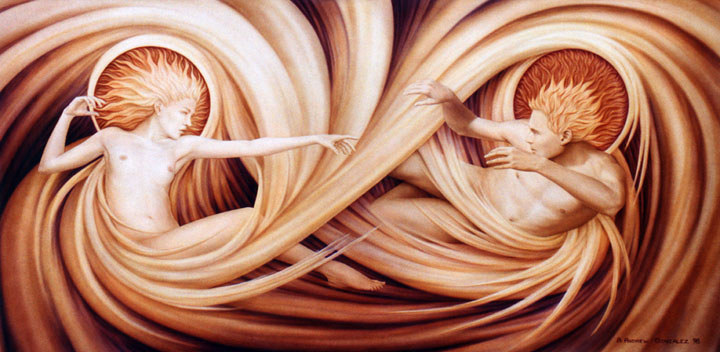 |
Aeterna Saltatus, cAndrew Gonzales,www.sublimatrix.com |
Jung spent the better part of the end of his life studying the subject of alchemy, which has been called the search for the godhead in matter. In typical "Jungian" style, his interest in alchemy developed from a vivid dream about an ancient library full of arcane books. Later, after much searching, Jung came to posses such a library. Alchemy reflected in symbolic form the same sorts of imagery Jung saw in his practice in neurosis, psychosis, dreams and imagination. Jung insisted that the psyche cannot be understood in conceptual terms, but only through living images or symbols, which are able to contain paradox and ambiguity. Alchemy reflects the process of personal transformation in the metaphor of transmuting base metals into gold.Jung was amazed to find that the images and operations he encountered in the old alchemy texts related strongly to his theories of psychoanalysis and the unconscious. Therefore, his main research project at the culmination of his career was around this topic of alchemy and how it related to the dynamics of consciousness. Jung saw in alchemy a metaphor for the process of individuation, and the morphing and mutating imagery of that process which emerges from the stream of consciousness. Alchemy can also be viewed as a system of self-initiation. Jung often turned to the images of alchemy, mythology and religion to help describe psychic life. For an image to be a living symbol it must refer to something that cannot be otherwise known.Jung elaborated most of his alchemical analysis of the psyche in three major volumes of his Collected Works. They include Alchemical Studies, Psychology and Alchemy, and his final volume Mysterium Coniunctionis. Since the publication of these there have been other works of alchemical interest produced by notable Jungian analysts. Among these are the following 2nd generation Jungians: 1). Foremost are the works of Marie-Louise vonFranz, who wrote Alchemical Active Imagination, Projection and Recollection in Jungian Psychology, Number and Time, and Alchemy: An Introduction to the Symbolism and its Psychology, to name but a few. 2). Edward Edinger has given us the classical text, Ego and Archetype, plus Anatomy of the Psyche.Other contributors include Henry Corbin with Spiritual Body and Celestial Earth, on Arabic alchemy, M. Esther Harding's Psychic Energy, Robert Grinnell's Alchemy in a Modern Woman, and Edward Whitmont's Psyche and Substance. A 3rd generation has arisen in depth psychology which considers imagination or 'the imaginal' to be the primal reality. Essentially unknowable, it can only be experienced through images by which it is expressed. It draws constantly on ancient elements of psychic life, which still abound in the modern world, such as ritual, gods and goddesses, dreams, alchemy and possession as well as aesthetics, etymology, humor, sensuality, poetry, etc. James Hillman has written extensively on Anima Mundi in Spring, the Journal for Archetypal Psychology, and it has many alchemical articles such as "Silver and the White Earth."Then there are the classical texts of alchemy, themselves, of course. There is a vast array of alchemical texts, with staggering varieties of ways of expressing the alchemical process, psychologically and experimentally. Many of them curiously contain homologues of the magic mushroom Amanita muscaria, (see Clark Heinrich's Forbidden Fruit). Among these texts are The Book of Lambspring, Aurora Consurgens, Codicillus (by Raymond Lully), Splendor Solis, Theatrum Chemicum, and the Alchemical Writings of Edward Kelly. Liber Azoth and De Natura Rerum (among others) by Paracelsus are foundational. Other classics include The Chymical Wedding of Christian Rosenkrutz and Rosarium Philosophorum which Jung used to illustrate his work The Psychology of the Transference.Finally, there are the modern translations of older works by A.E. Waite which include Turba Philosophorum, The Hermetic Museum, Lexicon of Alchemy, and The Hermetic and Alchemical Writings of Paracelsus. Even newer are the compendiums such as The Secret Art of Alchemy by Stanislaus Klossowski De Rola and Alchemist's Handbook by Frater Albertus. There is a whole catalogue of astute alchemical literature available from Phanes Press, including in particular those with commentary by Adam McLean, such as The Alchemical Mandala, Splendor Solis, and The Chemical Wedding of Christian Rosenkreutz. Another Jungian contribution is Eliade's The Forge & the Crucible. For lesser known treatises, Jung's bibliographies are a gold mine. Jung wrote the foreword to the Taoist classic on alchemy, The Secret of the Golden Flower.Most of us, unfamiliar with the subtle nuances of alchemical practice, view it as the historical predecessor of our modern sciences, like medicine, chemistry, metallurgy, etc. But, according to Jung's research, it seems to be much, much more. It is a curious fact that there is no single alchemy for us to examine. It is a cross-cultural phenomenon which has been practiced in various forms by ancient Egyptians, Greeks, Romans, Christian Europeans, and the Islamic, Hindu, and Taoist faiths. All of these use symbols to depict a process of transformation, whether this process is thought to occur inside (introverted) or outside (extroverted) of the human body. Although there are many types of alchemy, the main split is between intro- and extroverted forms. The deciding factor is the direction of the practitioner's creativity.In his book, The Alchemical Tradition in the Late Twentieth Century, Richard Grossinger summarizes the basic components of the different alchemical paths, which he dubs 'planet science.' These include the following:1. A theory of nature as made up of primary elements.2. A belief in the gradual evolution and transformation of substance.3. A system for inducing transmutation.4. The imitation of nature by a gentle technology.5. The faith that one's inner being is changed by participation in external chemical experiments.6. A general system of synchronistic correspondences between planets, colors, herbs, minerals, species of animals, signs and symbols, parts of the body, astrological signs, etc. known as the Doctrine of Signatures.7. Gold as the completed and perfected form of the metals, in specific, and substance in general (Alchemy is the attempt to transmute other substances into gold, however that attempt is understood and carried out).8. The existence of a paradoxical form of matter, sometimes called The Philosopher's Stone (the Lapis), which can be used in making gold or in brewing elixirs (elixer vitae) and medicines that have universal curative powers (panacea).9. A method of symbolism working on the simultaneity of a series of complementary pairs: Sun/Moon, Gold/Silver, Sulphur/Mercury, King/Queen, Male/Female, Husband/Bride, Christ/Man, etc.10. The search for magical texts that come from a time when the human race was closer to the source of things or are handed down from higher intelligences, extraterrestrials, guardians, or their immediate familiars during some Golden Age. These texts deal with the creation or synthesis of matter and are a blueprint for physical experimentation in a cosmic context (as well as for personal development). They have been reinterpreted in terms of the Earth's different epochs and nationalities.11. In the Occident, alchemy is early inductive experimental science and is closely allied with metallurgy, pharmacy, industrial chemistry, and coinage.12. In the Orient, alchemy is a system of meditation in which one's body is understood as elementally and harmonically equivalent to the field of creation. (Between East and West, the body may be thought of as a microcosm of nature, with its own deposits of seeds, elixirs, and mineral substances).13. Alchemy is joined to astrology in a set of meanings that arise from the correspondences of planets, metals, and parts of the body, and the overall belief in a cosmic timing that permeates nature.Thus, alchemy deals fundamentally with the basic mysteries of life as well as with transcendental mysticism. But its approach is neither abstract nor theoretical, but experimental, in nature.Just who were the alchemists, and why are their contributions important to us today? The alchemists were the leading explorers of consciousness in medieval times, and their research led to a vast improvement in the conditions of life. Among the more famous are Albertus Magnus, Paracelsus, Nicholas Flammel, and Sir Isaac Newton. Their contributions not only improved the lives of their contemporaries, but influenced the thought of many philosophers of the same and later eras, such as Meister Eckhart, Thomas a Kempis, John Dee, Johannes Kepler, Thomas Vaughn, Bishop Berkeley, Emanuel Swedenborg, William Blake, and Goethe.The contribution of these eminent alchemists are staggering: Albertus Magnus, alone, wrote eight books on physics, six on psychology, eight on astronomy, twenty-six on zoology, five on minerals, one on geography, and three on life in general from an Aristotelian point-of-view. He was a Dominican friar who was canonized a saint in 1931. Paracelsus was a Swiss born in 1493. His accomplishments were many and include being the first modern medical scientist. He fathered the sciences of microchemistry, antisepsis, modern wound surgery, hypnosis and homeopathy. He wrote the first medical literature on the causes and treatment of syphilis and epilepsy, as well as books on illness derived from adverse working conditions.Even with his accurate scientific bent, his work is also in close accord with mystical alchemical tradition. His was a worldview of animism, ensouled and infused by a variety of spirits. He wrote on furies in sleep, on ghosts appearing after death, on gnomes in mines and underground, of nymphs, pygmies, and magical salamanders. invisible forces were always at work and the physician had to constantly be aware of this fourth dimension in which he was moving. He utilized various techniques for divination and astrology as well as magical amulets, talismans, and incantations.Paracelsus believed in a vital force which radiated around every man like a luminous sphere and which could be made to act at a distance. He is also credited with the early use of what we now know as hypnotism. He believed that there was a star in each man, (Mishlove). This sentiment was echoed by 19th century magician and alchemist, Aleister Crowley, who said, "Every man and every woman is a star." This alludes to the essential Self, but is also literally in that our elements were forged in some distant supernova.Kepler developed the laws of planetary motion. But he developed his theories on the basis of explorations into the dimly lit archetypal regions of man's mind as surely as on his mathematical observations of the planetary motions. He was clearly a student in the tradition of earlier mystic-scientists such as Pythagoras and Paracelsus. Thomas Vaughn, Robert Fludd, and Sire Frances Bacon number among the 17th century Rosicrucians who practiced not only alchemy but also other hermetic arts and the qabalah.Sir Isaac Newton (1642-1727) was a mathematical genius, as well as one of the greatest scientists who ever lived. He discovered the binomial theorem, invented differential calculus, made the first calculations of the moon's attraction by the earth and described the laws of motion of classical mechanics, and formulated the theory of universal gravitation. He was very careful not to publish anything which was not firmly supported by experimental proofs or geometrical demonstrations; thus he exemplified and ushered in the Age of Reason.However, if we look at Newton's own personal notes and diaries, over a million words in his own handwriting, a startlingly different picture of the man emerges. Newton was an alchemist though after his death his family burned many of his arcane manuscripts in an attempt to hide the fact. He devoted himself to such endeavors as the transmutation of metals, the philosopher's stone, and the elixir of life. He was intensely introspective and had great mental endurance. He solved problems intuitively and dressed them up in logical proofs afterwards. He, himself, was astounded by the startling nature of his own theories. Gravity is a problem that still hasn't been dealt with satisfactorily by scientists.His followers, however, emphasized exclusively his mechanistic view of the universe to the exclusion of his religious and alchemical views. In a sense, their action ushered in a controversy in psychical research which has existed ever since. Since Newton's time, all discoveries suggesting the presence of spiritual force which transcended time or space were ironically considered to be a violation of Newton's Laws -- even though Newton himself held these very beliefs!It is interesting to note, that today scientists actually can turn small amounts of lead into gold through particle acceleration, since they are only one atomic weight apart, but the energy expense is prohibitive. Despite the advances in science, the "unknown" is still projected into the realm of matter, and the alchemical quest continues. Science is still debating over what is physical, what is psychic and what is metapsychic. VonFranz, in Projection and Recollection in Jungian Psychology, states that "In Western cultural history the transpsychic has been described sometimes as "spirit" sometimes as "matter." Theologians and philosophers are more concerned with the former, physicists with the later." Since the dawn of the 21st century, many physicists openly speak of the spiritual nature of Reality, especially in the quantum realm -- the microcosm and foundation of the macrocosmic world.VonFranz points out that "what was once regarded as the opposition between spirit and matter turns up again in contemporary physics as a discussion of the relation between consciousness (or Mind) and matter." It bears on such questions as the bias of the observer, and the theories of relativity, probability, synchronicity, non-locality, not to mention the whole field of parapsychology. Multidisciplinary studies such as quantum consciousness, quantum chaos and quantum cosmology have manifested Jung's prescient vision. Jung really returned us to the alchemistic viewpoint when he said, in Aion,"Sooner or later nuclear physics and the psychology of the unconscious will draw closely together as both of them independently of one another and from opposite directions, push forward into transcendental territory. ...Psyche cannot be totally different from matter for how otherwise could it move matter? And matter cannot be alien to psyche, for how else could matter produce psyche? Psyche and matter exist in the same world, and each partakes of the other, otherwise any reciprocal action would be impossible. If research could only advance far enough, therefore, we should arrive at an ultimate agreement between physical and psychological concepts. Our present attempts may be bold, but I believe they are on the right lines." (Jung).As vonFranz notes, "There is therefore no concept fundamental to modern physics that is not in one degree or another a differentiated form of some primordial archetypal idea." These include our concepts of time, space, energy, the field of force, particle theory, and chemical affinity.Laws in physics are subject to scientific revolutions and there has been a major breakthrough in paradigms shifts about every 20 years, or each generation. One of the most influential recently is Complexity or Chaos Theory. VonFranz says, "As soon as an archetypal idea that has been serving as a model no longer coincides with the observed facts of the external world, it is dropped or its origin in the psyche is recognized. This process always coincides with the upward thrust of a new thought-model from the unconscious to the threshold of consciousness."This is basically the process of weeding out "scientific errors." "...scarcely a thought is given to what they might mean, psychologically, once they are no longer fit to serve as a model in describing the outer world." This certainly happened to alchemy, until Jung revived an interest in it.. "It is only today, when we know that the assumptions of the observer decisively precondition the total results, that the question is becoming acute." Physicists have become increasingly conscious of the extent to which psychological circumstances influence their results. This "hard problem" of the subjectivity of our personal experience is the crux of consciousness studies and a sticking point in all neurologically-based descriptions of brain-mind dynamics, whether it is based in the quantum, holographic, electromagnetic, or chemical interactions.Other experimental-minded persons have sought the mysteries of life and divinity within their own bodies, since ancient times. Some employed entheogenic plants and elixirs, while others manipulated the paradoxical switch of the sympathetic and parasympathetic arousal systems through yoga or magick. Whether known as Yogis or Adepts, their goal was basically the same, as we shall see.Some modern schools of the Hermetic Arts see an identity between medieval European alchemy and the eastern practice of Yoga. They see a metaphysical or symbolic correspondence between the planetary and metallurgical attributions of alchemy and the chakras. Yoga is also experimental in nature; the experiment is performed on oneself. The qualities of the metals correspond to the planets and chakras as follows. |

| | | |
| | | |
| | | |
| | | |
| | | |
| | | |
| | | |
Alchemy is not concerned exclusively with consciousness, but also seeks the subtle transformation of the body, so that the physical level is also brought into perfect equilibrium. Thus, the alchemical metals may be considered analogous to the chakras of the yogis. We can draw another parallel among the three major principles of alchemy and those of Yoga, which are known as the Gunas. Mercury..........Sattva |
[excerpt from The Holistic Qabala, Miller & Miller, O.A.K., 1983]Part 2: ALCHEMICAL IMAGINATION: MAKING PSYCHE MATTER
Professor Wolfgang PauliIn the alchemical search for the God-head in matter (Kether in Malkuth), Paracelsus contended that matter was a living counterpart of the creating deity. A system of correspondences is the foundation of alchemy. The conception of a primal event manifested in different fields is fundamental to alchemy. The process in the retort vessel is analogous to the process of transformation of the psyche. Through alchemy, we can perceive the parallels between microcosm, universe, and man. Alchemy is based on the assumption that the equation world = man = God is Truth.The metaphorical perception of alchemy grew a new taproot in the Jungian school of psychology. It emphasizes the process of psychological transformation. This is the Opus, or Great Work of alchemy in one of its contemporary forms, through there are still alchemists who work with elixers, nostrums and potions or in experiments with metallurgy, preferring the concrete form. Alchemy is called the Great Work because that which "works" is that which has the active power to transform. The experiments are performed on oneself.This experiential act renews the alchemical philosophy which is primarily concerned with the union of psyche and matter. There is an indissoluble unity in alchemy between theory and practice. They are explicate aspects (which are experienced through a metaphorical sensory perception) of the Quest, or attainment of 'immortality' through the union of opposites. Thus, the goal of the Opus is precisely this union, which is known variously as the Philosopher's Stone, Royal Marriage or Unus Mundus (experience of one worldview uniting the psyche/body/spirit).Paracelsus described alchemy as the voluntary action of man in harmony with the involuntary action of nature. If the center of the creative process takes place in the "heart of man", his intentions take on profound significance. They can now influence the destiny of the cosmos. Attainment of this intentionality is known as the production of the Diamond Body, the stabilization of emergent magical perspectives and abilities. In modern terms, it means out-of-the-box thinking and being, a departure from mundane or ordinary consensus reality, but not in a dissociative or psychotic way -- but in a way that approaches Reality more closely. In modern consciousness studies, it can be likened to quantum consciousness, or a flow state.Alchemy strives for the experience of spiritual rebirth via the union of opposites, or the sacred marriage. The sacred marriage is characterized as the union of the Sun (+) and Moon (-). These polarized positions may be symbolized variously as positive-negative; yang-yin; male-female; god-devil; spirit-matter; father-mother, etc. The sacred marriage, or coniunctio, creates a bond by which opposites are united in an image which transcends both original potentials. The whole art of alchemy is contained within the image (implicate order) of a magical or divine child.There is an inherent paradox in alchemy: all the while stressing redemption of the physical body, or matter, alchemy is actively striving toward creation of a subtle, immortal body, which has no apparent physical basis (magical child = body of light).This central problem in alchemy is the spiritual redemption of the physical body, which has effectively been cut off from our spirituality in modern life by our culturally-rooted mind/body split. Alchemy requires resurrection of the soul of body. The challenge one encounters in developing and "owning" this fresh worldview is to "see through" to a unified vision of mundane physical processes with spiritual values and vision. This develops awareness of the psychophysical ordering processes inherent in matter -- in our matter. The solution is to visualize the physical body as a living metaphor -- a metaphorm -- for psychic transformation.For the true alchemist, according to vonFranz (1979),"...the mystery of the structure of the universe, was in themselves, in their own bodies and in that part of the personality which we call the unconscious, but they would say in the life of their own material existence. ...They thought that instead of taking outer materials you could just as well look inside and get information directly from that mystery because you were it. After all, you too were a part of the mystery of cosmic existence, so you could just as well watch it directly.Even further, you could ask matter, the mystery of which you consist, to tell you what it is, to reveal itself to you. Instead of treating it like a dead object to be thrown into a vessel and then cooked in order to see what came out, you could just as well take a block of iron, for instance, and ask it what it was, what its kind of life was, what it was doing, how it felt when melted. But since all these materials are within you, you can also contact them directly and in that way they contacted what we would now call the collective unconscious, which to them was also projected into the inner aspect of their own bodies.They consulted these powers directly through what they called meditation and therefore most of these introverted alchemists always stressed the fact that one should not only experiment outwardly but should always insert phases of introversion with prayer and meditation and a kind of yoga. With yoga meditation you try to get the right hypothesis, or information, about what you are doing or about the materials. Or you can, for instance, talk to quicksilver, or to iron, and if you talk to quicksilver and iron then naturally the unconscious fills up the gap by a personification. Then Mercury appears to you and tells you who the sun God is. A power, the soul of Gold, appears and tells you who and what it is. (Marie-Louise vonFranz, Alchemical Active Imagination, Spring Pub., Dallas, 1979).So, we see that basically the dynamic impulses of the original alchemists and modern physicists is the same -- to have a dialogue with matter and to find out all that is possible about how the creative process (God, to some) works.This Opus, or Work, is understood as taking place in a sealed retort vessel. The nature of this vessel is the original of the common-use term, "Hermetically sealed." This containment insures that none of the ingredients will be lost, and also provides a container in which the contents ("raw perceptions and emotions") are slowly heated, or cooked (calcinatio). The initial material (prima materia) then goes through several stages of transformation, defined as operations, or experimental stages. Only that which has been properly separated can be united.These are not always presented in the same sequence in alchemical texts. Most, however, include forms of calcinatio (heating); solutio (dissolving); coagulatio (congealing); sublimatio (ennobling); mortificatio or nigredo (blackening); ablutio (whitening); separatio (separating), and coniunctio (uniting). There are also operations of refinement, circulating, multiplying, and reiterating. Each stage displays typical colors and properties or qualities.The meditatio, or meditation, consists of inner dialogue with the alchemical figures: Saturn=lead; Luna=silver; Sol=gold; Mercury=quicksilver; Venus=copper; Mars=iron; Jupiter=tin. Because the process of alchemy does not extend into the Supernal Triad of the Tree of Life, it yields Self-Realization, not God-realization. It is a path of immanence, rather than transcendence. This does not exclude transcendence from happening through God's grace, however. Then Kether is in Malkuth, the beginning (prima materia) and end (ultima materia) are paradoxically a co-temporaneous One.In alchemy, the Anima Mundi, or Soul of the World acts as the soul-guide to the highest region. We experience An-imaginal (anima-ginal) Reality -- the world ensouled as living divinity, consciousness in its material unconsciousness. The putrefying contents of our psychophysical existence are elevated through insight and revisioning to the very means of our rebirth, and the unblocked, clear perception of our existential Reality.Always remember that the body is of vital importance in any alchemical operation. To transcend somewhere out of the body is not alchemical practice; rather, imagine the body NOWHERE, or now-here, fully present as the psychophysical self and its multi-dimensional holographic projection. Alchemy views our human condition as a psychophysical "Cosmosis," "As Above; So Below", hence we are permeated with and of the same essence and substance as the divine.:"...a physiological mythology juxtaposed with a cosmogonic mythology. In between is the psyche itself - the arcane substance, the subject factor - which achieves a personified level in the divinities of mythology. It is the psyche's own image-making activity, its self-creation through symbols, that is central to this model. It represents a process of the "psychization of instinct," the transformation of instinctual and biophysical phenomena into psychic experience. These phenomena can then to a certain extent be brought within the range of conscious will and reason. In this process instinct loses some of its primordial autonomy. It is an opus contra naturam, so to speak. ...Alchemy accordingly gives us a model for the psychology of projection; it points at once "upward" and "downward." It is radically symbolic in its insistence on the "arcanum." And finally, in the obligation it imposed for the careful elaboration of theoria, it included the formation of apperceptive concepts and symbols as a fundamental part of the opus." (Robert Grinnel, "Alchemy and Analytical Psychology", Methods of Treatment in Analytical Psychology, Spring Pub., Dallas, 1980).We can correspond the alchemist's metals and operations with the spheres of the Tree of Life: The prima materia is the original starting condition of the Probationer or Neophyte; in Malkuth, the earthy sphere one meets mortificatio, putrefactio, calcinatio; The Saturn Path, THE UNIVERSE = lead; which brings us to the lunar sphere, Yesod, and its alchemical attributes of silver and albedo. The mental sphere of Hod or Mercury (quicksilver; Mercurius) is balanced against the emotional sphere of Netzach, Venus (copper; benedictas veriditas); they are joined by the Mars-path, which is clearly rubedo, the "reddening." This path is bisected by the Sagittarian path, ART/TEMPERANCE, which is the formula of Solve et Coagula, culminating in the solar sphere of Tiphareth (gold, Sol, Lapis, solificatio, Minor Adept; self-actualization). The Mars sphere of Gedulah (Strength) is also linked with iron, while Chesed or Mercy is tin.We can examine what happens in initiation to the body/soul at the level of Malkuth for example, more closely. The process of alchemical initiation begins with the stage known as mortificatio, or psychological masochism. It means the death of the old personality for the the sake of the rebirth of the new renascent form or self-image. It means the disintegration of the conscious personality. It is specifically a spiritual or religious crisis in the life of the individual, where ruling ideas lose their meaning.Needless to say, this can be a depressing state of being, a loss of meaning. This classical depression is imaged in terms of "blackening" and has, therefore, to do with the Shadow. Depression necessitates a confrontation with one's own shadow, (self-defeating and self-destructive urges and patterns), not only as your personal inherent "evil", but as one's unlived life also for good. The actual process occurs as pathworking of XXI, The Universe, which corresponds through its Saturn attribute with the nigredo.To derive pleasure from punishing one's body is a curious pathological image. But, read metaphorically, we can see how we virtually flog our selves in a variety of ways, almost compulsively. We do it through stress, through overwork, through role-bound drives, through "shoulds" and "ought tos" -- we keep ourselves in virtual bondage. At least by mid-life, we ask the classic question of our consumer society, "Is this all that there is?" Our over-developed egos desperately try to maintain control over everything and everyone, but ourselves - and this tendency runs wild in our self-defeating and self-destructive addictions, including escapist consumerism. We are so used to trying desperately to dominate our reality, and what we really need to do is "let go" of our outworn rigidities.Intuitively we know that the one who dies still in the fast lane with the most toys doesn't necessarily win. We sense there is more to life and long to connect with it, to be reined in by it. The unheroic, self-humiliation and putting ourselves down with negative self-talk, is a form of masochism with a potentially religious aim: to gain forgiveness through a mode of redemption. This dedication to suffering -- to amplifying suffering -- produces meaning, compassion, humility, and healing. But it is an alchemical stage, not a way of life -- not suffering for suffering's sake. It is a discipline of the soul which contradicts the ego attitude, but those with chronic depression seem stuck in this stage, unable to escape the black mood.Seeking its archetypal background, we see there is a relationship between ritual flogging in initiation ceremonies and the intoxication of masochistic mortification. The same might be said of piercing or tattooing as behavioral expressions of this archetype, finding pleasure in the pain. The participant is entranced, connects with his/her pain, and enters the transformative process through a breaking of boundaries. The combination of humiliation and pleasure and unknownness yields an experience of ambivalence, a primal condition of psyche. It heralds a submission to the divine."Mortificatio is a psychological operation, not a moral one. We cannot apply a moral frame of reference to it; it is neither good nor bad, better nor worse. It is a necessary, just-so operation. One alchemical text advises, "Take the old black spirit and destroy and torture it..." Another philosopher tells us that "The tortured thing, when it is immersed in the body, changes it into an unalterable and indestructible nature." So the operation is necessary, not to make us morally better or spiritually purer, but rather to change us. When we immerse masochistic material in the body of fantasy, psyche and psychic reality become indestructible. The operation is necessary, not for the sake or moral ego-strengthening, but to make hard psychic reality. If we could fully realize this, that mortification is a way into the weighty, heavy matter of the soul, it might help us get past the momentary cringe. For we cringe and shrink at the moment of realization, at the reality of psyche where there is no ego-control, especially in its ugliness or banality." (Lyn Cowan, "On Masochism," Spring 1979, Spring Pub., 1979, p47).If you can see that the world is beautiful, but have lost the ability to feel that beauty, of course your moods are going to swing from sullen inertia to active despair. The ego feels out of control, and there is seemingly no meaning in life, so why exist at all? You feel fragmented, alienated from yourself. This is the beginning of the work, and a major reason people seek therapy or a mystical path to let go for renewal. When your ego can no longer pursue only its selfish concerns and addictive demands, the Self forces us into a depression to shake up the stagnant order of things. It brings a burning awareness of your shortcomings and inadequacies. To get to the root of these, we need to process old traumas and negative core beliefs that severely limit us. The Self appears on the inner stage as the shadow and confronts us with our inferior traits.Once we experientially comprehend the purposeful dynamics of the Nigredo, the depression begins to lift. But in order for this happen, we must accept the blackness as our own instead of blaming it on outside situations or other people. Then we begin to discover that it is our own withdrawal and loss of feeling about our own shadow natures that is the source of the darkness. When we turn our attention toward it, we see we are not suffering a mere personal ill, but one with transpersonal dimensions. In other words, this is a plight common to all of mankind, and a milestone on the path of individuation. It is a natural part of development.[for more on shadow and nigredo, also see my Modern Alchemist]The Nigredo in Alchemy, Path 32The putrefactio or nigredo represents the rotting stench of decay from the ego's outmoded attitudes and lack of adaptability. It occurs at the time in the life of the aspirant when the strain of the environment or pressure to achieve has become intolerable. In time, the attacked alchemist comes to realize that he must willingly subject him/herself to change.'Raven's head' is the traditional name for the stage of the process whose technical name is the nigredo. The nigredo is symbolized by multiple references to black substances, and is associated with the Shadow archetype, or repressed contents of the personal unconscious. The nigredo implies a time of anxiety, melancholia, sleeplessness, and restless volatility. This stage of discomfort with the status quo is necessary to initiate the alchemical process -- the dissatisfaction and discomfort turn up the psychic heat. Thus, we see there is an inherent value and meaning in this depression. In our modern world of antidepressants and tranquilizers many people fail to follow this mood toward its positive goal, and despair or become doubly disappointed after the medications begin to fail on them after a time.Psychologically, we experience in this phase a chaotic state of conflict between hostile psychic elements. There is a tendency toward regression, helplessness, inertia, or losing consciousness of the motivating factors of behavior. We don't want to do a thing; even rise in the morning; what's the point!? Any emotional response to the situation is practically impossible. We are too numb, too down, too paralyzed. We don't know where to turn if we could. In modern terms, it is equivalent to the concept of psychic dissociation, which is the root of neurosis and psychosis ("falling apart").There is always psychic suffering when we "fall down." And this is like falling down a psychic rabbit hole, like Alice into a totally unknown, disorienting world. We fall inexorably into a psychic black hole. It is not an adventure, but an abduction into the underworld of the powerful subconscious forces, and they seem to mean us ill, to torture and disempower us, while we are helpless. This suffering may even persist for a lifetime if there is technical blunder in the Work, a failure to respond to its spontaneous call to action. The alchemist must "pick him/herself back up." Then, there will be further transmutations from the instinctive psyche.This stage corresponds, again, to the encounter with the Shadow. The ego and the Shadow must eventually be reconciled. The restlessness and disorientation are the product of an initial collision between conscious and unconscious factors. This is the beginning of a descent into darkness, or the unconscious.As long as the psyche struggles in the nigredo, it will be emotionally attached to the literal aspects of any situation. Fascinated by "facts" and the "materialness" or "medicalness" of any condition, the alchemist fails to extract the symbolic aspect which would allow him/her to break through into a fresh mode of perception. Typical manifestations of this stage include long dreams, confusion, and a drained or depressed mental attitude. The symbolic attitude is presented when the nigredo is perceived as part of a mystery process -- a curse with a hidden blessing, or grace at its core.Missing the point, the eye of the aspirant caught up in the nigredo looks for what is "wrong." It ruminates on such physical questions as, "Is it an organic or neurological problem creating these manifestations of depression in me--is it clinical depression?" It will then propose such treatments as pills, body work, or dance therapy. Grossness casts a veil or cloak of physicality over the subtle body of the alchemist and he fails to realize it is his soul which is sick unto death. The "cure" will not come through antidepressants, tranquilizers, vitamin therapy, geographic escapes, or rejuvenating drugs and cosmetics, or exercise and endorphins.The elan vital, or life energy has been pulled into the unconscious, leaving the ego frustrated and discontent. The emptiness and sterility of this condition may be the result of placing too much emphasis on "getting it together in the work-a-day world, leaving the soul cut off from the well-springs of life. The feeling of being drained, or over-extended may become so powerful that one is forced into a breakdown which demands the time for introversion and recovery of energy reserves.The ability to see through to a value in depression (to experience the meaningfulness of the feeling of meaninglessness) has a prognosticative purpose. Attaching meaning to depression allows an emotional participation which unblocks the flow of psychic energy. Depression is not a loss of meaning, but the feeling of loss of a sense of meaning. One is reminded of King Arthur during his "wasteland" period, wandering in the wilderness before the finding of the Grail. There we learn "the King is the land, and the land is the King." And when it comes to the Grail to ask, "Who do these things serve?" Meaning comes through deepening the process."This whole experience is like a journey through the wilderness and it often appears in dreams under the symbol of the "Night-sea Journey." But when the problems of the personal unconscious have been met and dealt with in analysis, a sense of inner unity and renewal is usually found. This is often accompanied by glimpses of deeper values, of the Self, for instance, that are frequently couched in the terms of religious symbolism. The analysant feels that he is once again reconciled with himself and with God so he can go back to this ordinary life with renewed zest. The wilderness is no longer barren, his life blossoms and bears fruit." (M. Esther Harding, "The Value and Meaning of Depression," Bulletin for the APC of NY; Analytical Psychology Club of NY, Inc., 1970; p. 10.)Path 32, connecting Malkuth with Yesod, the Sphere of the Moon (corresponding with dreams), can be the path of renewal which transmutes the alchemist from his sense of confusion and despair."Following this state of darkness, the alchemists report that light begins to dawn, due to the rising moon, which psychologically means the beginning of insight gained through paying attention to the unconscious, to the night happenings, to dreams and so on, which throw a light on one's inner condition. The moon also refers to Eros, relatedness through feeling. In other words, when the nigredo, the blackness, has been accepted and taken to oneself, instead of being blamed on outside situations and other people, one begins to see that it is one's own withdrawal and loss of feeling one's own shadow, that is the true cause of darkness. Then the moon rises and in recognizing that one is suffering... that is the feminine eros; the lesser light begins to shine in the darkness of the night." (Harding, 1970).That moonrise in Qabalistic terms, means access now to the sphere of Yesod, the Moon. The stuckness is over, though other bouts with depression may bring further growth and insight on a higher arc. Further alchemical transmutation will bring one into the warmth of the sun, the greater light, which means there is an increase in the light of consciousness (Tiphareth stage). Thus one traverses astral world or the mystical realms of the Sun (Tiphareth), the Moon (Yesod) and Stars (The Universe)."And so one meaning of the experience of depression is that our wholeness, or individuation, the Self, can no longer wait while we follow egotistic ways or even seek for legitimate ego fulfillment, and so the Self brings us, drives us, into the wilderness of depression...and communication between earth and heaven is even then about to be revealed to us, if only we will attend to the vision." (Harding, 1970).It is an experiential journey, this experiment on oneself with the elements of nature. To really "get it" we must do the work to get the benefit. The method works if we do. At this stage we can greatly benefit from watching and participating in our imagery process by entering the stream of consciousness, the dreamtime. Dreamhealing, a form of shamanic dream journeys, also known as CRP (Consciousness Restructuring Process) can be very helpful in this process of letting go and connecting with source, with flow and the well-spring of life.See my whole body of work on this subject of Dreamhealing at asklepia.org |
ALCHEMY BOOKS:Aion: Research Into the Phenomenology of the Self, C.G. Jung Collected WorksA Study of Chinese Alchemy, Obed S. Johnson Alchemical Active Imagination, M-L Von Franz Alchemical Mandala, Adam McLean Alchemical Medicine, Paracelsus Alchemical Studies, C.G. Jung Alchemical Symbols and Secret Aphabets, C.J.S. Thompson Alchemical Tradition in the Late Twentieth Century, Richard Grossinger Alchemist's Handbook, Frater Albertus Alchemy, Franz Hartmann Alchemy, Child of Greek Philosophy, Arthur J. Hopkins Alchemy, the Secret Art, Stanislaus Klossowski de Rola Anatomy of the Psyche, Edward Edinger Archidoxes of Magic, Paracelsus Atalanta Fugiens, Joscelyn Godwin, trans. Aurora of the Philosophers, Paracelsus Azoth or the Star in the East, A.E. Waite Coelum Philosophorum, Paracelsus Collectanea Chemica, Philalethes Concerning the Alchemical Degrees, Grades & Compositions, Paracelsus Concerning the Spirits of the Planets, Paracelsus Cosmic Alchemy, C.C. Zain Crowning of Nature, Adam McLean Elixir of Enlightenment, A.H. Almas Forge and the Crucible, Eliade Foundations of Newton's Alchemy, Betty Dobbs Goethe: the Alchemist, Ronald Gray Golden Game, Klossowski de Rola Grail Legend, Jung & Von Franz Hermetic Tradition, Julius Evola Internal Alchemy: the Natural Way to Immortality, Master Hua-Ching Ni Jewish Alchemists, Raphael Patai Jung on Alchemy, Nathan Schwartz-Salant Mirror of Alchymy, Roger Bacon Mystery of the Coniunctio, Edward F. Edinger Orders of the Great Work: Alchemy, M.P. Hall Origin and Structure of the Cosmos, Robert Fludd Papers Toward Radical Metaphysics: Alchemy, Charles Ponce Paracelsus: Selected Writings, foreword by Jung; N. Guterman (Tr.) Philosopher's Stone, Michio Kushi Practical Handbook of Plant Alchemy, M. Junius Preparation of the Sophic Mercury, Philalethes Psychology and Alchemy, Jung Quest for the Red Sulphur: the Life of Ibn' Arabi, Claude Addas Robert Fludd, Joscelyn Godwin Rosary of the Philosophers, Adam McLean Science of Alchemy, William W. Westcott Secret Tradition in Alchemy, A.E. Waite Secrets of John Dee, James Gordon Spiritual Alchemy, Mikhael Omraam Splendor Solis, Godwin, McLean Understanding Reality: A Taoist Alchemical Classic, Chang Po-tuan, Thomas Cleary (Tr.) |
Holistic Qabala home | Iona Miller home | Synergetic Qabala home |


 Jung's dreams in 1925, 1926, and thereafter frequently found him in ancient houses surrounded by alchemical codices of great beauty and mystery. Inspired by such images, Jung amassed a library on the great art which represents probably one of the finest private collections in this field. In addition he secured photocopies of a large number of rare works which repose in various collections the world over. I well remember being told by the late Dr. Henry Drake, Vice President of the Philosophical Research Society in Los Angeles, how Jung secured copies of the extensive alchemical collection of the Society in the 1940's, and expressed his feelings to Manly P. Hall of that Society concerning the valuable use to which he had put these materials in his book Psychology and Alchemy. Jung's collection of rare works on alchemy is still extant in his former house in Küsnacht, a suburb of Zurich.


 Entradas








