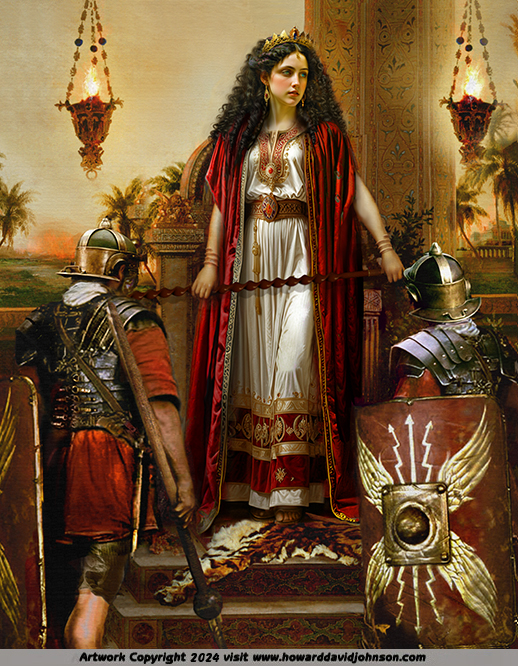
domingo, 25 de octubre de 2009

Nordic Myths by Howard David Johnson

Fuente:

http://www.howarddavidjohnson.com/nordicmyths.htm

Información:

Illustrations of Norse Mythology: Featuring Teutonic Mythology and the Siegfried Legends. ( Ancient Nordic Myths and Legends of the Vikings, Germany, and Scandinavia.) An educational multi-media gallery of realistic Illustrations of Norse Mythology and word paintings by Contemporary American Illustrator and Author Howard David Johnson

Illustrations of Norse Mythology.jpg (39039 bytes)

_Myths & Legends of the Ancient Norsemen.gif (3042 bytes)

A.K.A. Teutonic Mythology - Nordic Mythology - Scandinavian Mythology - Norse Myths - Myths of the Vikings - Legends of the Aesir and the Jötung Educational Multi-Media Mythic Art Galleries

Howard David Johnson has five different galleries devoted to myths and legends of the ancient world

_Btn.myth.jpg (4278 bytes)

btn celtic&.jpg (15723 bytes) Asian mythology Art Gallery.jpg (13921 bytes) deutsche mythologie.jpg (14999 bytes) Realistic Paintings Art Gallery.jpg (14400 bytes)
Greek Mythology Celtic Mythology Asian Mythology Norse Mythology Women of Mythology
Newly Updated! Newly Updated! Newly Updated! You are here! Newly Updated!

_Myths & Legends of the Ancient Norsemen.gif (3042 bytes)

Featuring Illustrations of The Aesir and The Nibelungenlied: The Ring of the Nibelung, The Valkyrie, Siegfried, & The Twilight of the gods

"Whosoever will renounce love and make a ring from the gold will rule the world."

The enormously popular "Lord of the Rings" is largely based on the 13th century Nibelungenlied saga from a Middle High German epic poem. It also draws upon the varying folklore of Northern Europe. Odin was the Scandinavian father god and his favorite mortal was Siegfried (or Sigurd in the Volsunga Saga from Iceland) and is the chief hero and Dragon Slayer of all Norse Mythology. In one version, Siegfried is the prince of the Netherlands who acquires the treasure of the Nibelungs by killing it's quarrelsome custodians in a cavern. He visits the court of Queen Brünhild of Iceland, who has vowed only to marry a man that can best her. Siegfried bests her by trickery, then infuriates her by departing without marrying her. An epic tale of heroism and treachery, romance and revenge, The Ring of the Nibelung or The Nibelungenlied has entertained listeners and readers for centuries.

It is best known to modern audiences as the source for The Ring Cycle - a series of four operas in the 1860's by Richard Wagner; "Die Nibelungenlied" or The song of the Nibelung: The Rhiengold, The Valkyrie, Sigfried, and The Twilight of the gods.

In the Wagnerian Opera version, Siegfried fell passionately in love with Brünhilde, who was Odin's daughter and captain of the Valkyries. Unlike the Greek & Roman myths, these Norse myths vary drastically in details, names, and spellings depending on their country of origin due to the use of oral tradition rather than written language.

The same early legends and semi- historical accounts gave birth to all the different variations. These diverse orators hailed from the British Isles, Germany, Austria-Hungary, Switzerland, Belgium, Sweden, Norway, the Netherlands, Iceland, Holland, Denmark, Russia, Finland, and even Flemish-speaking communities in Italy and France as well as faraway lands such as America and Africa due to wide-spread migration.


The Ring Cycle ( The Wagnerian Version )

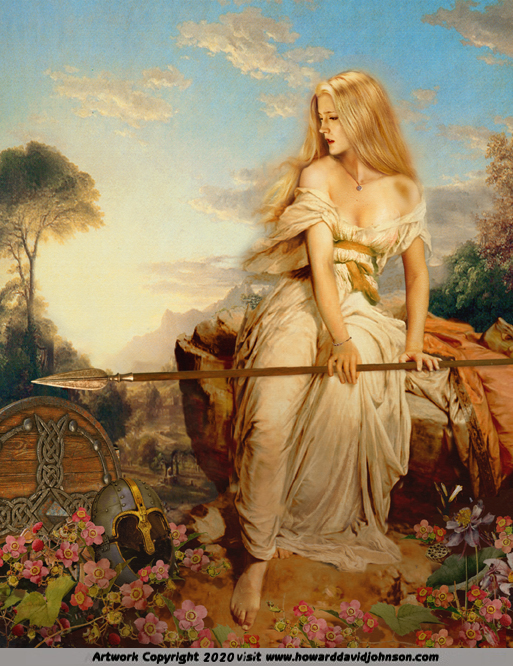
Freyja, (Freya, Freyia) in Norse mythology, the goddess of love and beauty and sister of Frey. (There are other spellings and variations depending on various geographical locations. ) She was the northern Venus and the most beautiful of all the Nordic goddesses.

As Valfrya, she also rode to the battlefield in her chariot, there to claim the slain. These she feasted in her great banqueting hall while Odin, chief god of the Aesir, transported all the others to Valhalla. She controlled the golden apples at the top of the world which were the secret of the immortality of the gods. When she was captured by Fafnir and Fasolt the Jötung and held hostage in demand for the Ring of the Nibelung her abscence caused the gods to begin to grow old and die; to fade into legend. "The Twilight of the gods".

She was married to Odur the god of sunshine, but he left her to roam in distant lands. She followed him, weeping teardrops that changed to gold in the rocks and amber in the sea. In later mythology, Freyja is often confused with Frigg, Odin's wife.

_Fafnir the  Dragon copy.jpg (43967 bytes)

Das Rheingold ( The Rhine Gold )

For eons the Rhine maidens guarded the gold that gleams on a rock above the Rhine River. Alberich, one of the Nibelung dwarfs, steals the gold. His bother, mime, makes the ring. Odin ( Wotan, Woten ) king of the gods tricks the Nibelungs out of the ring. He gives it to the giants, Fasolt and Fafnir for building the home of the gods, Valhalla high above the clouds. Alberich screams a death curse on the ring. Odin then sought to have his earth-son Siegmund regain the ring from Fafnir, who has transformed himself into a dragon. Erda predicts the fall of the gods if Alberich regains the ring. The Norse gods were not all- powerful.

_Odin, father god of the Aesir.jpg (62099 bytes) _Erda, wife of Odin & mother of the Valkyries.jpg (62641 bytes)

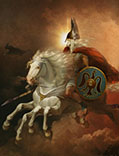
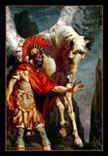
Odin, the supreme Norse god, gave one of his eyes for wisdom. He was also the god of war, wisdom, prophecy, poetry, and magic. His sons by different wives were Thor, Loki , and Baldur. He had two ravens, thought and memory fly to and fro in the Earth and report the activities of men to him in his Gladshiem, the grandest of Aesir palaces. The modern Santa Claus legend is partly based upon him flying out in a sled once a year to clobber the parents who beat their children too much. When he went out to battle he rode an eight legged horse named Sleipnir. The German form of the name was Wotan; the Anglo-saxon was Wodan or Woden. Wednesday ( Woden's day ) was named for him. Erda, Odin's wife was an Earth goddess of ancient wisdom. The Valkyries were Odin and Erda's nine beautiful daughters, who rode winged horses down a rainbow bridge to Earth.

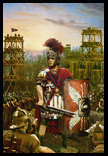
_The Priests of Odin.jpg (55177 bytes)

Die Walküre ( The Valkyrie )

The captain of the Valkyries was Brünhilde, the eldest. From the fields of battle they carried slain heroes up to Valhalla. Every day the slain would do battle on the great plain, and every night, their wounds would heal. Odin often joined them in the feasting and drinking of mead, a strong form of alcohol. Human sacrifice to the gods was also a part of the practice of this ancient religion. While seeking the ring, Brünhilde was commanded by Odin to protect Siegmund from Hundling, his rival. Siegmund and Hundling's wife Sieglinde fell in love and the goddess of marriage complelled Odin to protect Hundling. In pity for Siegmund, Brünhilde guards him. Odin then helps Hundling slay Siegmund. to punish Brünhilde, Odin puts her to sleep on a rock surrounded by fire, not to awaken until a hero claims her. Sieglinde, carrying the pieces of Siegmund's magic sword, Nöthung, escapes to take refuge near Fafnir's cave, where she will give birth to Sigfried.

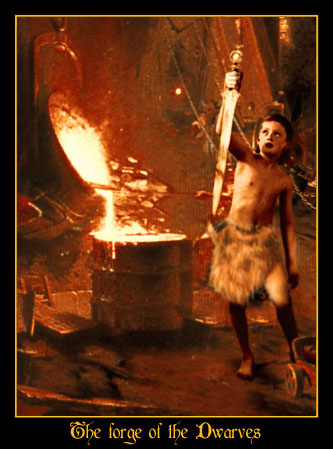
_The_ Sword_ of_ Siegfried.jpg (57385 bytes) _The_ Sword_ of_ Siegfried detail2.jpg (54177 bytes)

Siegfried

Young Sigfried was raised by Mime, a Nibelung dwarf, who plans to use him to gain the ring for himself. Working at his forge in a cave in the great forest, Mime tries in vain to rejoin the pieces Siegmund's sword hoping Siegfried could kill Fafnir with it. Mime wins a wager with a wanderer, ( Odin in disguise ) and the god tells the dwarf that only a warrior who has never learned fear could re-forge the magic sword. Siegfried manages to forge the pieces of his father's blade together and becomes the mortal favorite of Odin, receiving many blessings such as a Valkyrian flying horse.
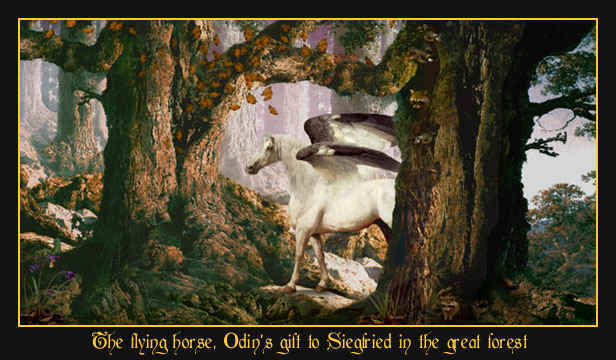
_the flying horse.jpg (90303 bytes)

As a young man, he slays the dragon, Fafnir and siezes the ring. A bath in the dragon's blood makes him impervious to injury everywhere save one small spot where a leaf has clung to his back. He accidentally tastes Fafnir's blood which gives him the power to understand the forest birds. He learns of Mime's plan to kill him for the ring, and Siegfried kills him first. In a rocky wilderness, Odin calls Erta up from the Earth. He tells her that, far from fearing the twilight of the gods, he desires it. He allows Siegfried to keep the ring by means of which he and Brünhilde will be able to masterthe world. A bird leads Siegfried to the sleeping Brünhilde. Siegfried plunges through the fire and rouses Brünhilde with a kiss.

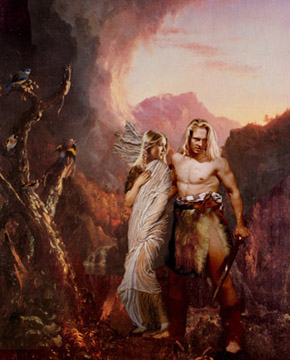
_The Dragonslayer copy.jpg (58903 bytes) _Siegfried and Brunhilde.jpg (66821 bytes)

Die Götterdämmerung (Twilight of the gods )

Later, when Brünhilde sends Siegfried on a Rhine journey he meets the sons of Alberich the nibelung, Hagen, Gunther, and Gutrune. He is tricked into drinking a potion by Hagen that destroys his memory and then he is decieved into betraying Brünhilde. He regains his memory and is stabbed in the back by Hagen. Gunther was then killed in a struggle for the ring. When Brünhilde learns that Siegfried had been tricked into betraying her, she takes the ring from his finger and rides up onto his funeral pyre.

In the distance Valhalla burns and the gods are destroyed.

_Myths & Legends of the Ancient Norsemen.gif (3042 bytes)

Other legends of the ancient Teutons...

_Thor & the Fire Trolls.jpg (57101 bytes)

The Mighty Thor, known primarily as the thunder god was also the norse god of war and agriculture. Among the great gods of the Aesir, Mighty Thor was second only to Odin, his father. His mother was Fiörgyn, and Loki, his half-brother, was a frequent companion on his adventures. His name is the teutonic word for thunder, outside the teutonic areas, he has close affinities with Jupiter or Zeus. He was worshipped as Thunor, or Thonar in ancient England. His hammer, also created by the dwarfs, was aptly called Mjölnir (crusher ) was as destructive as the thunderbolts of Zeus in punishing wrongdoers. It was the most potent weapon against the Frost Giants, Fire Trolls and other enemies. When Thor hurled it, it returned to his hand after hitting it's target. When Thor put on his magic belt his already enormous strength was doubled. The creators of these marvels, the Dwarfs were a class of clever supernatural beings not unlike elves and fairies, noted for skill at metalworking and serving the gods. Thor, is for whom Thursday or Thor's day was originally named. He was apparently more widely worshipped more than any other god by the ancient norsemen. The evolution of the popular Thor Mythology continues to this day in comic books, video games, and motion pictures.

Kriemhilde's Revenge - (from earlier versions of The Nibelungenlied )

THE REVENGE OF KRIEMHILDE:

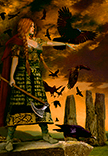
The Lady Kriemhilde (A.K.A. Grimhild, Hild, Brünhild) Her name means ‘armored warrior woman’ and the English word Grim derives from her name too. In her earliest legends she was originally a daemonic mythical figure representing darkness and death.

Like the legendary King Arthur, she was also a historical figure, wife of Attila the Hun and sister of Gunther. (453 A.D.) She marries Attila in one reliable historical account and kills him in revenge for the death of her former husband on their wedding night.

I have illustrated her here in the 13th century Middle High German mythic version preparing to confront her cowardly brothers with her dead husband’s shield and sword, demanding action! Siegfried was the Nordic people’s greatest hero and chief dragonslayer his story is similar to The Iliad and the Odessey of the Greeks. In another version she demands revenge for her murdered father. She is depicted here as the heroine of the The Nibelungenlied, greatest epic of Teutonic Mythology.

The lady Kriemhilde.jpg (68344 bytes)

"Lo there, do I see my father- Lo there do I see my mother and my sister and my brothers - Lo there I do see the line of my people back to the beginning - Lo they do call to me - they bid me to take my place among them - in the hallowed halls of Valhalla - where the brave shall live forever!" ~ Viking liturgy

_Myths & Legends of the Ancient world-.gif (15805 bytes)

Thank You For Visiting the Norse Myths and Legends Art Page of Howard David Johnson...

All images copyright 1993-2006 Howard David Johnson all rights reserved. Gorgeous Poster size Reprints Are Available Below...

*****

ON SALE NOW from BRANDYWINE PRESS!

These beautifully printed 11" x 8.5" 64 page trade paperbacks feature 48 full page interior plates in full color for only $24.99 USD. Less than the price of a single poster! Featuring incredibly Realistic Mythological and Fairy Art created in a style inspired by Classic Illustrators by American Artist & Photographer Howard David Johnson.

Click on the covers to order the books from Lulu.com

ALSO: Click on the CREDIT CARD logo below to

VISIT POD PUBLISHING FOR BEAUTIFUL POSTER SIZE REPRINTS

AND A VARIETY OF PAYMENT OPTIONS, SIZES, PAPERS, AND PRICES

Admission Free Fantastic & Realistic Art Galleries

Deutsch Francais Italiano De Portugese Espanol Dutch Japanese Chinese

The Realistic Drawings, Paintings & Digital Art of American Artist & Photographer Howard David Johnson.

Click on the Icons to visit the Educational Galleries of Realistic Art: Including Mythology of Greece, Rome, Asia, The Celts, The Norsemen, and more...Fairy and Dragon legends, The King Arthur Legends, The Seven Wonders of the Ancient World, Paintings of Ancient Egypt and Babylon, Ancient Mystic Religious texts, War & Civilization from The Ancient Spartans and the Trojan Horse to World War Two, The World's Great Religions, and Art Technique...

( These are best viewed in full screen mode. Simply click F11 on your keyboard )

Enter a world of imagination...

home page btn.02.jpg (13926 bytes)

Asian mythology Art Gallery.jpg (13921 bytes) _Btn.myth.jpg (4278 bytes)

btn celtic&.jpg (15723 bytes)

Realistic Paintings Art Gallery.jpg (14400 bytes)

~symbolist art.jpg (15008 bytes)

Home Page

Asian Mythology

Greek Mythology

Celtic Mythology

Mythic Women

Symbolist Art


~The great Pyramids copy.jpg (14977 bytes)

order repro.jpg (16120 bytes)

btn res publica.jpg (16510 bytes) The world'd great religions.jpg (12695 bytes)

The World's Great Religions Art Gallery.jpg (14460 bytes)

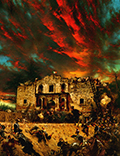
Alamo btn.jpg (17997 bytes)

Res Publica

Reprints for Sale

The Seven Wonders

World Religions

Realistic Paintings

Legends of History


btn.com.2.jpg (15461 bytes)

btn stages.jpg (16477 bytes) btn celtic fairies.jpg (18389 bytes)

History of Dragons..jpg (17045 bytes)

fantasy2link.jpg (14608 bytes) btn.Phantom of the Opera.jpg (16977 bytes)

Commercial Art

Style & Technique Fairy Paintings

History of Dragons

Fantasy Art I Fantasy Art II

btn.fine art 2.jpg (14122 bytes)

btn photos.jpg (11360 bytes) ~btn.pencil drawings.jpg (11394 bytes) Colored pencil portraits Art Gallery II.jpg (12252 bytes) Realistic Art Instruction link.jpg (18214 bytes) _Btn.abouthdj.jpg (3569 bytes)

Art Numérique

Studio Headshots Pencil Portraits I Pencil Portraits II

Art Instruction

About the artist

a 21st century realistic artist.GIF (8255 bytes)

Howard David Johnson is a contemporary visual artist and photographer with a background in the natural sciences and history. He works in a wide variety of media ranging from traditional oils, pastels and others to cutting edge digital media. After a lifetime of drawing and painting, Howard David Johnson's Traditional Realistic Art was exhibited in the British Museum in London in 1996, ( 3 years before he got his first computer ) as well as numerous American ones since, such as the Metropolitan Museum of Art. His illustrations have appeared in every major bookstore and gameshop chain in America as well as magazines and educational texts around the world. Some of his more prestigious clients have included the University of Texas, the Book of the Month Club, Paramount Studios, PBS TV, Adobe Photoshop Auto FX, and J Walter Thompson Advertising. Licenses to print his existing work are available at surprisingly affordable prices. Oil Paintings, Colored pencils, Pastels, Mixed media, and Digital art can also be commissioned for select projects - Click on commission new art below... Working in a variety of traditional and cutting edge digital media he offers his customers a variety of options and more than thirty years of experience. As a commercial illustrator HDJ has not only used the computer but has been involved in the development of imaging software. He delivers the rights to these custom made copyright free illustrations and old fashioned customer service when he does work-for-hire. On his existing works license offers start as low as $100.00

POSTER ART ART BOOKS PUBLISHING LICENSES BUY ORIGINAL ART ART INSTRUCTION

info@howarddavidjohnson.com

Thank you for Visiting... Your business, letters, & links are always welcome.

*****

Gorgeous Professional Quality Collectible Poster Size Fine Art Lithographs and Single Reprints

of H D Johnson's illustrations are available - or

Dealers- Ask about our GREAT bulk order discount pricing!

Bulk Customers- Ask for our credit application

info@howarddavidjohnson.com HIGHEST PROFESSIONAL QUALITY GUARANTEED!

realistic painting # 3.jpg (54556 bytes)

This Art Gallery has been honored by more than 20,000,000 Unique Visitors

from the Four Corners of the Earth:

My Friends from around the world thus far :

Sweden, Finland, Norway, Netherlands, Denmark, Germany, Iceland, England, Scotland, Wales, Ireland, France, Greece, Cyprus, Turkey, Italy, Belgium, Yugoslavia, Macedonia, Croatia, The Czech Republic, Bosnia, Herzegovina, Slovakia, Slovenia, Luxembourg, Latvia, Estonia, Hungary, Bulgaria, Lithuania, Poland, Austria, Romania, Spain, Russia, Ukraine, Moldova, Malta, Switzerland, Portugal, Israel, Egypt, Saudi Arabia, Yemen, The United Arab Emirates, Qatar, Iran, Lebanon, Morocco, The Republic of Congo, The Ivory Coast, Angola, Zambia, Zimbabwe, Nigeria, Namibia, South Africa, Mauritius, Japan, South Korea, China, Macau, Taiwan, Nuie, New Zealand, Australia, The Philippines, Palau, Cocos Island, The Kingdom of Tonga, Singapore, Thailand, Brunei Darussalem, Malaysia, India, Sri Lanka, Pakistan, Indonesia, Chile, Argentina, Uruguay, Brazil, Peru, Venezuela, The Dominican Republic, Guatemala, Costa Rica, Colombia, Trinidad and Tobago, Panama, Ecuador, Belize, Puerto Rico, Mexico, Canada, and my home,

The United States of America ...

If your home is not listed here please e-mail us and tell us where you're from..

POSTER ART ART BOOKS PUBLISHING LICENSES BUY ORIGINAL ART ART INSTRUCTION

info@howarddavidjohnson.com

Your business, letters, & links are always welcome

Thank You For Visiting the Norse Myths and Legends Art Page of Howard David Johnson...

All images copyright 1993-2008 Howard David Johnson all rights reserved.

*****

ABOUT THE ARTIST

"Those who are enamoured of practice without science are like a pilot who goes into a ship without rudder or compass and never has any certainty where he is going. Practice should always be based upon a sound knowledge of theory, of which perspective is the guide and gateway, and without it nothing can be done well in any kind of painting."

Howard David Johnson is a contemporary visual artist and photographer with a background in
the natural sciences and history. He works in a wide variety of media ranging from traditional
oils, pastels and others to cutting edge digital media. He loves mixing media. This site features
examples of his Realistic Art, including illustration, photography, experimentalism, and fine art.

The various galleries linked to by the icons above show many examples of His Realistic Art, and are grouped by theme rather than media. There are also sample illustrations from his upcoming books on Celtic Myth and Legend and World Myth & Legend. Since boyhood he has passionately copied the old masters. To create his work, he usually starts with a thematic concept followed by a rough realistic pencil sketch, then followed by his photography, often traveling to find suitable scenes and locations and then working in his Photography studio with live models from his sketches. He then assembles a variety of elements which are realistic and original. As a boy he dedicated his life to art in 1960. From 1965- 1999 he used xeroxes and tracings to make his preliminary photo montages. This is patterned after the manner used by Maxfield Parrish and other 19th century notables. Beginning with a tracing, he then draws or paints from these complex original Computer Photo Montages. Many of these are on display on this web and slated for future completion in a variety of realistic traditional art media. As this happens, the finished work is substituted in the exhibit. Recently he shot hundreds of aerial photos of clouds at marvelous angles and perspectives and also looking down on the mighty mountains, rivers, and deserts of the American west while flying from Texas to Oregon and back for dynamic source material for realistic flying scenes in upcoming paintings , drawings, and pictures.

His favourite medium for realistic art is colored pencil because of the high speed and low expense, and people began expressing difficulty in telling his colored pencil drawing from photographs in the early 1980's. In the last 35 plus years he has also mastered Oils, Pastels, Acrylics, Watercolors, Inks, Scratchboard, Gouache, Photography, and the highly controversial digital media ( Art Numérica ) . As a commercial illustrator Johnson has not only used the computer to create art but has been involved in the development of computer imaging software. Working in a realistic style inspired by classic illustrators HDJ is deeply rooted and grounded in the Greco-Roman artistic tradition, Feeling that with realistic art, the human form is the ultimate arena for artistic expression. His lifelong dream came true when his Traditional Realistic Art was exhibited in the British Museum in London England in 1996. His mixed media has also been displayed in numerous other ones since such as the Metropolitan Museum of Art. Having achieved international acclaim as a traditional visual artist he discovered digital media ( Art Numérica ) in 1999. Because of his passion for realistic art and photography he elected to embrace it and joyfully be a part of this historic era in the visual arts as a 21st century realistic visual artist. `fig.0003-3a.jpg (47139 bytes)

Since 1972 when he began his career as a scientific illustrator for the University of Texas he has earned his living illustrating all kinds of books, magazines, CD covers, and all sorts of games, greeting cards, calendars, portraits, murals and the like with his contemporary realistic art... HDJ's Realistic Art has appeared in every major bookstore chain and fantasy gaming shop in The United States and has been used in educational texts and magazines all over the world. This site features realistic paintings & pictures for the twenty-first Century including some oil paintings, as well as lots of other exciting media such as colored pencil drawings, pastel paintings, acrylic paintings, gouache paintings, watercolor paintings, and pencil drawings, and also featuring studio, field, & aerial photography, digital painting and photo-montage and all these media mixed in an assortment of experimental combinations...Working in a wide variety of media to create his realistic art he offers his customers a host of payment and product options. He delivers the rights to these custom made copyright free illustrations and old fashioned customer service when he does work-for-hire. He loves to paint custom oil paintings and accepts commissions with down payments starting at one thousand dollars. On his existing works his low cost license offers start at only 100 dollars.

*****

All paintings, pictures, & text (c) 2004-8 Howard David Johnson All rights reserved

Thank You for Visiting the Nordic Mythology Art Gallery of Howard David Johnson...

*****


Bonus Section:

Personal Opinion Essays on Realistic Art yesterday and today by the artist.

In addition to his mastery of traditional media, Howard David Johnson now combines drawing, painting, photography, and digital media with more than thirty years of experience in these fields to create his Realistic Art Numérica in 21st century paintings and pictures.

Did you know the Greek word "Photography" means "Painting with Light"? Today with the advent of computers it truly lives up to it's name. Due to developments in Art and Technology, a broader definition of painting is needed than that which is found in common usage.

Announcing Art Numérica -an exciting merger of traditional visual art and cutting edge technology... a new art form for the twenty- first century... Art Numérica is not limited to realistic art but also offers limitless horizons for everything from cartoons to absttactions.

It is the most dramatic development in the visual arts since the Renaissance. In the words of Al Jolson in the movie world's first talking picture" You ain't seen nothin' yet!"

"THE MORE THINGS CHANGE, THE MORE THEY STAY THE SAME..."

(A Brief essay dealing with attitudes toward Traditional Realistic Paintings, Pastels, Colored Pencils and Art Numérique )

"Painting, in art, the action of laying colour on a surface, or the representation of objects by this means. Considered one of the fine arts"

~Encyclopaedia Britannica.

"Painting. noun. 1.) The act or employment of laying on colors or paints. 2.) The art of forming figures or objects in colors on canvas or any other surface, or the art of representing to the eye by means of figures and colors any object; the work of an illustrator or painter. 3.) A picture; a likeness or resemblance in shape or colors. 4.) Colors laid on. 5.) Delineation that raises a vivid image in the mind; as in word painting.

~ Webster's Unabridged Dictionary of the English Language

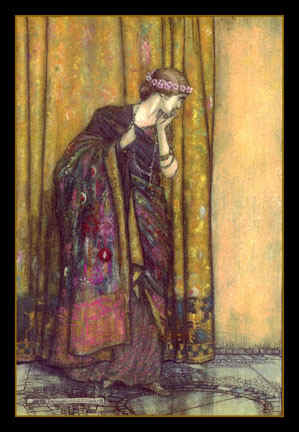
~Dierdre of the Sorrows copy.jpg (49196 bytes)

Pastel, Acrylics, and Colored Pencils combined

Snobbism in the arts is nothing new. Some people will tell you that oils are the only valid medium for realistic paintings. That Colored Pencil, Digital, and other Realistic Painting and Drawing Media are not valid for "real" art. Young artists, Don't let them bother you. Their forerunners used to condemn Pastels before they gained acceptance and called them "crayons" when Johann Alexander Thiele (1685-1752) invented them. Mercilessly disrespectful art critics of the time could not stop the Experimentalists no matter how viciously they attacked and derided them. "Crayon-painting" as it was called in England was practiced early on by persecuted pioneers in Switzerland and many other nations. What a debt we owe to these master artists who refused to knuckle under to the pressure of those short-sighted critics during those historic and experimental times. It took until 1870 with the founding of the "Societe` Des Pastellistes" in France that respect came at last to these heroic & immortal visual artists.

In England the liberation of the Pastellists from slight regard and undeserved disrespect came with the first exhibition of "The Pastel Society" at the Grosvenor Gallery in 1880. Pastel Painters like Mary Cassat and others from America and other nations forever silenced the snobs with their masterworks and gained recognition at long last for Thiele's invention as a valid art medium. I am persuaded that history will repeat itself. Like Pastels, I believe these wonderful new colored pencils and even Digital Realistic Art Media will one day receive the recognition they deserve as powerful mediums of artistic expression just as pastel paintings did. What is your definition of art? Have you thought about it?

Mine is: "anything that makes you feel or think."

Consider dancing... it can be a little skip in the step or rise to the level of the incomparable Russian Ballet. Did you know that just the materials alone for a single oil painting cost up to a thousand dollars these days? Even paying the artist less than minimum wage no one but the super rich can afford them anymore. Something's got to give. Realistic paintings in oil have been highly prized for centuries and the appeal and following of realistic art is undiminished to this day. Oil paintings featuring Abstract Art and Realistic Art are generally the most treasured form of all the visual art media and with good reason. But snobbish art critics favoring abstract art have declared that realistic paintings, or illustrations are not art for a century. With so many representationalist paintings by so many immortal master artists hanging in the Louvre, the Hermitage, and the British Museum and others I think the disrespect for realistic illustrators that dominated the 20th century is academically ridiculous as well as vain and intolerant, insisting theirs is the only valid opinion. What is your definition of Art? I believe almost any form of human expression can be raised to the level of "high art" especially visual art and Realistic illustration...

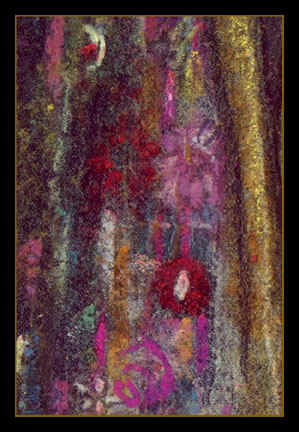
~Dierdre of the Sorrows detail.jpg (59016 bytes)

The detail reveals Realistic art and abstract art combined

By my own definition of art, which is: "anything that makes you feel or think" most abstract paintings are not "real art" to me personally, because abstract paintings usually neither make me feel or think, usually focusing obsessively on technique and avoiding any coherent content. I usually draw a complete blank mentally and emotionally when I look at them. In 1979 the Houston Metropolitan Museum of Art displayed a triptych of 3 giant paintings they paid fifty thousand dollars for- three blank white canvasses entitled "untitled". Then there was "The incredible new artistic Genius" with an I.Q. of 62 ...Congo the chimpanzee with his gala New York art exhibition...an elaborate prank played on the Snobbish American Art critics about a generation ago by research scientists in the field of primatology. Imagine how upset they were when he created one of his "ingenious masterpieces" right before their eyes.

( My Source for this is the Time Life Science Library volume entitled "The Primates". )

Art education has been almost completely removed from American Schools as a result of generations of this kind of fabulous nonsense contributing to America's cultural illiteracy crisis. Now, the works of Leonardo Da Vinci, Michaelangelo, and other notables are being removed from school libraries. After generations of this, most American college graduates today cannot name even one living visual artist, abstract or realistic.

There is no way that mandating more math, requiring more reading, or scheduling more science will replace what we have lost as a culture.

What is your definition of Art?

~HDJ

*****

Note: Abstract Paintings by Congo the Chimpanzee outsold Warhol and Renoir by over 25,000 dollars in June 2005 at a London art auction. Born in 1954, Congo created more than 400 drawings and paintings between the ages of two and four. He died in 1964 of tuberculosis. There is no precedent for this kind of sale.

The Rebirth of Realism

More thoughts on realistic art yesterday and today by the artist

Art History has entered a new era with the birth of Art Numérica, or digital art media in the 21st century. Artists never stop exploring with mediums. Artists have been developing techniques, experimenting with different tools since at least twenty- five thousand years ago, when the first artist picked up a charred stick and scratched a picture out on the wall of his cave. You'd think everything would have been tried by now, but it hasn't. Exploring new mediums this very day is just as exciting, just as full of freshness and newness as it ever was.

Photography, Drawing, Painting and Art Numérica combined

The creation of Realistic art has been the goal of most artists since the dawn of civilization. Realistic art was the pride of ancient Greece. The world's greatest museums are full of realistic art. Realistic art WAS art until the advent of the abstract expressionist movement in the twentieth century. The coming of the camera in the nineteenth century changed realistic art forever. Suddenly, realistic art was not the only way to create realism in portraits and historical records. The work of the realistic artist was suddenly made into an expensive luxury. The political power of the realistic artist was broken and they were no longer an indispensable member of society. Hostility to the creators of realistic art goes back to ancient times and the jealousy of advisers to the Pharaohs and others who were not able to spend as much time with their rulers as their portraitists. Although with the aid of photographs, realistic art achieved levels of excellence undreamed of, the realistic art movement of the late nineteenth century was short.
None of these people earning their living creating realistic art could compete with the speed and low cost of photographic portraiture. Determined to survive, great realistic artists like Pablo Picasso ingeniously turned inward and began to explore things that could not be photographed in a new school of art, abstract expressionism. The day of the fine art superstars had arrived. It was now largely just a hobby to abstract and realistic artists alike. Illustration, because of advances in printing technology enabled an elite few to earn a living with their realistic art. These illustrators working in realistic art media were condemned and ridiculed in much the same way Europe's great symphonic composers were condemned for working in motion pictures after fleeing the nazis during World War Two. The rift between realistic and abstract art grew wider and wider. The universities and key media usually sided with the abstract camp and derided anyone working in any realistic art media declaring boldly that realistic art was not "real" art. Immortal giants of realistic art such as Maxfield Parrish were mistreated their entire lives. They were accused of selling out for creating beautiful pieces of realistic fine art to earn a living. The attitude that the true artist must suffer and starve and die in poverty became a rule. There were the Abstract art superstars, the professional realistic illustrators, and the hobbyists who, although cut off from gainful employment and social influence still recognized their artistic gifts as a calling rather than a profession.

Early abstract art masters proved themselves as realistic artists before delving into realms of the intangible. They had to do this at that time to prove themselves because of the challenges they faced from the establishment for going against the status quo. In the latter part of the 20th century, realistic artists like HDJ were challenged to do abstract art to prove themselves as shown in the example above (Deirdre of the sorrows). Later realistic art training was abandoned in most schools and things like splattering paint in fits of rage were deemed more than enough. By the end of the 20th century something as destructive and ridiculous as nailing a pack of cigarettes to a shoe was considered fine art but not realistic paintings. Fashions in art have often been as silly as fashions in ladies hats. As the century drew to a close, many people had had enough. The realistic revolt was at hand. The rebirth of realism was fueled by the advent of the digital era. Now, for the first time in almost two centuries, an artist or illustrator could earn a decent living again with his realistic art. This is historic. Realistic art is not going to go away, especially now that photography has truly merged with traditional realistic visual art. Photography comes from the Greek words meaning "painting with light". Now with the advent of digital media the capability of realistic art has become almost limitless, truly, "painting with light". The merger of all the world's art forms to realize the potential of motion pictures has come now to still realistic art media. This website for example, combines music, prose, poetry, photography and traditional realistic art media to create an experience beyond merely looking at realistic paintings.

The twenty- first century is already seeing a new renaissance in the arts because of the world wide web. There has never been anything like it. Abstract art, computer art, photographic art, and realistic art are continuing to be separate schools of art but are also blending to create exciting new horizons. Although Digital art does offer completely new horizons to the artist in the 21st century it does not mean the end of our time honored art traditions. Instead, it offers additional ways to keep these traditions and schools of thought fresh and alive. ~ HDJ

*****

Thank You For Visiting the Norse Myths and Legends Art page of Howard David Johnson...

All images and text copyright 2008 Howard David Johnson . All rights reserved.

*****

Who is who in Nordic Mythology - Letter A

Fuente:

http://74.125.77.132/search?q=cache:ROB4OZ9WHGAJ:www.luth.se/luth/present/sweden/history/dictionary/lettera.shtml+Nordic+Mythology+site:luth.se/luth/&cd=2&hl=es&ct=clnk&gl=es&client=firefox-a

Información:
Esta es la versión en caché de http://www.luth.se/luth/present/sweden/history/dictionary/lettera.shtml de Google. Se trata de una captura de pantalla de la página tal como esta se mostraba el 5 Ago 2009 08:49:03 GMT. Es posible que la página haya sufrido modificaciones durante este tiempo. Más información

Se han resaltado estos términos de búsqueda: nordic mythology
LuleŒ University of Technology
home search contact us

A


Aarja

(See Nåjd). Lappish Schaman.

Abaskun

City at the caspian sea. Between 910-912 this city was plundered by vikings.

Abbon

French Monk who took part in the defence of Paris against a danish vikingfleet in 866. He has written about the event in his opus (written in latin) 'The battle of Paris'.

Achio

See Akio.

Ackja

The Swedish name on the special sleighs which the lappish people uses.

By the samish people the sleighs is called 'Pulka'. 'Kerres' or 'lökekk'. The 'Ackja' is a small sleigh with a pointed stem and cut-off stern. It has a keel instead of a runner. It is meant to be pulled by reindeers.

In some respects it looks like a boat on land...

Adaccar

See 'hamder'

Adalbert

Archbishop of Hamburg-Bremen. He rejected the offer to become a pope in 1047. Instead he wanted to build his own papacy (Separated from rome) consisting of the scandinavian and the german countries. The new papacy was supposed to have it's headquarter in Bremen.

His plans was hindered by the cardinal Hildebrand and death of King Henrik III in 1056. Adalbert was in war with the three nordic kings (Emund Gamle in sweden, Sven Estridsson in Denmark and Harald Hårdråde in Norway), who wanted to build their own papacys.

As the guardian of Henrik IV Adalbert was the sole ruler of the german-roman empire between 1063 -1066. He died in Goslar (a nice litle medieval town by the way) in 1072.

Adaldag

Archbishop of Hamburg Bremen between 937-988. He consecrated the first three bishops on Jylland, Denmark in 948. Harald in Slesvi, Lifdag i Ribe and rembrand in Århus. With the support of emperor Otto I Adaldal baptized Harald Gormsson Blåtand of Denmark byforce...

Adalsyssla

The estonian mainland, in contrast to Ösyssla (the island Ösel on the coast of estonia). In the 'ynglinga saga' (One of the icelandic sagas from the 8:th century) the estonians where named 'sysslans folk' (sysslas people). They where the ones who where supposed to have killed king Yngvar).

Adam of Bremen

Kanik and domscholastichus in Bremen. In 1070 he wrote down the history of Hamburg Bremen diocese in four books. In his books he describes the heathen traditions (with 'julblot', temples and all) and the Ansgars mission in Birka. He is supposed to have been helped by the swedish king Sven Estridsson in his work.

His work 'Gesta Hammaburgensis ecclesiae pontificium' deals with the time between 788-1072 and was first published in 1579 by Anders Sörensson Vendel (Denmark). He published his book from a handwritten manuscript which he found in Sorö, Denmark.

Adam of Bremen also made an important work in his atlas 'De situ Dania' which gives us a clue about what the people on the continent knew about the geography of the nordic countries.

Adelsö

A small island in Mälaren (a large lake in sweden, the Stockholm area). In the 8:th century this island was the home for the Munsö family. There are many ancient monuments left on this Island. Among the more important ones are the runestone located at Hovgården and the three big king barrows at the church. The ancient monuments have been researched by the archeologist Hanna Rydh.

Adils

King over Svearna, from the Skilfinga family. He was the son of Ottar Vendelkråka. Adils founded sweden in the form it has today as he met, and defeated, the king of Västergötland, Åle Opländske, on the ice of the lake Vänern (Swedens largest lake). This took place aproximately 550.

A. was married to Åsa of Venden which was the mother of the danish king Rolf Krake.

Aldils was famous for his excellent horses, one of the best was the charcoal black Hravn which he 'inherrited' from the deceased Åle Opländske...

Adils died, according to Snorre Sturlausson:s Heimskringla, while he was riding (ritually) around disarssalen in Uppsala. His horse stumbled and he fell off and crushed his scull against a stone. For a more (and more bloody) description of the event, please read the saga 'Ynglingatal'.

Adils is burried, According to Birger Nerman, under the biggest of the barrows at Old Uppsala (Torshögen). The barrow was examined (in an archaeological digging) in 1874 by B.E Hildebrand. He found the remains of a burnt body from aproximately 575. He found clothes with goldthread in the seams, combs and other usefull things. The body layed on a bear skin and at his feet he had two dogs (which probably was meant to lead him to Valhall).

Adogit

The people which is described by the roman writer Jordanes. He is probably writing about the lapish (or samish) people in his works.

Aescr

The Anglosaxian name on the rune which in the 24 character long futhark has the fourth position. Is usually called 'ass', 'ase' or 'os'. In the anglosaxian runalphabet this rune occupies the 26:th place and has another 'sound value'. An older name on the rune is probably 'askr' (which proable means 'ash').

Aethelred

1) Anglosaxian king of wessex and Kent in 866-871. He fought against the Danish vikings which invaded Mercia 867, and east anglia in 870. Ethelred defeated the vikings in the battle of Ashdown 870 but where in turn beaten the next year at Merton where he died of his wounds.

2) Aethelred the aimless. English king between 979-1016. He bought friendship with Olav Tryggvason between the years 991-994. But he fought Sven Tveskägg of Denmark in the same period.

In the year 1002 Aethelred commited the 'dana mord', an act where he killed all danes which had moved to England. When Sven was elected to english king in 1013 Athelred fled to normandy but he returned to England after Svens death in 1014 and died in London while Knut the great prepared his invasion of the city.

Aethelstan

Anglosaxian king, great son to Alfred the great. Aethelstan was elected to king of Mercia and Wessex in the year 925. The year after his election he forced his rule upon the danish vikings which lived in north umberland.

Aethelstan defetaed a strong coalition between scots, Nordic Vikings and brits in the battle of Brunanburh in the year 937.

It can be noted (of esoteric interest) that the famous poet Egil Skallagrimsson and his brother took part in this battle. Egils brother was killed in the battle.

Aethelwulf

Anglosaxian king of Wessex and Kent between 839-858. He fought during all his reign against the danish vikings which he defeated in the battle of Ockley, 851. The vikings returned in 855 and stayed for the winter for the first time in england.

Aggersborg

A viking stronghold located on Jylland, limfjorden. The stronghold consisted of 48 halls, distributed in 12 squares, all located within a big circular wall. The construction is the same as in the stronghold located in Trelleborg (Southern Sweden).

Agilmund

According to the tradition Agilmund was the son of the chief Akio in the end of the 2:nd century. He was elected king of the langobard people. According to Paulus Diaconus Agilmund ruled for 33 years. As he didnt get a son during his life he adopted one, Lamissio, to become A. sucessor.

Agnar

1) the Hreidgoterkings Hraudung oldest son. According to Grimnismal in the Edda A. was the ward of Frigg. He was driven out of Jotunheim by his own brother Geirröd whereafter G. became king.

2) King Geirröd Hraudungssons ten year old son which saved the god Odin (which called himself for Grimner) from the fires in his fathers hall by lowering a kettle from the smoke hole so that the god got a clear sky over his head. As a reward Agnar got the throne the same day.

3) A hero in the Edda, "Audas brother".

Agne

In the later part of the 3:rd century. The first king of the skilfinga family. He was king over the 'svea' people.

According to Snorre Sturlausson Agne took his wife, Skjalf, (with force) from Finland. But crime doesn't pay ;-) He was killed at the entrance to Mälaren (the big lake in the stockholm area).

Agund

Norwegian viking king in Dublin, Ireland. He was defeated 847 by king Cearbhall of Ossorg.

Agvald

Norwegian king (from ancient times). He is supoosed to have been defeated by king Varin and burried at Agdenäs. The god Odin told the story about agvald for Olav Tryggvason in th 9:th century.

Ahelmil

A people described by Jordanes. They are said to have lived in scandinavia ('Scandza'), south of the Svea people.

Aistier

A name on a Baltic people. Used from the 1:st century until the late 9:th century. First used by the roman, Tacitius. About the 10:th century the name was replaced with 'pruser'.

Akershus

Stronghold in Oslo. It was constructed in the 12:th century.

Akio

Paulus Diaconus 'latinization' of the nordic name 'Åke'. Together with his brother, Ibor, Akio was the leader of the langobardian peoples emmigration from Skåne in the 2:nd century.

Akkor

'Old Lady'. The word comes from the lappish word: 'Akka' which means grand mother. In the lappish peoples pre cristian era akka referred to the eight godesses: Madderaka, and her daughters, Sarakka, Uksakka, Juksakka. Jabmiakka, Rotakka, the godesses of the kingdom of death. Bergmoakka, the birds leader. Possjoakka, the ruler of the fireplace.

Akvitanien

For more than 1000 years this was the name of the south-west of france (between Loire and the pyrenees.

In romans times this land was populated with the keltiber people. In the 3:rd century the country was divided in three parts.

Nordic Vikings regularly invaded and plundered the country during the Viking era.

Alaner

Nomadic people i south-east Europe. In the 4:th century this people founded a state in the loire district. Later on they moved to Lusitanien.

Alarik

King of the visigothic people. Ruled in the late 3:rd century, and died 410.

He helped emperor Teodosius 394, and signed a treaty with Stilicho two years later and became an eastroman general (or rather, in swedish terms: fältherre).

401 he invaded north italy but he was beaten in 402. He signed a new treaty with Stilichos in 407. In 408 he was granted a large sum of money from the roman senat, but the emperor Honorius denied him his money.

As a result Alarik forced the romans to pay him a large ransom (he frettened to invade Rome). In 409 he dissmissed Honorius and appointed Attalus to the throne. Unfortunately for Attalus he refused to attack Africa whereupon he in turn was dismissed from the throne. As a further punishment Alarik plundered Rome for three days in 410, the same year he died.

Alboin

Founder of the Langobardian peoples state in Italy. He suceeded his father (Audoin) aproximately 560.

567 he beat the Gepidic people, he personally killed their king (Kunimund). Somewhat untactically he made a cup out of Kunimund:s skull, married his daughter (Rosimunda) and forced her to drink a toast from her fathers own scull.

Not surprisingly she wasn't that pleased and planned her revenge. She killed her husband in 572.

Before his death A. managed to found the langobardian state in north Italy, nowadays it's called lombardy.

Aldeigjuborg

Swedish viking stronghold between 830-1000. It is situated at the outlet of Ladoga in Volchov.

Aldhelm

Anglosaxian priest from the 6:th century. Related to the Wessex royal family. He was appointed archbishop of Sherborne in 705. He wrote in latin verse. He was at ease with greek and hebrew.

Ale(s) stenar

The worlds largest 'skeppsättning'. A 'skeppsättning' consists of individual large stones (like obelisks) raised in long rows formed after the characteristic form of a viking ship.

This particular monument is located at Kåsehuvud, Kåsebergaåsens highest point at Kåseberga fishing camp in the eastern part of Skånes south coast.

The monument is believed to be very old (allthough never exactly dated), probably built even before the 4:th century.

The monument consists of 47 large stones standing in the above described manner. The orientation of the 'ship' is north-west south-easst. The stem points straight out over the sea towards the outlet of the river Weichsels.

You can, in a way, call Ale stenar for the swedish version of Stonehenge. No one really knows when it was built or why. Many Archaeologist and historians have stated different theories about these large construction (it's 67 metres long and 21 metres wide).

One of the more plausible theories in later day states that the whole monument is (rather like Stonehenge) meant to be an astronomical clock. But no one really knows.

Some people thinks that the monument harbours magical powers, still others thinks of it as a temple for the Old Norse gods.

Alf

King of the Skilfinga family. Son to Alrek. He is supposed to have lived during the 4:th century first half.

Snorre Sturlauson tells us in Ynglingatal that Alf was 'taciturn, hungry for power and had few friends'. He is said to have stabbed his brother Yngve in an attack of jealosy when Yngve sat on the Throne together with Alfs consort (Bera). Before Yngve died he killed Alf with his sword and both of them died.

Alfgifa

Is said to have been a mistress to Knut. She is the mother to king Sven Alfgifasson who ruled over Norway from 1030.

Alfhild

According to Hervararsagan Alfhild was the name of Ivar Vidfamnes only child. Alfhild married king Valdar of Denmark and gave birth to Harald Hildetand of Denmark and Randver of Svitjod (which later became the father of Sigurd Ring).

Alfred the Great

King of Wessex between 871 and 900 (approximately). Alfred fought against the Vikings during his whole reign. He finally defeated the danes in Eddington (Aethsmdim) 878 and forced the danish king Guthrum to be baptized.

The danes nevertheless kept a large bit of the United kingdom (Danelagen). In 885 King Alfred managed to conquer London from the Danes.

Among his more cultural contributions one can mention the translation of Orosius world history to anglosaxian. He also included the norwegians Ottar and Wulfstans descriptions of their travels in the nordic waters.

Algeciras

A seaport at Guadalquivir i southern Spain. The city was occupied and burnt by the Viking leaders Hastings and Björn Järnsida in 859. He led a fleet of 62 ships.

Algir

The name of the 15:th rune in the germanic Futhark rune alphabet. In Gothic the rune has the name 'algs' and in the anglosaxian language: 'eolhx'. The name probably refers to 'Elk'.

The rune looks like:

which is supposed to be a stylized drawing of an Elk. As in many other cases this theory is one of many. Sigurd Agrell, a swedish scientis, thinks that this rune is supposed to have some thing to do with the twin gods Alhs. His grounds for this reasoning is the fact that Elks aren't mentioned in the swedish mythology. And since the futhark was given from the gods, why should they name a rune after an Elk?

Alhs

(Alci), twin gods which are, according to Tacitus, worshipped by the Nahanarvales germanic tribe in northern Germany.The word in it's self is suppsed to be connected to the word 'Elk', but this is not verified.

Alkuin

(Alcuinus; 735-804)

Northhumbrian (?) Noble man and one of the more learned men in his time. 766 he became director for the cathedral school of york. 781 he became the master of king Karl the great court school in Aachen. In 796 he becam abbot for S:t Martins monastary in Tours.

Alcuin depicted the first (large) Viking invasion in england, the raid against the monastery Lindisfarne in 793. He has also written bout the viking raids on the south west coast of france (akvitanien).

Alle

  1. Short for Alrek. Chief Alrek Olufsson, blotgode, in Uppsala. He is thought to be related to the Skilfinga king Alrek Afnason (mentioned on the Sparlösa rune stone in the county of Väster Götland, Sweden).
  2. According to göingsk (a swedish county) folklore Alle was the king of Bratte borg (a fortress which was believed to have sunk in the Ivö lake).

Allemanner

A germanic association of tribes. It is first mentioned in 211. The people was said to live somewhere between Main and Donau.

Allgrön

The Island where Odin, according to Harbardsljod, ravaged as a viking in five vinters together with Fjölvar. Among other feats he seduced seven girls.

Allsherjargode

Heathen priest which was the chief of all other priest in a country.

Allsvinn and Arvak

The two slender horses which pulls the suns wagoon across the sky during the day. As the sun is hot they are equipped with cooling devices 'isarnkol' located under their shoulders.

Alltinget

The highest court in Iceland. It was created in the 10:th century (930) and they gathered each year until 1800. The place where Thingvellir (where the author of this text broke his foot when he was running down a narrow path, not a pleasant memory), at the Thingvallasjön in the south west of Iceland. The gathering lasted for about two weeks.

The legislation work was carried out by a special workgroup 'lögrettan' where all the priests in the land took place. The group was headed by the 'lagsageman' which was elected for three years at a time. His responsibility was to lecture about the law, interpret it, present the agenda at the Gathering and, last but not least, present new laws.

Lögrettan also functioned as a court of law until 956 when this task was divided on several countys with three courts in each county (with the exception of the northcounty which had four). Each of this courts consisted of nine judges which was elected by the priests which maintained the role of 'supreme court'.

1004 it was time for yet another change in the legal system, this was the year when the 'femtedommen' was created. It was meant to be a sort of official supreme court.

The icelandic laws where not written laws from the beginning. The first written law, 'grågås', appeared in the 12:th century. Grågås was suceeded in 1271 by 'Järnsida' and this law in turn was suceeded by 'Jónsbók' in 1281.

'Femtedommen' was Iceland:s supreme court until 1593 a new court was established 'överrätten' (I have now runned out of english translations of different levels in the juridical system). Överrätten consisted of the danish ruler (Icleand where now danish), and 23 persons from Iceland.

In 1800 Alltinget ceased to exist (Denmark saw it as threat against the danish rule on the island). In 1843 it was resurrected in a new form. This time 26 members from Iceland (The rest came from Denmark) where to meet once every second year in Reykjavik. This new parliament consisted of two chambers with 12 and 24 members each.

Several large changes where carried out when Iceland separated from Denmark in 1918. The separation was fully done in 1940 when Germany invaded Denmark.

Allvis

The dwarf which was promissed to marry Trud (Thors Daughter) while Thor was away. Needless to say this wasn't a too popular decision for Thor.

Thor, which normally isn't depicted as a especially bright god (allthough strong, brave, and goodlooking he isn't that clever), now manage to deceive the dwarf to stay above ground until he is struck by sunlight. Thor does this by asking the dwarf thirteen questions about what different objects is called among the seven beings which exist in the world. With beings he is referring to: Humans, Asar (The old norse gods), alver, Giants, Helbor (The dead), Vanerna and ginnregin.

When the dwarf is struck by light he is immediately turned into stone.

Alver, alvs

The one who is aquinted with Tolkien knows that Alver are godlike creatures. There are two kinds of alver, light alver and dark alver. The light alv:s (I am not fully sure on the translation of the name on these beeings) lives in Alvheim in the third heaven (Vidblåin). The dark alv:s (or should I say black?) lives underground.

Alv:s has the same size as humans (they also looks like humans). In the saga 'Volundarkvida' the master smith Volund is called king of the alv:s by king Nidud. The sons of the dark Alv Ivalde made the ship Skidbladner for the giant Loke and the spear Gugner for Odin. They also made Siv:s golden hair.

Alvheim

  1. According to Snorre Sturlaussons Edda, the home of the light alv:s
  2. According to Grimnismal this is the name on the farm owned by the van Frey. The farm is located in Asgård.

Asar

Asar is the dominating family of gods in the prechristian era of the scandinavian countries. There is some debate over where this religion originated from. Something which is clear though is that the asa religion is probably older than the scandinavian people. The religion seems to have been 'imported' from the gothic people.

According to some historians the name 'asar' refers to the sculptures of the gods which the gothic people had. In those sculptures the gods where depicted with their usual special belongings (Odin has a spear, Tor his hammer and so on).

Allthough the 'asa' gods is longlived they are NOT immortal, they can be killed (but not easily). At the end of the heathen period the 'asa' gods where believed to have been a people from Asia which originated from 'Trojubourg' in Asia. Under the rule of Odin they settled down in 'Fyn' (Denmark) where they founded a new state in Sigtuna. According to some historians Odin led a small group of 12 gods with himself as number 13. But in the sagas they are said to have been 24 (I have listed them below). Odin was considered to be father of all Asar (with the exceptions of Njord, Frej, Tyr, Loke and Ull).

Allthough the above theory is interesting there are no hard evidence which supports it. Anyway the Asa gods where supposed to have been a ruthless people, bigger and more long lived than ordinary people.

A list of all known (At least to my knowledge) Asa gods:

Asar... Official Wife...
  1. Balder
  2. Brage
  3. Byggver
  4. Forsete
  5. Heimdal
  6. Hermod
  7. Hjuke
  8. Häner /Höner
  9. Höder
  10. Kvaser
  11. Loke
  12. Magne
  13. Meile
  14. Mimer
  15. Mode
  16. Odin /Od
  17. Tjalve
  18. Tor /Thor
  19. Tyr
  20. Ull
  21. Vidar
  22. Våle
  1. Nanna
  2. Idun
  3. Beyla
  4. -
  5. -
  6. -
  7. -
  8. -
  9. -
  10. -
  11. Sigyn
  12. -
  13. -
  14. -
  15. -
  16. Frigg
  17. -
  18. Siv
  19. -
  20. -
  21. -
  22. -

And finally also:

  1. Njord Tjatse
  2. Frej (Frey)

These last two gods are 'semi' Asar. See 'vaner' for further information.

Asciburgum

A. was a town at the river Rhen. It is mentioned by the Roman historian Tacitus as 'still existing' (Tacitus wrote his works in 100 ac). According to the legend, A. had been founded by Odysseus. In it's time A. was an important town for trade. Asberg, within the rheinland, and Aschaffenburg has been associated with this town. Modern research, however points out a small village at the river Rhen, straight across the town Duisburg.

Asgeir

A. was a viking chief which on the 12th of May 841 lead the danish viking fleet up the river Seine, Burnt Rouen and then managed to reach as far as Saint Dennis. Here he was forced to flee as the Frankish army neared.

Asgård

  1. Asgård the ancient. According to Prologus (by Snorre Sturluson, the Eddae) this name referes to Troy in TyrkLand (according to 'Ynglingasagan' situated in Asaheim, east of Tanakvisl /Don/ in Asia. From this ancient, and oldest, asgå, ODin was supposed to have come with his Asa Gods to Svitjiod.

  2. The new Asgård, founded by Odin in Svitjod "east", or "at lögen /Mälaren/, where it was to be called old Sigtuna".
  3. Asgård in Heaven or on a high mountain with rooms for all of the living beings. In this asgård twelve houses was supposed to exist: Tors Trudvång (with the hall Bilskirner), Ulls Ydalar, Frejs Alvheim, Våles Valaskjalf, Sågas Sökvabekk, Tjatjes Trymheim, Balders Breidablick, Heimdals Himingbjörg, Frejas folkvång (with the hall Sessrumner), Forsetes Glitner Njords Noatun and Vidars vide. The thirteenth room, Glansheim, was Odins home, with the Hall Valhall. In the center of Asgård (Glansheim), at the foot of the world tree (Ygdrasil), the gods had their court. Mimers well is also located here, as well as the two rivers Kormt and Ormt. There is also two bathing places here ("Karlögar"). The bridge Bifrost was used for transports between the earth (midgärd) and the heavenly Asgård. In late heathen times The rainbow was supposed to be the Bifrost bridge, in early heathen times this bridge was identified as the milky way. At the heavenly side the guardian god Heimdal had his place.

Ask (Ash)

From the beginning a word describing a tree of rgeat stature. The word could also be used to name the tree of the family Fraxinus. In normal old norse language it could also mean:

  • The first man (Askr and Embla, the old norse version of Adam and Eve)
  • A small box or container
  • A spear with a handle made of Ashe
  • A ship
  • A Warrior

Ask and Embla

The firts human pair, created by Odin, Häner and Lodur (Loke) from two pieces of wood which had drifted ashore. Embla means 'a small elm'. Odin gave them their breath, Häner gave them their wisdom and Lodur their language and blood ('colour of life'). More of this myth can be read in Voluspa.

Askold (Houml;skuld)

Old Varjager king in Kiev in Ruriks time. Askold was outsmarted by Ruriks son Oleg. A. Was killed by hanging (as was his fellow king Dir, Dyre) in 882. Kiev was then brought under the Holmgårds empire.

Aslög

Sigurd Faffnesbanes Daughter with Brynhild, begat on their first night in the Sköldborgen at Hindarfjäll. After the murder of Sigurd the girls is saved of her aunts husband, king Heimer in Hlymdalarna, which disguised as a harp player travelled through the world with the girl hidden in his harp. Later on she was adopted by Åke and Grimaat Spangarheid. Here she was fetched by Ragnar Lodbrok. She bore him several sons. All this time she kept her silence and thereby was thought to be mute, no one knew her real name and she was called "Lilla kraka" (The small crow). When Ragnar planned to wed a princess, she finally spoke and thereby revelaed her noble inherritage. She could thereafter get married to Ragnar.

Ass rune

The fourth rune in the Futhark. The soundvalue was "a", and the name meant "Asa gud" or in english: Asa god.

Alsvinn

The giant that (according to Havamal) taught the Giants the secret of rune writing. He was the first rune writing Giant.

Asynjor

  1. Frigg
  2. Beyla
  3. Gerd (Frey)
  4. Idun
  5. Nanna
  6. Sigyn
  7. Siv
  8. Skade (Njord)
  9. Freja
  10. Eir
  11. Sjovn
  12. Lovn
  13. Snotra
  14. Fulla
  15. Hlin
  16. Gnå
  17. Såga
  18. Gefion
  19. Rind
  20. Vår
  21. Var
  22. Syn
  23. Jord/Hlodyn/Fjörgyn
  24. Sol
  25. Bil

Atlakvida and Atlamal

A poem about king Atle Budlason (Atle). Atlakvida is gothis in appeareance and is one the oldest eddaes while Atlamal is comparably late, written in Greenland.

Atle

(From the poem 'Der nibelunge-notz' Etzel. A. was hard ans rutheless leader, brother to Brynhild and son of king Budle. As gjukungarna murdered Sigurd Fafnesbane (on Brynhilds advice) they are invited for feast by Atle. Atle is longing for the wealth which was robbed from Sigurd (The nibelungen Treasure). In spite of warning the brothers (Högne and Gunnar) goes to the feast. They are attacked, overpowered and killed. They manage to keep the location of the treasure secret. Atles wife (which happens to be sister to the deceased), Gudrun, gets a very bloody revenge. She kills her own sons and lets Atle eat their hearts whereafter she stabs him to death and set fire to the house (thereby burning Atle and all his men).

Attundaland

The second highest ranked land among Uppsala "folkland". Situtated east of the main land 'Tiundaland'. The name refers to the size of the land in the unit of 'Härader'. Mora äng is situated in Attundaland, the place where the swedish tradition had it that the swedish kings was elected. After the election (which was carried out at 'Mora Sten') they where then installed in Uppsala whereafter they started their Eriksgata through the country.

Aud Djupaudga

  1. According to 'Sögubrot af nökkurum fornkonungum' she was Ivar Vidfamnes daughter, married to Hrörek Slöngvanbaunge and mother to Harald Hildetand in Lejre.
  2. Historic person, daughter to Kettil Flatnäsa from sogn, king over the Hebrides. She was married to Olav Vite, viking king in Dublin between 853 - 871.

Audumla (ödhumbla)

The giant cow which eixtsed in the very beginning of time. It was supposed to have fed Mimer with the milk which she gave. She manages to create a human head form a salt stone by licking on it. After a while she had created a whole man, the first god, Bore.

Audun Västfjording

Hero in a short Icelandic Saga. In the saga he gives a polar bear to king Sven Estridsson of Denmark.

Aufnennung

The german term for the nordic naming scheme on children. A child was named after his grandfather, or some older relative. The idea behind this is simple, by giving the child an ancestors name it was belived that the ancestor to an extent could be reborn in the new child.

Augandzi

A west nordic people (at least it's thought so) which is mentioned by Jordanes as the second people of seven over which Roduulf was king.

Aun den gamle (Aun old)

A king from the Skilfinga family (from Uppsala). SOn to king Jorund. Aun ruled with several breaks through the latter part of the 4th century. According to the legend he sacrificed nine sons to Odin in order to live yet another decade for each son. When he got to his last son, Egil Tunnadolg, his son was rescued by the Svea people. Snorre Sturlusson tells the story in Ynglingasagan.

According to the tale Aun was supposed to have gotten so old and weak that he had to lay down at all time. The only food he could eat, or rather drink, was milk. Aun is (probably) burried in Old Uppsala in Odinshögen.

Aurboda

The wife of the giant Gymer. Mother to Bele.

Aurgelmer

One of the oldest giants. Grandfather to Bergelmer and either son of Ymer or a second name for Ymer. A. is mentioned in Vaftrudnismal.

Aurner

Name on an ancient Giant. Probably NOT Ymer, but possibly his son.

Aurvandil

A kind giant, also called 'the brave' and probably identified with the Orion constellation. Thor carried A. in his knapsack when he crossed the river Elivågor (the ice river). One A. toes frooze and was removed by Thor. The toe was then thrown to heaven where it became a star. The anglosaxons knew the star Earendel, and there exists a german poem about the prince, Orendel, who is rescued by a fisherman after haivng abandoned ship. According to the tale he gets a grey coat, once owned by Jesus, and clothed in this coat he manages to seduce the queens of Jerusalem and marry her. According to Saxo Grammaticus Aurvandil name is Horvendil and the father to Amleth (Which should be Hamlet).

Austrasien

The eastern part of the Frankish Empire (the germanic part). The western part of the Frankish empire was called Neustrien. The name really reffered to Ripuarien at the river rhen, and Salier between Maas and Silva Carbonaria.

Austre (östre

One of the four dwarfs which carries the firmament (which was creted from the scull of Ymer).

Avarer

Ural Altaiskt nomadic people from central asia considered to be related with the Hunns. Avarerna was froced to move from their origina habitat in 557 by a turkish people. A. attacked the Slavic people and Bulgarian people at lower Donau. The Avaric people was separated in to several clans whose chiefs followed the Chagan (the king). In 568 they crushed the Gepidic people together with the Langobards. The Avars was of great concerns for the east roman empire and it was not until Karl the great that they finally brooke their power.

Avioner

One of seven Nerthus worshipping people which are enumerated by Tacitus. According to C L Roth the A. people was supposed to have been living in Lauenburg ans southern Mecklenburg.

Last edited: Author: Editor: Stable:
Sunday, 04-Apr-1999 15:25:31 MET DST
Joakim Hansson
NONE
NO

Please send any comments/suggestions or bug reports to:

frazze@ludd.luth.se

Germanic Myths, Legends, and Sagas - Compiled by D. L. Ashliman

Fuente:

http://www.pitt.edu/~dash/mythlinks.html

Información:

Germanic Myths, Legends, and Sagas

The illustration on the right is a detail from a standing stone found on the Island of Gotland, Sweden. Click here to see the entire picture stone.


Compiled by

D. L. Ashliman

See also

Folklore and Mythology Electronic Texts


Germanic Geography

  • The Germanic world. Links to sites describing the history, geography, and culture of Germany, Switzerland, Austria, Scandinavia, the low countries, and England.


Germanic (Especially Old Norse) Mythology and Culture

Ancient Monuments

  • Dolmens in Denmark, a collection of photographs of pre-Christian stone graves and monuments.

  • Runestones and Picture Stones from Scandinavia: A Selection of Photographs.

  • The Sigurd Portal. Carved doorposts of the medieval stave church at Hylestad, Setesdal, Norway. Although part of a Christian church, the carvings represent scenes from the heathen story of Sigurd the dragon slayer.

  • The Sigurd Runestone at Ramsundsberget, Jäder, Södermanland, Sweden. This famous runestone illustrates the story of how Sigurd kills the dragon Fafnir and his treacherous companion Regin.

  • Stone Monuments, legends about ancient alters, graves, megaliths, menhirs, mounds, pictographs, runestones, picture stones, standing stones, and other such monuments from the past.

The Gods' Home Pages

The Vikings

  • Vikings in America. Information about the Norse settlement in Vinland, including photographs of the reconstructed way station at L'Anse aux Meadows, Newfoundland, Canada.

  • Viking Ship Home Page. Illustrations, stories, facts, and links concerning the ship culture of the Vikings.

  • When Vikings Rules the Seas. More about the Vikings, including the opportunity to purchase authentic scale models of their ships.

Electronic texts


Related Links

Germanic Mythology and Culture


Mythology and legendry in general


Fairy mythology


Folk and fairy tales


Return to the top of this document


Tabulation by WebCounter.

Revised September 27, 2004.

Vikings in America - edited by D. L. Ashliman University of Pittsburgh

Fuente:

http://www.pitt.edu/~dash/vinland.html

Información:

Vikings in America

edited by
D. L. Ashliman
University of Pittsburgh

According to Icelandic sagas written in the 12th and 13th centuries (but based on much earlier oral tradition), in about 985 Bjarni Herjolfsson, a Norse settler in Greenland, was blown off course and sighted a continent west of Greenland, but he did not go ashore. About 15 years later Leif Eriksson (son of Erik the Red) explored the new continent. For the next ten years a number of voyages were made from Greenland to the new land, which the Norsemen called "Vinland" because of the profusion of grapes that grew there.
Return to

The Way Station at L'Anse aux Meadows, Newfoundland

The following photographs are all courtesy of the Canadian National Parks Service.

General View of the Site

Artifacts Discovered at L'Anse aux Meadows

  • A copper alloy ring headed pin of Norse design. Greatly magnified. Pins such as these were used to close the outer garments of both men and women.

  • A soapstone spindle whorl of Norse design. These common household items, typically carved from soapstone, served as small flywheels on the spindles used for spinning yarn and thread.

  • A simple stone lamp. The carved indentation would hold animal fat and a wick.

  • Carved wooden pieces of unknown use. These pieces were likely some sort of ship fittings. There is evidence that a substantial amount of woodworking and carpentry was conducted at L'Anse aux Meadows during the Viking era.

  • A ship repair piece made from wood. Identical repair patches have been found in excavations of Norse Dublin.

Excavations and Reconstructed Buildings

  • Aerial view of three reconstructed buildings, surrounded by a fence. In the tradition of Iceland, buildings were constructed of sod over a wooden frame.

  • Another view of the above scene, showing the settlement as it would have appeared during the Viking era.

  • A close-up view of the fence, showing its woven construction (a technique still used in Scandinavia), with sod buildings in the background.

  • Another view of the above scene.

  • Excavation of the smithy. The existence of a smithy or furnace pit at L'Anse aux Meadows suggests that the location's most important function was that of a way station where Viking travelers could repair their ships and restock their supplies.

  • Reconstructed smithy, showing the facility as it would have appeared during the Viking era.

  • Interior of a reconstructed longhouse of Icelandic design.

  • Another view, showing a central fireplace, of the above longhouse interior. Norse longhouses were heated by central, open fires. The smoke escaped through one or more vents in the roof.


Poetry about Vikings in America

  • "The Skeleton in Armor" by Henry Wadsworth Longfellow. In this well known ballad, Longfellow creates a tale of ancient love and adventure around two New England artifacts of his day: a skeleton clad in corroded armor and the ruin of the Round Tower at Newport, then thought to have been built by the Vikings, a view not shared by twentieth-century scholars.

  • "The Norsemen" by John Greenleaf Whittier. A ballad prompted by the discovery, in the early nineteenth century, of the fragment of a statue held to be a relic from the Norsemen in New England.


The Vinland Map

  • Vinlanda: The Vinland Map on the Web. Tim Spalding's excellent study and collection of sites dealing with a document purporting to be a 15th-century map depicting North America. Despite intensive scrutiny, scholars are not united as to whether this map is a genuine pre-Columbian document, or a very clever forgery.


North American Runestones

Examine the following sites, then decide for yourself: Are the North American runestones authentic artifacts from Viking explorers, or are they elaborate frauds by Scandinavian-Americans?

Additional Links


Revised August 27, 2002.