sábado, 8 de agosto de 2009

Carnival of the Etymologies

Fuente:

http://vernondent.blogspot.com/2005/10/carnival-of-etymologies_13.html

Información:

Thursday, October 13, 2005

Carnival of the Etymologies

Special Supersized Halloween Edition

Halloween is a mid-18th century Scottish shortening of Allhallow-even, the "Eve of All Saints," which was the last night of October. Hallowmas as the name for All-Saints Day is first attested in 1389. The Christian calendar day Halloween corresponds to the last night of the year in the old Celtic calendar, where it was Old Year's Night, a night for witches. Thus it is another example of a pagan holiday given a cursory baptism during the Dark Ages conversions and sent on its way.

The hallow in this word is Old English halgian "to make holy, to honor as holy," which of course is related to halig, the ancestor of modern holy. It was the word used in Christian translations to render Latin sanctificare. The group of words goes back to an ancient root, *kailo-, meaning "whole, uninjured, of good omen," which also produced health (Old English hælþ), heal (Old English hælan), and whole (Old English hal).


Mischief Nights in 19th century England were the eve of May Day and of Nov. 5, both major holidays, and perhaps the original point was pilfering for the next day's celebration and bonfire; but in Yorkshire, Scotland, and Ireland the night for mischief was Halloween.

Mischief originally came into English (c.1300) meaning "evil condition, misfortune, need, want." Its source is Old French meschief (Modern French méchef), a verbal noun from meschever "come or bring to grief, be unfortunate" (literally the opposite of achieve), which is formed from mes- "badly" and chever "happen," literally "come to a head," ultimately from Latin caput "head."

The meaning "harm or evil considered as the work of some agent or due to some cause" is attested from 1480; and the softened sense of "playful malice" first is recorded in 1784.

The useful Middle English verb mischieve has, for some reason, fallen from currency.


The phrase trick-or-treat is recorded only from 1947, though obviously the customs of dressing up in costumes, and of making food offerings, around this time of year have roots deep in historical and pagan practice.

Candy, on the other hand, was one of the first Asian words to be borrowed into English. It first is attested in a document from 1274, and the immediate source of the borrowing was Old French sucre candi "sugar candy." This word, from the time of the Crusades, was a Frenchified form of Arabic qandi, which itself was borrowed from Persian qand "cane sugar," whicch in turn probably came from Sanskrit khanda "piece (of sugar)." The Sanskrit word itself may have been a borrowing from an earlier Dravidian language of India, since it bears a similarity to Tamil kantu "candy," kattu "to harden, condense."


Jack o'lantern is attested from 1663, a local name for a Will-o-the-wisp (Latin ignis fatuus), the flickering lights sometimes seen over marshes at night. The Jack o'lantern personification is mainly attested in East Anglia but also in southwestern England. The extension to carved pumpkins is first recorded in 1837, in the U.S.

Pumpkin is a 17th century alteration of earlier pumpion "melon, pumpkin," a word known since 1545 (Shakespeare used it in "Merry Wives of Windsor").

Evidently the French encountered pumpkins in their exploration of the New World, gave them a French name that means roughly "large melon," and the word passed from French to English. The word is Middle French pompon, which comes from Latin peponem "melon," which the Romans borrowed from Greek pepon "melon." This probably originally meant "cooked by the sun, ripe," since it seems to be related to the Greek verb peptein "to cook."

Thus the name of the American Halloween pumpkin comes from the language of Socrates and Homer, who never met the thing.

The first record of pumpkin-pie is from 1654. In the time of the American Revolution, when long hair for men was the fashion, pumpkin-head was colloquial for "person with hair cut short all around."


Skeleton was a medical word originally (our non-medical ancestors likely would have referred to it simply as "bones"). It first was used in English around 1578, adopted from Medical Latin sceleton, which in turn was taken from Greek skeleton soma "dried-up body, mummy." The root of this is the verb skellein "to dry up" (source also of sclerosis), from the Proto-Indo-European base *skele- "to parch, whither."

The Greek word had been borrowed into Late Latin as sceletus, which was the direct source of French squelette, Spanish esqueleto, and Italian scheletro.

The meaning "bare outline" is first recorded for skeleton in 1607. This is somewhat obscure now, but it is preserved in the phrases skeleton crew (1778) and skeleton key. The phrase skeleton in the closet meaning "source of secret shame to a person or family" was popularized in 1845 by Thackeray, though he likely didn't coin it.


Ghost is easily recognizable in Old English gast, which meant "soul, spirit, life, breath." It comes from the reconstructed Proto-Germanic root *ghoizdoz, which provided the general word for "supernatural being" across the range of the West Germanic language group (cf. Old Saxon gest, Old Frisian jest, Middle Dutch gheest, German Geist "spirit, ghost").

The surviving senses from Old English, however, are in Christian writing, where the word is used to render Latin spiritus, a sense preserved in Holy Ghost. But comparison with the other German languages makes it clear that the English word, too, certainly originally had a sense more macabre than theological.

In fact, the source of the Germanic words seems to be the Proto-Indo-European base *ghois- "to be excited, frightened" (cf. Sanskrit hedah "wrath;" Avestan zaesha- "horrible, frightful;" Gothic usgaisjan, Old English gæstan "to frighten").

Thus the modern English ghost in the sense of "disembodied spirit of a dead person" (attested from c.1385) returns the word toward its ancient sense.

The gh- spelling was used in works printed by William Caxton, the first English printer, who set up his business in Flanders, then the center of the nascent printing industry, and was influenced by Flemish and Middle Dutch gheest. But this spelling did not become common in English until after c.1550.

Most Indo-European words for "soul, spirit" also double as the word for "supernatural spirit." Many have a base sense of "appearance" (e.g. Greek phantasma; French spectre; Polish widmo, from Old Church Slavonic videti "to see;" and Old English scin, Old High German giskin, originally "appearance, apparition," related to O.E. scinan, Old High German skinan "to shine").

Other "supernatural spirit" concepts are found in French revenant, literally "returning" (from the other world), and Old Norse aptr-ganga, literally "back-comer."

Breton bugelnoz is literally "night-child." Latin manes, literally "the good ones," is a euphemism, a result of Roman superstition against even saying the word for "ghost."

Just as skeleton came to mean "bare outline," ghost in the early 17th century acquired a metaphoric sense of "slight suggestion" (preserved in ghost image, ghost of a chance, etc.). The sense in ghost writing is attested from 1884, but that exact term is not found until 1927.


Witch belongs here, too. I already did that one, but it's fun, so let's do it again.

Witch is Old English wicce "female magician, sorceress," in later use especially "a woman supposed to have dealings with the devil or evil spirits and to be able by their cooperation to perform supernatural acts."

English used to be a fully inflected language, with genders like German or Latin, and wicce is the feminine form of wicca "sorcerer, wizard, man who practices witchcraft or magic."

The nouns all come from the verb wiccian "to practice witchcraft," which has relatives in Low German. But the exact origin of it is lost in the murk of history.

The Oxford English Dictionary simply dismisses it as of uncertain origin. Ernest Klein's etymology dictionary suggests a connection with Old English wigle "divination," and wig, wih "idol."

Calvert Watkins, another noted modern etymology writer, suggests the nouns represent a Proto-Germanic *wikkjaz "necromancer," and thinks this may mean literally "one who wakes the dead." He bases this on the notion that the root of the word is Proto-Indo-European *weg- "to be strong, be lively" (the root of wake (v.) and vigil).

The early 20th century English etymologist Ernest Weekly notes a possible connection to Gothic weihs "holy" and German weihan "consecrate," and writes, "the priests of a suppressed religion naturally become magicians to its successors or opponents."

That wicce once had a more specific sense than the later general one of "female magician, sorceress" perhaps is suggested by the presence of other words in Anglo-Saxon describing more specific kinds of magical craft. In the Laws of Ælfred (c.890), for instance, witchcraft was specifically singled out as a woman's craft, whose practitioners were not to be suffered to live among the West Saxons:

"Ða fæmnan þe gewuniað onfon gealdorcræftigan & scinlæcan & wiccan, ne læt þu ða libban."

The other two words combined with it here are gealdricge, a woman who practices "incantations," and scinlæce "female wizard, woman magician," from a root meaning "phantom, evil spirit."

Another word that appears in the Anglo-Saxon laws is lyblæca "wizard, sorcerer," but with suggestions of skill in the use of drugs, since the root of the word is lybb "drug, poison, charm." Lybbestre was a feminine noun meaning "sorceress," and lybcorn was the name of a certain medicinal seed (perhaps wild saffron).

In Anglo-Saxon glossaries, wicca renders Latin augur (c.1100), and wicce stands for "pythoness, divinatricem." One glossary translates Latin necromantia ("demonum invocatio") with galdre, wiccecræft.

But the Anglo-Saxon poem called "Men's Crafts" has wiccræft, which appears to be the same word, and by its context means "skill with horses." And in a c.1250 translation of "Exodus," witches is used as a word for the Egyptian midwives who save the newborn sons of the Hebrews: "Ðe wicches hidden hem for-ðan, Biforen pharaun nolden he ben."

If witch once had a narrower meaning, after the Christian conquest it acquired a much broader one. "At this day," Reginald Scot wrote in "The Discoverie of Witchcraft" (1584), "it is indifferent to say in the English tongue, 'she is a witch,' or 'she is a wise woman.' "


The word bat meaning "flying rodent" is a strange 16th century dialect alteration of Middle English bakke, which probably is related to Scandinavian words like Old Swedish natbakka and Old Danish nathbakkæ, both meaning "night bat," and Old Norse leðrblaka, literally "leather flapper." So the original sense of bat likely is "flapper," and the word may have been somehow imitative of the sound of flapping wings. The shift from -k- to -t- may have come through confusion with the extinct Middle English bakke "nocturnal insect," which derives from Latin blatta "moth."

Given the Scandinavian connections, bat likely is one of the words the Vikings brought to England which displaced the local word. The Anglo-Saxon word for the animal was hreremus, literally "shaky mouse," from hreran "to shake." That's closer to the German fledermaus.


Goblin is a mystery word. It turns up in English about 1327, and it seems pretty clear that it comes from Old French gobelin, but there the trail goes cold. The French word is known from the 12th century, as Gobelinus, the name of a spirit haunting the region of Evreux.

Perhaps the word is related to German kobold "goblin," a compound formed from Middle High German kobe "hut, shed" and *holt "goblin." The second term in this was a euphemism (like Latin manes, under ghost, above), from hold "gracious, friendly." Complimentary words were used to avoid the wrath of troublesome beings.

Harz Mountains silver miners used kobold as their term for rock laced with arsenic and sulphur (so called probably because it made them ill). A metal was extracted from this rock, and identified in the 18th century as an element. It was given the name cobalt.

But it's just as possible that gobelin comes from Medieval Latin cabalus, from Greek kobalos "rogue, knave," kobaloi "wicked spirits invoked by rogues." Yet another suggestion is that it is a diminutive of the proper name Gobel.


Haunt is another Middle English word from French, in this case from Old French hanter "to frequent, resort to, be familiar with." Most of French is from Latin, but French, like English, has a body of words from Old Norse, brought over by the Vikings who settled extensively in Normandy and elsewhere in the Dark Ages.

Thus hanter probably comes from Old Norse heimta "bring home," from the Germanic root of home. The sense is of a spirit returning to the house where it had lived.

The verb originally was not limited to supernatural presences, and it could be applied to living beings, too (a sense preserved in the noun haunts "place or places one frequents"). But the ghostly sense probably was present in ancient Germanic, and its modern use was reinforced by Shakespeare's plays, where it is first recorded in "A Midsummer Night's Dream" (1590).

By coincidence, the Old English verb formed from the word for "home" was hæman, which evolved from "to bring home" to "take home as a sexual partner, co-habit with."

ICELAND - THE VIKINGS

Fuente:

http://www.nat.is/travelguideeng/icelandic_vikings.htm

Información:

ICELAND - THE VIKINGS
.

The word Viking is a collective designation of Nordic peoples, Danes, Swedes, Norwegians and Icelanders, who ranged abroad during a period of dynamic Scandinavian expansion in the Middle Ages, from about AD 800 to 1100. Called the Viking Age, the period has long been popularly associated with unbridled piracy, when freebooters came swarming out of the northlands in their predatory long ships to burn and pillage their way across civilized Europe. This, however, is now recognized as a gross simplification. Modern scholarship emphasizes the achievements of the Viking Age in terms of Scandinavian art and craftsmanship, marine technology, exploration, and the development of commerce, the Vikings as traders, not raiders.

Extension of Viking Activities. The derivation of the word “Viking” is disputed. t may be from Old Norse
vik (a bay or creek) or Old English wic (a fortified trade settlement). Not every Scandinavian, however, was a professional warrior or a Viking, and not every Viking was a pirate. The motive causes of Viking Age expansion are complex. Land shortage in Scandinavia, improved iron production, and the need for new markets probably all played a part.

The first recorded Viking raid was a sea borne assault (793) by Norwegian marauders on the holy island of Lindisfarne, just off the northeastern coast of England. Growing evidence indicates, however, that considerable overseas Viking migration, west across the North Sea and east across the Baltic, occurred long before that. Swedish entrepreneurs penetrated the hinterland of Russia, pioneering new trade routes down the Volga and the Dnepr, founding city-states such as Kiev and Novgorod, and opening the way to Constantinople and the exotic markets of Arabia and the Far East. In Constantinople, Vikings formed the elite bodyguard of the Byzantine emperors, the feared and famous Varangian Guard. Danish warriors hammered at the cities of the crumbling Carolingian Empire, Hamburg, Dorestad, Rouen, Paris, Nantes, Bordeaux, until one of the armies in 911 accepted by treaty huge tracts of land in northern France (now known as Normandy, “Land of the Northmen”) and settled there.

Briefly, under King Canute (Knut) II in the 11th century, a Scandinavian empire of the North Sea was established, comprising England, Denmark, and Norway. Norwegian adventurers joined Danish Vikings in subjugating much of northern England (the Danelaw) before settling there as farmers and traders and developing great mercantile cities such as York, while gradually extending their settlement into unconquered northern areas such as Cumbria. They also took over the Northern Isles of Scotland (Shetland and the Orkneys), the Hebrides, and much of mainland Scotland as well. In Ireland they played a lusty part in the internecine squabbles of rival Irish clans, and they founded Ireland’s first trading towns: Dublin, Waterford, Wexford, Wicklow, and Limerick. Viking exploration brought the discovery and settlement of uninhabited lands in the Atlantic—first the Faroes, then Iceland, then Greenland. From Greenland the Vikings launched ambitious expeditions to settle on the eastern seaboard of North America (Vinland), but these attempts to colonize the New World 500 years before Columbus were soon abandoned in the face of hostility from the indigenous peoples. Stories of the abortive American venture are recorded in the medieval Icelandic sagas; but little authentic evidence of the Viking presence has been found, apart from substantial traces of a Viking Age settlement at L’Anse-aux-Meadows, in northern Newfoundland. All other Viking “finds”, such as the Kensington Stone, have been exposed as forgeries or hoaxes, or merely wishful thinking.

Lasting Influences. The impact of the Vikings was less enduring than might have been expected. In general, they had a great capacity for being assimilated into local populations. In some areas of Britain, especially in Cumbria and other locations where settlements were established in previously unpopulated land, concentrations of Norse and Danish place names are the most notable residue of their presence. A century and a half after settling in Normandy, however, their Franco-Viking descendants were strong enough to conquer England (1066) and Sicily (1060-1090). The settlers brought to the British Isles energetic Viking art forms, new farming techniques, mercantile acumen, and a vigorous language; Scandinavian traces are still apparent in the dialects of Scotland and northern England. They introduced new forms of administration and justice, such as the jury system; even the word “law” is from an Old Norse word. Perhaps the most enduring legacy of the Viking Age is to be found in Iceland, which produced the great medieval literature of the sagas.

In their time, the Vikings had criss-crossed half the world in their open boats and vastly extended its horizons. Having achieved that, however, they had neither the manpower nor the staying power, neither the reserves of wealth nor the political experience, neither the cohesion at home nor the confidence abroad to master effectively the older, richer, more stable states they tried to overrun. Their dynamism was gradually exhausted, and even their swift, magnificent ships were superseded—replaced by much larger, more prosaic vessels better suited to bulk cargo carrying.


Víkingaheimar
Fitjum
260 Reykjanesbaer
Ytri-Njardvik
Tel.: 422-2000
info@vikingaheimar.com

Vikingaheimar is open everyday from 11:00 to 18:00

Maritime Museum / Boat Models / Art Museum Reykjanesbaer
Duus hus, Duusgata 230 Reykjanesbaer
Tel: 421-6700 / 421-3155


save

Vikings : The Middle Ages . net

Fuente:

http://www.themiddleages.net/people/vikings.html

Información:

Vikings

vikingsThe term Viking commonly denotes the ship-born warriors and traders of Norsemen (literally, men from the north) who originated in Scandinavia and raided the coasts of Britain, Ireland and mainland Europe as far east as the Volga River in Russia from the late 8th–11th century. This period (generally dated 793–1066) is often referred to as the Viking Age. The term Viking has also denoted entire populations of Viking Age Scandinavia and their settlements, as an expanded meaning.
Famed for their longships, Vikings founded settlements for three centuries along the coasts and rivers of mainland Europe, Ireland, Great Britain, Normandy, the Shetland, Orkney, and Faroe Islands, Iceland, Greenland, Newfoundland circa 1000.[1] They reached south to North Africa and east to Russia and Constantinople, as looters, traders, or mercenaries. Vikings under Leif Ericson, heir to Erik the Red, reached North America, with putative expeditions to present-day Canada, Maine and Southeastern Massachusetts, Including Cape cod in the 10th century. Viking voyages decreased with the introduction of Christianity to Scandinavia in the late 10th and 11th century.
The word Viking was introduced to the English language with romantic connotations in the 18th century. However, etymologists trace the word to Anglo-Frankish writers, who referred to "víkingr" as one who set about to raid and pillage,[2] as in the saga of Egil Skallagrimsson. In current Scandinavian languages, the term Viking is applied to the people who went away on Viking expeditions, be it for raiding or trading. In English and many other languages, Viking might refer to the Viking Age Scandinavians in general.[3] The pre-Christian Scandinavian population is also referred to as Norse, although that term is properly applied to the whole civilization of Old-Norse speaking people.

Ships

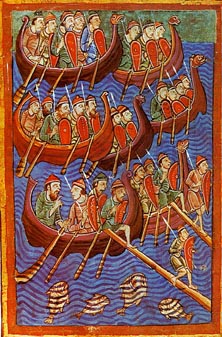
There were two distinct classes of Viking ships: the longship (sometimes erroneously called "drakkar", a corruption of "dragon" in Norse) and the knarr. The longship, intended for warfare and exploration, was designed for speed and agility, and were equipped with oars to complement the sail as well as making it able to navigate independently of the wind. The longship had a long and narrow hull, as well as a shallow draft, in order to facilitate landings and troop deployments in shallow water. The knarr, on the other hand, was a slower merchant vessel with a greater cargo capacity than the longship. It was designed with a short and broad hull, and a deep draft. It also lacked the oars of the longship.
Longships were used extensively by the Leidang, the Scandinavian defense fleets. The term "Viking ships" has entered common usage, however, possibly because of its romantic associations (discussed below).
In Roskilde are the well-preserved remains of five ships, excavated from nearby Roskilde Fjord in the late 1960s. The ships were scuttled there in the 11th century to block a navigation channel, thus protecting the city, which was then the Danish capital, from seaborne assault. These five ships represent the two distinct classes of the Viking Ships, the longship and the knarr.
Longships are not to be confused with longboats.

Heathenry - Yawiki.org

Fuente:

http://yawiki.org/proc/Heathenry

Información:

Heathenry is one of several modern revivals of historical Germanic paganism. Heathenry is the term used by many adherents of Germanic neopaganism, especially in the UK.


Heathenry
Overview
Heathenry and reconstruction
Practices and discourses (what Heathens do and say)
Worldview and discourse
Runic magic
Galdr
Seidr
Web resources relevant to Heathenry in Britain
Other sources

top

Overview
While some practitioners use the term Heathenry as equivalent to Paganism, others use it much more specifically. It is used by those who are re-creating the old religion and worldview from the literary and archaeological sources, who describe themselves as "Heathen" in part to distinguish themselves from other pagans whose rituals come from other sources. Some North Americans use Heathenism with a similar intent.

Heathenry differs from Ásatrú in North America in being generally more rooted in the landscape (Blain, 2002a, Harvey 2006 forthcoming) and in this may possibly be more akin to Ásatrú in Iceland and similar religious expression in Scandinavia. Heathenry draws on ideas of a living landscape, close to some expressed by indigenous religions elsewhere. Heathenry, therefore, for many adherents, is about creating a connection between humans and landscape, through the acknowledgement of land- and other wights, ancestors (spiritual and cultural, not necessarily physical) and other beings; it is therefore an animist religion drawing on (for instance) the Old English healing charms, the Icelandic Eddas and Sagas, and folklore elements in creating a religion from today from these and other resources.Shamanic or shamanistic elements are evident and practitioners may use seid and galdr, or shamanistic magic and sung magic, in rituals.

Heathenry relates to both the practices and worldviews of Heathens and to the practitioners - thus Heathenry can mean people who are Heathen, or what they do. In general, Heathens consider that people are called to the religion, perhaps by the gods or by the landscape, regardless of their ethnic origins. In this sense, Heathens are new-indigenes (Blain and Wallis, 2002).

top

Heathenry and reconstruction
Heathenry is often described as polytheistic reconstructionism. Not all Heathens agree with this - saying that their goal is to create religious practice and personal empowerment for today, rather than to imitate or re-enact past rituals. Basically, such construction or reconstruction works from the principle that earlier documents or artefacts (from literature or archaeology) hold clues to religious or spiritual practice and relationships with deities or spirits, and in particular to world-views or religious philosophies. These practices and worldviews and relationships can be used or adopted meaningfully within today's world, with practitioners concerned to locate practices, deities, etc, within culture and time, and to be able to point to some documentation or other justification for what they do.

The deities of Heathenry are those of Anglo-Saxon religion and of Norse Mythology - see list of Norse gods. Some British Heathens may also honour one or more Brythonic or Gaelic deities of Celtic Mythology. As with other polytheist religions, it is quite common for individuals to owe personal allegiance to a small number of deities while also recognising and honouring many others. In North America there is also Theodism or Þéodisc Geléafa ("tribal belief") which started out as a form of Germanic Neopaganism which sought to reconstruct the beliefs and practices of the Anglo-Saxon tribes which settled in England. þéodisc is the adjective of þéod "people, tribe", cognate to deutsch.

top

Practices and discourses (what Heathens do and say)
Many of the ritual forms of blót - making an offering - and sumble (or symbel)- a ritual of toasting - are discussed under Asatru. Indeed these forms generally serve to separate Germanic/Nordic religion from other pagan and neo-pagan practices. Heathenry is defined, however, as much by worldview and discourse as by specific rituals. The following list is given by Blain (2006, based on 2002a) for this article, from her ethnographic work with today's Heathens, of understandings or discourses of Heathenry that shape what Heathens do.

For more informationon blots, see the Book of Blotar.

top

Worldview and discourse
The following list is given by Blain (2006, based on 2002a) for this article, from her ethnographic work with today's Heathens, of understandings or discourses of Heathenry that shape what Heathens do.

  1. references to myths and stories of the Aesir and Vanir - ‘the lore’, found in the Eddas and Sagas and some other mediaeval writings. Heathens will make reference to particular stories or poems, and explain to others where these can be found.


  2. polytheism: a sense of gods or wights as discrete individuals, each with 'their own agendas'. That is, Heathens do not usually consider that different goddesses are 'aspects' of each other, but particular individual beings who can be spoken to.

  3. cultural specificity or locatedness of myths or deities and ways of approaching these, including ritual forms (sparsely described in the lore). This means that the stories and poems – the understanding of the goddesses and gods and of the earth – have come from a particular period in history and particular places in the world. In a sense, the telling of the poetry and stories is rooted in culture and place.

  4. the possibility of direct communication with deities or wights – not only can be spoken to but they will often speak back.

  5. the possibility of manipulation of consciousness or ‘reality’ by the wights or deities, or through magic inspired by them: including galdr or sung spells, runic magic, and seidr or 'shamanistic' magic.

  6. a sense that spirituality is not separate from everyday life, but informs it. For instance, Heathens will talk about their gardening, how they are raising their children, their voluntary work in the community, or how they deal with people at their workplace, linking these to examples in 'the lore'.

  7. a sense of individual merit and responsibility, combined with community worth. In particular ideas about fair play, taking responsibility for one's own actions, honouring the motives and actions of others, are seen to come from 'the lore'.

  8. an elaborate concept of 'soul' and 'self’, personal ørlög, and overall Wyrd. People's personal destinies are shaped in part by what is past, in part by what they and others are now doing, by the vows they take and contracts they enter into.

  9. the Elder Kin (i.e. deities of Northern Europe) and other wights also are subject to the workings of Wyrd (Blain 2006, available http://ebooks.abc-clio.com).


For most Heathens, Heathenry is part of daily life. While Heathen ritual practices vary from the construction of elaborate blots or seid-rituals, to a daily communing with wights or deities, it seems to be worldview that most matters. Therefore, Heathens do not necessarily see 'magic' as an important or central constituent of their personal practice: but, as polytheists and, often, animists, the possibility of magic exists, and magical specialists form part of the Heathen community in the UK.

Heathens meeting in small groups on a regular (monthly, quarterly) basis will often refer to this as their blót. Offerings during a blot usually involve mead or other alcohol, sometimes food, sometimes song or poetry, specially written for the occasion or for a particular deity, is delivered as an offering. Rituals of blot (most Heathens in Britain will omit the Icelandic accented 'o') may be designed or even scripted for the occasion or may be spontaneous. Usual dress for a blot is whatever suits the seasons - many blots are outdoors, sometimes at sacred sites. Some Heathens will wear clothing reminiscent of Anglo-Saxon or Norse 'Viking' times, especially if the blot is open to the public or part of a larger pagan event (camps, conferences, etc.) Heathens who are also involved in reenactment are most likely to do this.

There is no single Heathen calendar of sacred days on which to make blot, and different groups or organisations celebrate their own festivals or sacred days as they see fit or as the season dictates: thus Winternights, for the end of summer and coming of winter, may be celebrated from early October to mid November in different areas of the UK. The festival most commonly celebrated is Yule, often over 12 days from the evening before winter solstice until New Year.

top

Runic magic
Many British Heathens use the runes of the Common Germanic Futhark (24 runes), others use Anglo-Saxon Futhorcs with from five to nine 'extra' runes, up to 33 in the case of the Northumbrian Futhorc, and a few, particularly Scottish Heathens, may also use the Scandinavian and Icelandic Younger Futharks. (The names Futhark and Futhorc relate to the sound of the first six 'letters' and the difference in spelling addresses a difference in sound arising over time and place.) Rune magic may involve galdr singing of rune names, carving taufr (charms), or drawing runes in the air or on materials, in addition to using runes on small slips for divination. Many Heathens use runes in some of their work, drawing runes for personal guidance or engraving their own ritual objects or indeed household items. However some heathens are known as rune specialists and others seek them out for teaching or for 'readings'.

top

Galdr
Galdr, already mentioned, may refer to chanted runes, but often refers to sung 'spells' of some kind. These include both 'new' poems and chants, and those from parts of the Eddas or from the Old English healing charms, such as the Nine Herbs Charm. Galdr-singers have many different ways to shape or craft their songs, and these may be combined with, for example, seid.

top

Seidr
Seid (Old Norse: seiðr, sometimes anglicized as "seidhr", "seidh", "seidr", "seithr" or "seith") and Spae (Old Norse: spá) may be seen as forms of "sorcery" or "witchcraft" related to shamanism elsewhere. Seid and/or spae may be constituted as community practices, the best known of which is 'Oracular Seidr', i.e. ritual performed to gain knowledge, in which a seeress or seer, in an altered consciousness, speaks prophecy. Oracular Seidr is constructed differently in the UK, the US and elsewhere. US constructions (often including guided meditation, etc) are more formalised: in the UK, a community seid for knowledge is more likely to be related to contact with Landwights and local deities, with a ritual that is less formally prescribed (see Blain, 2002a). The singing of participants provides energy for the seeing and speaking of the seer, and in some UK practices this singing may be the only ritualised part of proceedings.

Seidr is however a term used for other purposes, including working alone or in company for healing (Blain, 2002b), protection, and for developing links with land and ancestors. It may be related - in past and present - to alterations of consciousness and negotiations with otherworld beings. Many British practitioners see this work as related to indigenous 'shamanic' practices dating back to the Iron and Bronze ages of Northern Europe, and potentially further. Other obvious links for seidr as ‘shamanic’ practice are with Sámi shamanism (Dubois 1999, Price 2002), (the Sámi being the nomadic reindeer-herding people indigenous to the north of Scandinavia and western Russia.)

Various practitioners such as 'Runic John' have recently written about their experiences with Seidr, Runes and Galdr, and the recent book by Johnson and Wallis (2005) explores in detail how one group in the south of England has developed its own ways of working with these techniques and traditions.

top

Web resources relevant to Heathenry in Britain


top

Other sources

    Heithni comes from the Old Norse word heiðni.
    Brasil
      http://br.geocities.com/visgothbr/visigoalian.html Aliança da Águia Visigoda América
      http://br.geocities.com/visgothbr/apresentacao.html O Clã Falkar
    Mexico
      http://www.angelfire.com/folk/sagradofuego/ HERMANDAD ODINISTA DEL FUEGO SAGRADO MEXICO Alianza del Águila Visigoda América
      http://odinismovisigodo.blogspot.com/ Alianza del Águila Visigoda América

Webs de Referencia (75) :: Vikings :: Their World & Gods

Una excelente fuente de información, muy bien organizada.

Enlace:

http://www.angelfire.com/realm/shades/vikings/titlepage.htm