Fuente:
http://vernondent.blogspot.com/2005/10/carnival-of-etymologies_13.htmlInformación:
Carnival of the Etymologies
Special Supersized Halloween EditionHalloween is a mid-18th century Scottish shortening of
Allhallow-even, the "Eve of All Saints," which was the last night of October.
Hallowmas as the name for All-Saints Day is first attested in 1389. The Christian calendar day Halloween corresponds to the last night of the year in the old Celtic calendar, where it was
Old Year's Night, a night for witches. Thus it is another example of a pagan holiday given a cursory baptism during the Dark Ages conversions and sent on its way.
The
hallow in this word is Old English
halgian "to make holy, to honor as holy," which of course is related to
halig, the ancestor of modern
holy. It was the word used in Christian translations to render Latin
sanctificare. The group of words goes back to an ancient root,
*kailo-, meaning "whole, uninjured, of good omen," which also produced
health (Old English
hælþ),
heal (Old English
hælan), and
whole (Old English
hal).
Mischief Nights in 19th century England were the eve of May Day and of Nov. 5, both major holidays, and perhaps the original point was pilfering for the next day's celebration and bonfire; but in Yorkshire, Scotland, and Ireland the night for mischief was Halloween.
Mischief originally came into English (c.1300) meaning "evil condition, misfortune, need, want." Its source is Old French
meschief (Modern French
méchef), a verbal noun from
meschever "come or bring to grief, be unfortunate" (literally the opposite of
achieve), which is formed from
mes- "badly" and
chever "happen," literally "come to a head," ultimately from Latin
caput "head."
The meaning "harm or evil considered as the work of some agent or due to some cause" is attested from 1480; and the softened sense of "playful malice" first is recorded in 1784.
The useful Middle English verb
mischieve has, for some reason, fallen from currency.
The phrase
trick-or-treat is recorded only from 1947, though obviously the customs of dressing up in costumes, and of making food offerings, around this time of year have roots deep in historical and pagan practice.
Candy, on the other hand, was one of the first Asian words to be borrowed into English. It first is attested in a document from 1274, and the immediate source of the borrowing was Old French
sucre candi "sugar candy." This word, from the time of the Crusades, was a Frenchified form of Arabic
qandi, which itself was borrowed from Persian
qand "cane sugar," whicch in turn probably came from Sanskrit
khanda "piece (of sugar)." The Sanskrit word itself may have been a borrowing from an earlier Dravidian language of India, since it bears a similarity to Tamil
kantu "candy,"
kattu "to harden, condense."
Jack o'lantern is attested from 1663, a local name for a
Will-o-the-wisp (Latin
ignis fatuus), the flickering lights sometimes seen over marshes at night. The
Jack o'lantern personification is mainly attested in East Anglia but also in southwestern England. The extension to carved pumpkins is first recorded in 1837, in the U.S.
Pumpkin is a 17th century alteration of earlier
pumpion "melon, pumpkin," a word known since 1545 (Shakespeare used it in "Merry Wives of Windsor").
Evidently the French encountered pumpkins in their exploration of the New World, gave them a French name that means roughly "large melon," and the word passed from French to English. The word is Middle French
pompon, which comes from Latin
peponem "melon," which the Romans borrowed from Greek
pepon "melon." This probably originally meant "cooked by the sun, ripe," since it seems to be related to the Greek verb
peptein "to cook."
Thus the name of the American Halloween pumpkin comes from the language of Socrates and Homer, who never met the thing.
The first record of
pumpkin-pie is from 1654. In the time of the American Revolution, when long hair for men was the fashion,
pumpkin-head was colloquial for "person with hair cut short all around."
Skeleton was a medical word originally (our non-medical ancestors likely would have referred to it simply as "bones"). It first was used in English around 1578, adopted from Medical Latin
sceleton, which in turn was taken from Greek
skeleton soma "dried-up body, mummy." The root of this is the verb
skellein "to dry up" (source also of
sclerosis), from the Proto-Indo-European base
*skele- "to parch, whither."
The Greek word had been borrowed into Late Latin as
sceletus, which was the direct source of French
squelette, Spanish
esqueleto, and Italian
scheletro.
The meaning "bare outline" is first recorded for
skeleton in 1607. This is somewhat obscure now, but it is preserved in the phrases
skeleton crew (1778) and
skeleton key. The phrase
skeleton in the closet meaning "source of secret shame to a person or family" was popularized in 1845 by Thackeray, though he likely didn't coin it.
Ghost is easily recognizable in Old English
gast, which meant "soul, spirit, life, breath." It comes from the reconstructed Proto-Germanic root
*ghoizdoz, which provided the general word for "supernatural being" across the range of the West Germanic language group (cf. Old Saxon
gest, Old Frisian
jest, Middle Dutch
gheest, German
Geist "spirit, ghost").
The surviving senses from Old English, however, are in Christian writing, where the word is used to render Latin
spiritus, a sense preserved in
Holy Ghost. But comparison with the other German languages makes it clear that the English word, too, certainly originally had a sense more macabre than theological.
In fact, the source of the Germanic words seems to be the Proto-Indo-European base
*ghois- "to be excited, frightened" (cf. Sanskrit
hedah "wrath;" Avestan
zaesha- "horrible, frightful;" Gothic
usgaisjan, Old English
gæstan "to frighten").
Thus the modern English
ghost in the sense of "disembodied spirit of a dead person" (attested from c.1385) returns the word toward its ancient sense.
The
gh- spelling was used in works printed by William Caxton, the first English printer, who set up his business in Flanders, then the center of the nascent printing industry, and was influenced by Flemish and Middle Dutch
gheest. But this spelling did not become common in English until after c.1550.
Most Indo-European words for "soul, spirit" also double as the word for "supernatural spirit." Many have a base sense of "appearance" (e.g. Greek
phantasma; French
spectre; Polish
widmo, from Old Church Slavonic
videti "to see;" and Old English
scin, Old High German
giskin, originally "appearance, apparition," related to O.E.
scinan, Old High German
skinan "to shine").
Other "supernatural spirit" concepts are found in French
revenant, literally "returning" (from the other world), and Old Norse
aptr-ganga, literally "back-comer."
Breton
bugelnoz is literally "night-child." Latin
manes, literally "the good ones," is a euphemism, a result of Roman superstition against even saying the word for "ghost."
Just as
skeleton came to mean "bare outline,"
ghost in the early 17th century acquired a metaphoric sense of "slight suggestion" (preserved in
ghost image, ghost of a chance, etc.). The sense in
ghost writing is attested from 1884, but that exact term is not found until 1927.
Witch belongs here, too.
I already did that one, but it's fun, so let's do it again.
Witch is Old English
wicce "female magician, sorceress," in later use especially "a woman supposed to have dealings with the devil or evil spirits and to be able by their cooperation to perform supernatural acts."
English used to be a fully inflected language, with genders like German or Latin, and
wicce is the feminine form of
wicca "sorcerer, wizard, man who practices witchcraft or magic."
The nouns all come from the verb
wiccian "to practice witchcraft," which has relatives in Low German. But the exact origin of it is lost in the murk of history.
The Oxford English Dictionary simply dismisses it as of uncertain origin. Ernest Klein's etymology dictionary suggests a connection with Old English
wigle "divination," and
wig, wih "idol."
Calvert Watkins, another noted modern etymology writer, suggests the nouns represent a Proto-Germanic
*wikkjaz "necromancer," and thinks this may mean literally "one who wakes the dead." He bases this on the notion that the root of the word is Proto-Indo-European
*weg- "to be strong, be lively" (the root of
wake (v.) and
vigil).
The early 20th century English etymologist Ernest Weekly notes a possible connection to Gothic
weihs "holy" and German
weihan "consecrate," and writes, "the priests of a suppressed religion naturally become magicians to its successors or opponents."
That
wicce once had a more specific sense than the later general one of "female magician, sorceress" perhaps is suggested by the presence of other words in Anglo-Saxon describing more specific kinds of magical craft. In the Laws of Ælfred (c.890), for instance, witchcraft was specifically singled out as a woman's craft, whose practitioners were not to be suffered to live among the West Saxons:
"Ða fæmnan þe gewuniað onfon gealdorcræftigan & scinlæcan & wiccan, ne læt þu ða libban."
The other two words combined with it here are
gealdricge, a woman who practices "incantations," and
scinlæce "female wizard, woman magician," from a root meaning "phantom, evil spirit."
Another word that appears in the Anglo-Saxon laws is
lyblæca "wizard, sorcerer," but with suggestions of skill in the use of drugs, since the root of the word is
lybb "drug, poison, charm."
Lybbestre was a feminine noun meaning "sorceress," and
lybcorn was the name of a certain medicinal seed (perhaps wild saffron).
In Anglo-Saxon glossaries,
wicca renders Latin
augur (c.1100), and
wicce stands for "pythoness,
divinatricem." One glossary translates Latin
necromantia ("demonum invocatio") with
galdre, wiccecræft.
But the Anglo-Saxon poem called "Men's Crafts" has
wiccræft, which appears to be the same word, and by its context means "skill with horses." And in a c.1250 translation of "Exodus,"
witches is used as a word for the Egyptian midwives who save the newborn sons of the Hebrews: "Ðe wicches hidden hem for-ðan, Biforen pharaun nolden he ben."
If
witch once had a narrower meaning, after the Christian conquest it acquired a much broader one. "At this day," Reginald Scot wrote in "The Discoverie of Witchcraft" (1584), "it is indifferent to say in the English tongue, 'she is a witch,' or 'she is a wise woman.' "
The word
bat meaning "flying rodent" is a strange 16th century dialect alteration of Middle English
bakke, which probably is related to Scandinavian words like Old Swedish
natbakka and Old Danish
nathbakkæ, both meaning "night bat," and Old Norse
leðrblaka, literally "leather flapper." So the original sense of
bat likely is "flapper," and the word may have been somehow imitative of the sound of flapping wings. The shift from -k- to -t- may have come through confusion with the extinct Middle English
bakke "nocturnal insect," which derives from Latin
blatta "moth."
Given the Scandinavian connections,
bat likely is one of the words the Vikings brought to England which displaced the local word. The Anglo-Saxon word for the animal was
hreremus, literally "shaky mouse," from
hreran "to shake." That's closer to the German
fledermaus.
Goblin is a mystery word. It turns up in English about 1327, and it seems pretty clear that it comes from Old French
gobelin, but there the trail goes cold. The French word is known from the 12th century, as
Gobelinus, the name of a spirit haunting the region of Evreux.
Perhaps the word is related to German
kobold "goblin," a compound formed from Middle High German
kobe "hut, shed" and
*holt "goblin." The second term in this was a euphemism (like Latin
manes, under
ghost, above), from
hold "gracious, friendly." Complimentary words were used to avoid the wrath of troublesome beings.
Harz Mountains silver miners used
kobold as their term for rock laced with arsenic and sulphur (so called probably because it made them ill). A metal was extracted from this rock, and identified in the 18th century as an element. It was given the name
cobalt.But it's just as possible that
gobelin comes from Medieval Latin
cabalus, from Greek
kobalos "rogue, knave,"
kobaloi "wicked spirits invoked by rogues." Yet another suggestion is that it is a diminutive of the proper name
Gobel.
Haunt is another Middle English word from French, in this case from Old French
hanter "to frequent, resort to, be familiar with." Most of French is from Latin, but French, like English, has a body of words from Old Norse, brought over by the Vikings who settled extensively in Normandy and elsewhere in the Dark Ages.
Thus
hanter probably comes from Old Norse
heimta "bring home," from the Germanic root of
home. The sense is of a spirit returning to the house where it had lived.
The verb originally was not limited to supernatural presences, and it could be applied to living beings, too (a sense preserved in the noun
haunts "place or places one frequents"). But the ghostly sense probably was present in ancient Germanic, and its modern use was reinforced by Shakespeare's plays, where it is first recorded in "A Midsummer Night's Dream" (1590).
By coincidence, the Old English verb formed from the word for "home" was
hæman, which evolved from "to bring home" to "take home as a sexual partner, co-habit with."
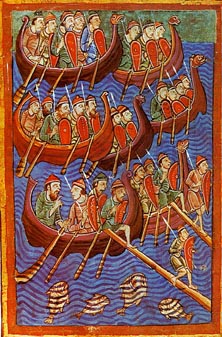 The term Viking commonly denotes the ship-born warriors and traders of Norsemen (literally, men from the north) who originated in Scandinavia and raided the coasts of Britain, Ireland and mainland Europe as far east as the Volga River in Russia from the late 8th–11th century. This period (generally dated 793–1066) is often referred to as the Viking Age. The term Viking has also denoted entire populations of Viking Age Scandinavia and their settlements, as an expanded meaning.


 Entradas








